SEO Content Ecosystems for High-Trust Businesses
Your Website Is Not a Brochure. It Is Either a Trust Engine or a Decorative Liability.
Most lawyers, doctors, therapists, and private practice owners have a website that looks respectable enough to avoid embarrassment. The logo sits there. The headshot smiles politely. The service pages describe the work. A contact button exists somewhere, probably hiding near the top-right corner like it owes someone money.
Then the business owner checks reality. Google traffic is thin. The blog gets a few visits from mysterious cities. The service pages rank beneath competitors with weaker experience, thinner credentials, and websites that look like they were assembled during a thunderstorm. The owner wonders the obvious question: why are we invisible when we are actually good?
That question is the entire problem. High-trust businesses do not sell impulse buys. Someone looking for a therapist, attorney, physician, surgeon, specialist, accountant, consultant, or serious local professional is usually making a decision with consequences. They are anxious, confused, embarrassed, hurting, overwhelmed, skeptical, or quietly comparing five options at 11:43 p.m. while pretending they are “just researching.” Humanity remains very normal and emotionally efficient, as always.
For these buyers, ranking on Google is only the first gate. Trust is the second. Clarity is the third. Conversion is the fourth. A random 700-word blog post titled “Five Tips for Better Wellness” is not going to carry that journey on its tiny little shoulders. It may technically be content, the way a microwave burrito is technically dinner.
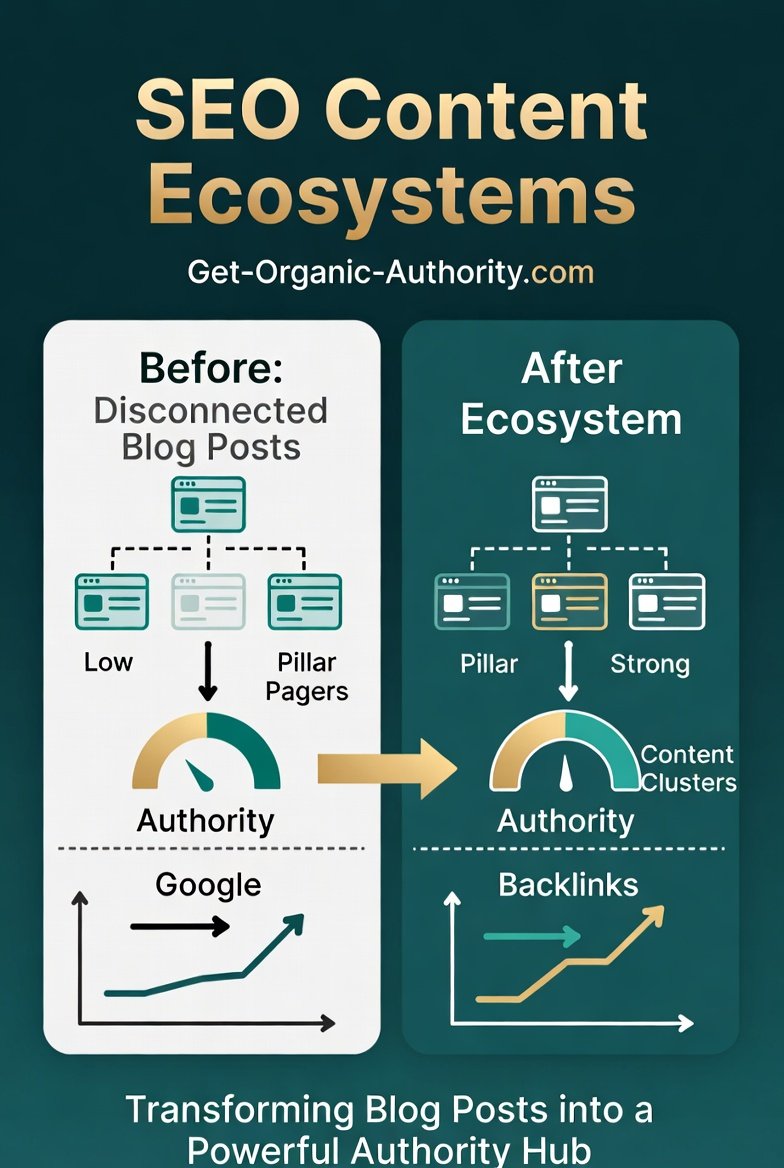
High-trust professional service businesses need something stronger: an SEO content ecosystem.
An SEO content ecosystem is a connected structure of homepage messaging, service pages, pillar pages, supporting blog articles, local content, internal links, reviews, Google Business Profile signals, author credibility, FAQs, and conversion paths. Each page has a job. Each article supports a larger topic. Each internal link moves the reader somewhere useful. Each section helps Google understand what the business deserves to rank for and helps the human visitor feel safer taking the next step.
That is the difference between publishing content and building authority. Publishing content says, “Here is another blog.” Building authority says, “Here is a complete body of useful answers around the problems our best clients actually search for.”
Google’s own guidance says its ranking systems are designed to prioritize helpful, reliable, people-first content rather than content created mainly to manipulate search rankings. Its self-assessment questions ask whether content provides original information, comprehensive coverage, and analysis beyond the obvious. In other words, Google is politely begging the internet to stop producing padded nonsense with keywords sprinkled on top like lawn fertilizer.Google Search Central explains this directly here.
For lawyers, doctors, therapists, and private practices, that standard matters more because the reader is not choosing a novelty mug. They are choosing someone to trust with their body, money, marriage, child, injury, diagnosis, trauma, business, freedom, or future. That kind of decision demands depth. It demands specificity. It demands a website that behaves less like a digital flyer and more like a guided explanation.
This is exactly where Get Organic Authority separates itself from generic SEO agencies, cheap blog mills, and AI content farms. The goal is not to flood your site with “SEO articles” that sound like a blender full of LinkedIn posts. The goal is to build a structured organic authority system around your services, your expertise, your local market, your search intent, and your buyer’s emotional reality.
A cheap SEO agency usually asks, “What keywords can we rank for?” A smarter organic authority strategy asks better questions. What does your ideal client search before they know the name of your service? What page should answer that search? What service page should the article support? What trust signal does the reader need next? What internal link helps them move from confusion to confidence? What proof makes the business feel credible before the first call?
That shift sounds simple. It is not. It is the difference between a website with a blog and a website with a nervous system.
The numbers make the trust problem even more obvious. BrightLocal’s 2026 Local Consumer Review Survey reports that 97% of consumers read reviews for local businesses, and the average consumer uses six different review sites when choosing businesses. Reviews, AI tools, Google, Facebook, Healthgrades, BBB, and niche platforms all shape the trust picture now. Your website sits inside that larger decision web, which is deeply annoying for anyone hoping one pretty homepage would solve everything.BrightLocal’s 2026 survey breaks this down here.
For medical practices, Software Advice found that 90% of surveyed patients use online reviews to evaluate physicians, and 71% use online reviews as the first step to finding a new doctor. That means many patients are not waiting until they know you. They are evaluating you before your practice ever hears their name. Lovely. A first impression now has tabs open.Software Advice’s patient review research is here.
A professional service website has to meet that behavior. It has to explain. It has to reassure. It has to organize expertise into pages Google and humans can follow. This is why a content ecosystem matters. One article can rank. One service page can convert. One review can reassure. But a connected ecosystem compounds all of those signals together.
If your website already has decent service pages but little supporting content, The Organic SEO Authority Blueprint gives you one strong long-form pillar article built around your core service, niche, or audience. It creates the frame for a larger content system. If you are ready to build momentum month after month, The Foundation turns that strategy into 10 long-form SEO articles each month, built into topic clusters, internal links, long-tail keywords, and authority-building structure.
The point is simple. Your business does not need more random blogs. It needs a content ecosystem that proves you understand the problem better than anyone else in the room.
How a Content Ecosystem Actually Works
A content ecosystem starts with the pages that matter most: homepage, service pages, location pages, and conversion pages. These are the pages where money, appointments, consultations, and actual business outcomes live. A therapist may need pages for trauma therapy, anxiety therapy, EMDR, couples counseling, and therapy in a specific city. A law firm may need practice area pages for workers’ compensation, personal injury, criminal defense, SSD, family law, or estate planning. A doctor may need pages for conditions, treatments, provider bios, accepted insurance, specialties, and appointment scheduling. A local professional service firm may need service-area pages, pricing explainers, comparison pages, and trust-heavy FAQs.
Those pages are the bones. The content ecosystem adds muscle, connective tissue, blood flow, and a brain. Preferably a better brain than the one that told someone to publish “What Is SEO?” for the 9 millionth time.
The first layer is search intent. Search intent means the reason behind the keyword. A person searching “therapist near me” is in a different state of mind than a person searching “why do I shut down during conflict.” A person searching “workers comp lawyer Richmond” is closer to hiring than someone searching “what happens if my workers comp claim was denied.” A person searching “knee pain when walking upstairs” may need education first, while a person searching “orthopedic doctor appointment near me” may be ready to book.
This is why the page must match the person behind the keyword. Get Organic Authority already has a supporting article on search intent for service businesses, and this pillar should link to it because search intent is the control panel for the whole strategy. Informational searches need helpful articles. Commercial searches need comparison pages or service explainers. Local high-intent searches need service pages, city pages, Google Business Profile optimization, and clean conversion paths.
Topical Authority: Why it is important
The second layer is topical authority. Topical authority means your website has enough depth around a subject that search engines and readers can understand your expertise. You are not claiming authority in one lonely article. You are demonstrating it across connected pages.
For example, a therapist who wants to rank for trauma therapy should not rely on one trauma therapy service page and a prayer candle. The ecosystem could include a trauma therapy service page, a trauma therapy pillar article, supporting articles on emotional numbness, childhood trauma in adult relationships, trauma responses, EMDR questions, somatic symptoms, shame, triggers, dissociation, attachment wounds, and how therapy helps. Each article should connect back to the core trauma therapy service page and related pages.
A law firm building authority around workers’ compensation might need a main workers’ comp lawyer service page, city pages, a pillar guide on workplace injury claims, and supporting blogs on denied claims, medical evidence, settlements, wage loss, employer retaliation, independent medical exams, deadlines, mistakes after injury, and comparison-style content like “workers comp lawyer vs handling the claim alone.”
A medical practice building authority around knee pain treatment might need a knee pain service page, orthopedic provider bios, a treatment guide, and supporting articles on pain going upstairs, swelling, meniscus injuries, arthritis symptoms, physical therapy, imaging, injections, surgery options, recovery timelines, and when to see a specialist.
Notice the pattern. The website becomes a map of the buyer’s concerns. That is topical authority with a pulse. It also makes the business feel more credible because the reader sees the practice understand their actual questions, not just the polished brochure version of the service.
The third layer is pillar pages. A pillar page is the central, broad, useful page that anchors a topic. Supporting blogs point to it. It points back to them. Service pages connect to it when relevant. The pillar becomes the hub of a subject area. Get Organic Authority’s article on how to build a topic cluster for a service business website already explains that hub-and-spoke model. This article should serve as a higher-level hub for the entire content ecosystem concept.
A strong pillar page usually answers the broad question in a way that feels complete without trying to swallow the entire internet. It explains the issue, defines the strategy, gives examples, connects the supporting pages, and invites the reader toward a next step. A supporting blog can go narrow. A pillar page holds the architecture.
Internal Linking
The fourth layer is internal linking. Internal links are the little roads between pages. Without them, your site becomes a neighborhood where every house has been built with no streets. Interesting choice, terrible commute.
Google’s link best practices explain that links help Google discover pages and that descriptive anchor text helps both users and Google understand the linked page. That matters because high-trust service websites often have pages that need support from related content. Service pages should not sit alone. Supporting articles should point readers toward the page that solves the problem. Pillar pages should collect and distribute relevance. Related posts should connect when they answer the next logical question.Google’s link best practices are here.
Get Organic Authority’s internal linking article says the quiet part well: internal links turn isolated content into a connected ecosystem. That article should be a required internal link from this pillar because it gives the practical mechanics behind the system.Read the internal linking guide here.
A good internal link plan starts before writing. Every article should have a job. Does it support a service page? Does it support a pillar? Does it explain a problem that leads naturally toward a consultation? Does it answer an early-stage question and then guide the reader to a deeper resource? Random linking after publication is how websites become spaghetti. Strategic linking before writing is how websites become authority systems.
The fifth layer is trust-building content. This is where high-trust SEO breaks away from ordinary SEO. Ranking for a keyword is nice. Having the reader believe you are safe, competent, relevant, and worth contacting is the real win. Search visibility without trust is just a more efficient way to disappoint strangers.
Trust-building content includes practitioner bios, author credentials, thoughtful FAQs, explanations of process, pricing transparency where appropriate, before-and-after educational examples, ethical disclaimers, review integration, case-style stories, patient or client concerns, and clear next steps. For doctors and therapists, trust also means careful language. For lawyers, it means clarity without reckless guarantees. For financial, legal, and medical topics, content has to respect the seriousness of the decision.
Google’s guidance around AI-generated content makes a useful point: success in Search comes from original, high-quality, people-first content demonstrating E-E-A-T qualities, regardless of how content is produced. That is especially important now because AI content farms can produce endless bland articles. Endless blandness is still blandness. It just arrives faster and makes everyone slightly worse at reading.Google’s AI content guidance is here.
Generic AI content fails high-trust businesses because it usually has no lived experience, no market insight, no service understanding, no emotional nuance, and no strategic internal linking plan. It can define “topical authority” with the confidence of a substitute teacher holding the wrong textbook. What it usually cannot do is understand why a trauma client searches in fragments, why a patient reads reviews before booking, why a law firm prospect needs reassurance before calling, or why a private practice website needs language that feels warm without sounding like lavender-scented fog.
A content ecosystem works differently because every piece is designed around business purpose. The homepage explains the big promise. Service pages convert high-intent searchers. Pillar pages build broad authority. Supporting articles capture long-tail questions. Internal links connect the journey. Reviews and trust signals reduce hesitation. CTAs give the reader a clean next step. Google Business Profile supports local discovery. The blog stops being a drawer full of articles and becomes a guided path from search to trust to action.
Google Business Profile matters because many high-trust services are local. Google says Business Profiles help companies appear on Search and Maps, manage reviews, share services, enable booking, and give customers information before they call. For service businesses, Google specifically highlights booking, quote requests, service areas, and review-based trust signals.Google Business Profile features are described here.
But a Google Business Profile alone is not a strategy. It is a doorway. The website still needs rooms worth entering. If someone finds your profile, sees the reviews, clicks your website, and lands on shallow content, the trust leaks out. If they land on a page that answers their exact concern, links to a deeper guide, shows credentials, explains the service, and gives a clean CTA, the experience feels different. It feels like competence. A shocking concept.
This is why Get Organic Authority uses dogfooding. The site is not just selling the strategy. It is demonstrating the strategy. The blog already includes articles on topic clusters, internal linking, search intent, local SEO, therapist SEO, doctor SEO, law firm SEO, and the Trust Gap. This pillar ties those pieces together and becomes another proof point: the brand is building the same ecosystem it recommends for clients.
That matters because many SEO agencies talk in abstractions. They promise rankings. They flash dashboards. They send reports full of graphs shaped like regret. But high-trust professional service businesses need more than reporting. They need an actual content architecture.
Here is what that architecture can look like in practice.
For a law firm, the ecosystem may start with practice area pages: personal injury lawyer, workers’ compensation lawyer, criminal defense lawyer, estate planning attorney. Each page gets supporting articles based on the way real prospects search: “how long does a settlement take,” “what if the insurance company denies my claim,” “can I be fired after filing workers comp,” “what happens after an arrest,” “how much does a lawyer cost.” Those supporting pieces link back to the appropriate service page and across to related explainers. The firm also creates trust content around attorney bios, case approach, consultation expectations, reviews, FAQs, and local authority. An article like How Law Firms Turn Google Traffic Into Consultations belongs inside that cluster.
For a doctor or medical practice, the ecosystem may start with treatment pages, provider pages, location pages, and condition pages. Supporting articles answer symptom searches and patient concerns: “when should I see a doctor for knee pain,” “what causes numbness in hands,” “how long does recovery take after surgery,” “what questions should I ask my specialist.” The content should educate without replacing care, build confidence without overpromising, and guide patients toward appointments when appropriate. A page like How Doctors Get More Patients From Google Without Depending on Ads supports that direction.
For a therapist or private practice, the ecosystem has to be even more sensitive because people often search from shame, fear, ambivalence, or privacy concerns. A strong therapist SEO ecosystem can include specialty pages for anxiety, trauma, EMDR, depression, couples therapy, grief, addiction, or family therapy, supported by articles that answer emotional long-tail searches. The writing needs to feel human, grounded, and safe, without turning every paragraph into a therapy brochure wrapped in a weighted blanket. The existing SEO for Therapists article gives that cluster a strong internal target.
For local service businesses and professional firms, the structure may include service pages, city pages, comparison guides, “near me” content, reviews, Google Business Profile optimization, and educational articles that address urgent problems. A local SEO article like Local SEO for Service Businesses can support the location layer of the ecosystem.
The seventh layer is measurement. A content ecosystem should be evaluated by rankings, traffic, impressions, clicks, internal link flow, assisted conversions, calls, forms, appointment requests, consultation requests, and the growth of topic clusters over time. One article may not produce leads immediately. A cluster can. A pillar plus supporting articles plus service pages plus internal links can create movement across many related searches.
That is why random content disappoints. It isolates effort. One article tries to rank alone. One service page tries to convert alone. One homepage tries to explain everything alone. A content ecosystem distributes the work. It lets each page play its role.
The practical buildout looks like this. Start with your main revenue services. Map the search intent around each one. Create or strengthen the service page. Build one broad pillar page around the topic. Add supporting articles based on long-tail questions, objections, fears, comparisons, symptoms, local intent, and decision-stage searches. Internally link every piece with descriptive anchor text. Add trust signals. Add CTAs. Update older pages as new content publishes. Watch which clusters gain impressions and clicks. Expand the winners. Prune the dead leaves.
This is not glamorous. It is better than glamorous. It compounds.
That is the real promise of an SEO content ecosystem. It turns your website into proof. Proof that you know the problem. Proof that you understand the buyer. Proof that your service page is supported by more than a few claims and a stock photo handshake. Proof that your business belongs in the conversation when someone searches for help.
Build the System Your Competitors Are Too Lazy to Build
If your business sells trust, expertise, care, judgment, protection, healing, guidance, or serious local service, your SEO strategy cannot be a pile of disconnected blog posts. You need a system. You need service pages that convert. Pillar pages that anchor authority. Supporting articles that answer real searches. Internal links that guide people and Google. Trust content that reduces hesitation. CTAs that turn attention into action.
That is what Get Organic Authority builds. Not keyword confetti. Not bargain-bin articles. Not AI sludge dressed up in headings. A real organic authority system for high-trust businesses that need their website to work harder, rank smarter, and sound like an actual human being wrote it on purpose.
Start with The Organic SEO Authority Blueprint if you need one strong pillar article that maps your first serious authority opportunity. Choose The Foundation if you are ready for 10 long-form SEO articles each month, built into strategic topic clusters around your services, search intent, internal links, and long-term organic growth.
Your competitors can keep publishing random blogs into the mist. You can build the ecosystem that makes your expertise easier to find, easier to trust, and harder to ignore.
