We're Publishing One SEO Article Every Day — Here's the Raw, Unfiltered Truth About What We're Doing on Get-Organic-Authority.com
A transparent look at dogfooding, daily SEO content, long-tail keywords, and the organic authority system we are building in public for lawyers, doctors, therapists, and private practices.
Core point: This article is not theory. It is the receipt. Get Organic Authority is using its own daily SEO article strategy to demonstrate exactly how long-form content, topic clusters, internal linking, private practice SEO, and human writing build organic visibility over time.
We Are Showing the Recipe While the Oven Is On
Most SEO agencies talk like they are guarding the nuclear codes. They whisper about proprietary systems, secret ranking formulas, and exclusive growth frameworks as if Google handed them a flaming tablet behind a Chili’s. We are taking the opposite route. We are publishing one SEO article every day on Get-Organic-Authority.com, and we are telling you exactly why we are doing it.
This is dogfooding. That means we are using our own product, on our own site, in public, to prove the product actually works. If we tell lawyers, doctors, therapists, and private practices that long-form SEO content builds organic authority, we should be willing to build our own organic authority the same way. Daily articles. Strategic long-tail keywords. Internal links. Topic clusters. Clear service pages. Human writing. Useful examples. No smoke machine. No mystical SEO monastery nonsense.
The goal is simple: build a content ecosystem that Google can understand and people can actually use. That matters because Google says its ranking systems are designed to reward helpful, reliable, people-first content. The keyword there is helpful. Not inflated. Not stuffed. Not written by a beige robot after three hours inside a LinkedIn comment section. Helpful. If someone lands on a page about private practice SEO, law firm SEO, healthcare SEO, or SEO for therapists, the page should leave them smarter than it found them.
This is also why we keep pointing readers back to our services early, softly, and clearly. If you want this kind of organic SEO system built for your practice, The Foundation gives you 10 long-form SEO articles every month, built into strategic topic clusters around your core services. If you want a starting asset first, The Organic SEO Authority Blueprint gives you one pillar article designed to map your first authority ecosystem. This article you are reading is a live example of the method, because apparently the best way to sell a system is to let people watch it breathe.

Why Daily SEO Content Is Not Just “More Blogging”
Daily publishing sounds reckless if the strategy is weak. A random article every day becomes content confetti. It makes noise, floats around for a second, then gets swept into the internet’s sad little corner of abandoned thought leadership. The point here is not volume for volume’s sake. The point is controlled repetition around high-value clusters.
We are not trying to rank for one cute phrase. We are building repeated relevance around private practice SEO, SEO for lawyers, SEO for doctors, SEO for therapists, long-tail keywords for service businesses, internal linking strategy, topic clusters, organic authority, service page SEO, and website content that turns search traffic into clients. That repeated relevance matters because a single blog post can answer one question, but an ecosystem helps Google understand the entire business.
Think about a therapist. One article about “SEO for therapists” helps. A cluster around private-pay therapy clients, trauma therapy SEO, therapy service pages, local therapist SEO, emotional search intent, and why therapy websites fail to convert gives Google a much clearer map. That is why our article on why therapy websites fail to get clients connects naturally with our deeper piece on SEO for trauma therapists. One explains the broken website problem. The other attacks a niche, emotionally sensitive search layer. Together, they create depth.
The same principle works for law firms. A general page about law firm SEO is useful. A connected cluster around legal content writing, long-tail keywords for lawyers, attorney city rankings, practice-area pages, and turning Google traffic into consultations is much stronger. Our pieces on legal content writing that turns search traffic into clients, long-tail keywords for lawyers, and how law firms turn Google traffic into consultations are meant to feed each other instead of wandering around alone like confused brochures.
For doctors and healthcare practices, the search journey is even more layered. People search symptoms, conditions, costs, insurance questions, provider credibility, nearby availability, reviews, and treatment options before they ever book. Pew Research reported that 73% of Americans get health information at least sometimes from three or more sources, which is exactly why medical SEO needs depth and trust, not one thin service page gasping for rankings in a paper gown. A healthcare website needs educational content, provider authority, service pages, local search signals, and careful language. Our article on how doctors get more patients from Google without ads connects with broader organic authority articles because healthcare SEO lives at the intersection of visibility and trust.
The Real Strategy Is Long-Tail Ownership
The daily article plan is built around long-tail keyword ownership. Long-tail keywords are the more specific searches people use when they are closer to a real problem, a real decision, or a real fear. “Therapist” is broad. “trauma therapist for adults with childhood emotional neglect near me” is a human being finally naming the thing. “Lawyer” is broad. “workers comp lawyer after employer denies injury claim” is a case beginning to form. “Doctor near me” is broad. “specialist for chronic stomach pain after normal bloodwork” is a person trying to solve something that has already wasted their time.
Broad keywords are attractive because they look powerful. They also tend to be crowded, vague, expensive, and full of mixed intent. Long-tail keywords usually carry more context. They reveal who the searcher is, what they need, how urgent the situation feels, and what kind of answer would earn trust. That is why private practice SEO should never live on generic phrases alone. Lawyers, doctors, therapists, and professional practices win by answering the exact searches that happen before the call.
Our daily content strategy is designed to capture those searches from multiple angles: informational searches, comparison searches, local searches, service-specific searches, trust-building searches, and “do I need help?” searches. That is why our ecosystem includes pieces on search intent for service businesses, service pages for small businesses, and how to internally link blog posts to service pages. Those articles explain the mechanics behind what this article is doing in real time.
If someone searches “how to build SEO authority for a therapy practice,” this article can help. If someone searches “daily SEO articles for private practice,” this article can help. If someone searches “how does dogfooding work in SEO,” this article can help. If someone searches “how to build an SEO content ecosystem for lawyers doctors therapists,” this article can help. Notice the pattern: each phrase is specific, practical, and tied to a problem. That is long-tail SEO with a pulse.
The Numbers Behind the Bet
This strategy is not built on vibes, even though vibes remain a suspiciously durable part of human decision-making. Search is still one of the main ways people discover brands, services, and answers. DataReportal’s 2026 mid-year global update reported that 79.3% of online adults use search engines each month. StatCounter showed Google holding about 90% of worldwide search engine market share in April 2026. So yes, AI search is growing. Social platforms matter. Referrals matter. Reviews matter. But people still search. They search before they trust, before they call, before they pay, and before they admit they have a problem.
Local trust also matters. BrightLocal’s 2026 Local Consumer Review Survey was based on a representative panel of 1,002 U.S. adult consumers and continues to show how heavily reviews shape local business decisions. For lawyers, doctors, therapists, and private practices, that matters because search visibility and trust signals work together. A person may find you through a blog article, check your service page, scan your reviews, look at your bio, compare you to another practice, and then finally decide if reaching out feels safe.
That full journey is the reason we are building daily content. Organic SEO is rarely one magic page. It is usually a chain of useful touchpoints. A blog post answers the question. An internal link points to the service. A service page explains the offer. A review or testimonial adds proof. A clear CTA lowers friction. A homepage reinforces the brand. The user moves from curiosity to confidence. Google moves from vague understanding to clearer topical authority. Everybody gets a map. Miracles continue to be in short supply, so maps will have to do.
The Blog Is the Demonstration, Not the Brochure
A lot of businesses use their blog as a storage closet for announcements, seasonal tips, and articles with titles like “Five Reasons You Need Our Service.” That content can have a place, but it rarely builds authority by itself. The blog on Get Organic Authority is being built as a public proof system. Each article is supposed to show how the strategy works while also helping the reader understand one part of the strategy.
That distinction matters. A brochure talks about the business. A demonstration shows the business doing the work. This article is not saying, “Trust us, we understand SEO content ecosystems.” It is showing the ecosystem. The title targets long-tail SEO ideas around publishing daily SEO articles, dogfooding SEO strategy, building organic authority in public, private practice SEO content, and transparent SEO strategy. The body connects those ideas to lawyers, doctors, therapists, and private practices. The links connect this page to related articles and services. The CTA explains the business model. The whole thing is the product being used in the open.
How Dogfooding Works in SEO Content
Dogfooding in software means using the thing you sell. Dogfooding in SEO content means building your own site with the same strategy you recommend to clients. For Get Organic Authority, that means we are using long-form SEO content, daily publishing, topic clusters, internal links, service-page support, long-tail keywords, and human writing on our own website.
We are not asking a therapist to believe in content clusters while our own blog sits there with three sleepy posts from last October. We are not telling a law firm to build legal content depth while we publish generic “SEO is important” mush once per quarter. We are not telling a doctor to create patient education content while our own site avoids specificity like it owes it money. We are doing the thing, repeatedly, in public.
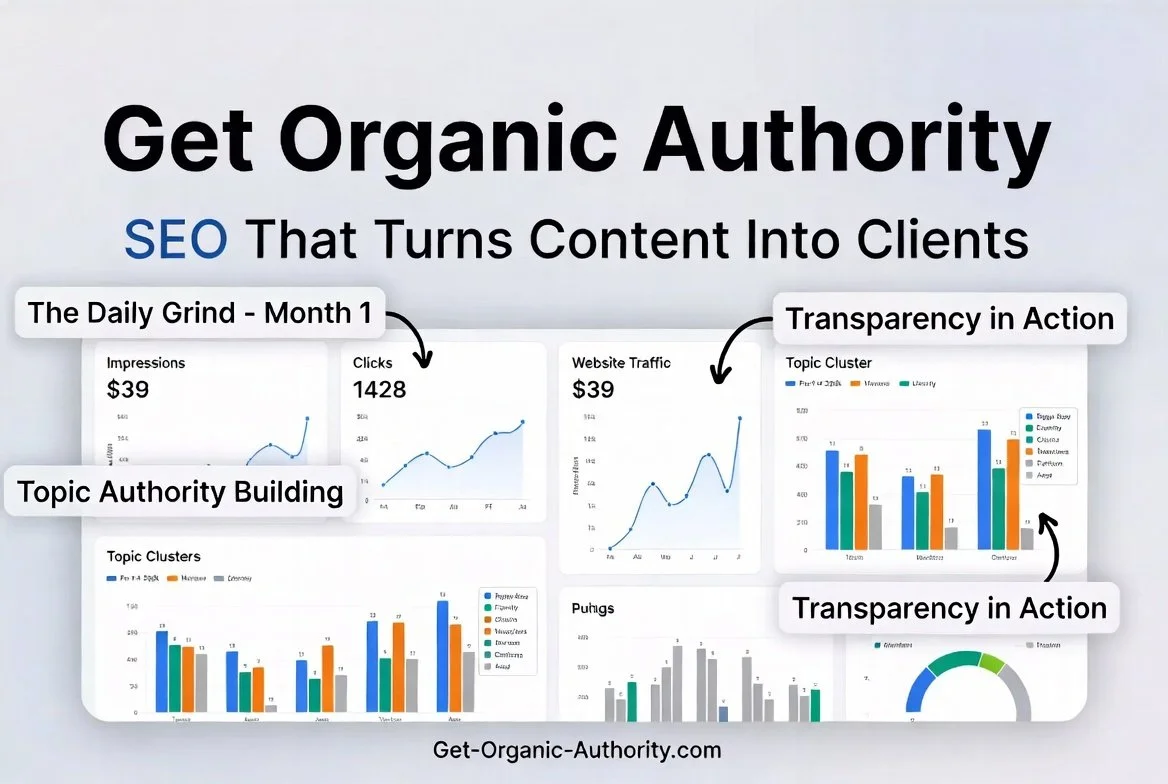
That public repetition is useful because SEO takes time. People want screenshots, instant rankings, and dopamine confetti. Search engines usually move slower. They crawl, compare, test, index, evaluate, and re-evaluate. A daily publishing strategy gives the site more opportunities to earn impressions, cover long-tail searches, strengthen topical relevance, and create internal pathways between articles and services.
Google’s guidance on helpful content asks creators to consider whether their content provides original information, reporting, research, or analysis, and whether it leaves readers feeling they have learned enough to achieve their goal. That is the standard we are aiming at. Each article should answer something real. Each article should add a useful angle. Each article should connect to another part of the site. Each article should give readers something they can use even if they never buy. Terrible business? No. Strong trust strategy. People can smell thin content now. The internet trained them through trauma.
Why This Matters More for High-Trust Practices
Private practice SEO is not the same as selling novelty socks or ranking a recipe blog for “air fryer sadness bites.” Lawyers, doctors, and therapists operate in high-trust markets. The searcher is often dealing with pain, risk, shame, fear, money, identity, health, family, trauma, legal consequences, or a life decision with sharp edges. That changes the content game.
A therapist’s website must feel safe before it feels persuasive. A law firm website must feel credible before it feels aggressive. A doctor’s website must feel clear before it feels promotional. A private practice website has to answer the question beneath the keyword: “Can I trust you with this?”
That is why high-trust SEO needs more than keyword stuffing and a contact button. It needs plain language. It needs service pages that explain what happens next. It needs educational articles that meet people earlier in the decision process. It needs internal links that guide readers instead of trapping them inside a maze built by a caffeinated intern. It needs topic clusters that prove depth. It needs specificity. Specificity is oxygen.
A therapy practice can build content around anxiety therapy, trauma therapy, EMDR, depression, relationship issues, private-pay therapy, and local searches. A law firm can build content around practice areas, client questions, state-specific rules, city pages, consultation pathways, and comparison searches. A medical practice can build content around symptoms, conditions, treatments, provider expertise, appointment expectations, and local patient questions. Each piece should connect back to a larger system.
That is exactly why our ecosystem keeps returning to private practice SEO. Articles about why competitors show up on Google before you do, local SEO for service businesses, organic SEO for doctors and healthcare practices, and organic SEO for practices that want to become the obvious choice all connect to the same big idea: expertise has to become visible, understandable, and trustworthy online.
The Article-a-Day Strategy Is a Signal Factory
Every article sends signals. Some are obvious. A keyword in the title. A heading that matches the search intent. A paragraph answering a long-tail question. A link to a service page. A link to a related article. Some signals are softer. The tone feels human. The examples match the reader’s world. The article explains without making the reader feel stupid. That last one matters more than many SEO people admit, mostly because many SEO people talk like tax software wearing cologne.
Publishing one article a day gives us a way to build a signal factory. One day, the article might target SEO for private practices. Another day, it might target long-tail keywords for lawyers. Another day, it might target why doctors need patient education content. Another day, it might explain why therapists lose private-pay clients to directories. Over time, those articles create a dense map around the markets we want to own: lawyers, doctors, therapists, and private practice.
A good content ecosystem does three things at once. It helps Google understand what the site is about. It helps readers understand what they need. It helps the business guide readers toward the right service. That is why the internal link architecture matters so much. The article on topic clusters explains how related pages build authority. The article on internal linking explains how blog posts should support service pages. The article on service pages explains where high-intent visitors should land. The article you are reading ties the whole machine together and admits the quiet part out loud: we are using the blog to prove the blog strategy.
This transparency is also part of the brand. We are not pretending SEO is magic. We are showing the levers. Long-form content creates depth. Long-tail keywords capture specific searches. Topic clusters create topical relevance. Internal links connect related ideas. Service pages convert demand. Reviews and proof build trust. Consistency creates compounding visibility. Personality keeps the whole thing from sounding like a printer manual had a nervous breakdown.
What We Are Actually Building, One Article at a Time
Here is the raw version. Get Organic Authority is building a public authority engine around SEO content for lawyers, doctors, therapists, and private practices. Every daily article is meant to function as both a useful standalone resource and a supporting beam inside the larger ecosystem. Some pieces target broad concepts. Some target niche long-tail searches. Some explain the mechanics. Some sell the vision. Some handle objections. Some show proof. Together, they help the site become more visible for the exact topics we want to own.
This is how organic authority is built in real life. It is rarely one viral post, one backlink, one homepage rewrite, or one expensive tool. It is the steady accumulation of useful, connected pages that make the business easier to find and easier to trust. Boring? A little. Effective? Very. Most compounding systems look boring until the curve bends upward and everyone starts pretending they saw it coming.
The Content Ecosystem We Are Building
The ecosystem has several layers. First, there is the homepage. It explains the core promise: trusted professionals are often invisible on Google, and long-form SEO content helps turn expertise into visibility. Second, there are services like The Foundation and The Organic SEO Authority Blueprint. These are the offers. They explain how a practice can start building authority through monthly content or a single pillar asset.
Third, there are core educational articles. These explain the big ideas: organic SEO, search intent, topic clusters, internal linking, service pages, long-form content, local SEO, backlinks, and why websites fail to get clients from Google. Fourth, there are vertical-specific articles for lawyers, doctors, therapists, and private practices. These take the big ideas and make them practical for high-trust markets. Fifth, there are transparent proof articles like this one, where we explain the strategy as we use it.
That layered structure is important because different readers enter at different points. A lawyer might find an article about legal content writing. A therapist might find an article about trauma therapy SEO. A doctor might find an article about getting patients from Google without ads. A private practice owner might find this article because they are searching for whether daily SEO articles actually work. Each entry point should lead somewhere useful.
That is why internal linking cannot be an afterthought. It is the connective tissue. A reader who starts with this dogfooding article should be able to move into search intent, then topic clusters, then internal linking, then service pages, then a relevant offer. A reader who starts with a lawyer article should be able to move into legal content writing, long-tail keywords, and law firm consultation strategy. A reader who starts with healthcare SEO should be able to move into patient trust, reviews, and service page strategy. Good SEO architecture feels like a guided hallway, not a haunted house with pop-ups.
The Long-Tail Searches This Article Is Built to Catch
This article is also built to rank for the kinds of searches that rarely get enough attention. Searches like “why publish one SEO article every day,” “does daily SEO content work,” “how to dogfood SEO strategy,” “SEO content ecosystem example,” “how to build organic authority in public,” “private practice SEO content strategy,” “SEO articles for lawyers doctors therapists,” “daily blog posting for SEO,” “how long-form SEO content compounds,” “transparent SEO strategy for small businesses,” and “how internal linking helps service pages rank.”
Those are not glamorous keywords. Nobody throws a parade for “SEO content ecosystem example.” There are no balloons. But those searches are valuable because they come from people trying to understand the system behind ranking. That reader is often smarter, more serious, and closer to buying than the person casually searching “what is SEO” between lunch and a minor crisis.
For high-trust practices, this matters even more. A therapist searching for “how to get private pay therapy clients from Google” is asking a business growth question. A lawyer searching for “how law firm blogs turn traffic into consultations” is asking a conversion question. A doctor searching for “medical SEO content strategy for patient trust” is asking an authority question. These are rich searches. They deserve rich answers.
The best long-tail SEO does not chase tiny phrases at random. It builds a net around a real market. Our market is clear: lawyers, doctors, therapists, and private practices that need organic authority, stronger rankings, better long-form content, and more trust before the first call. Every daily article should make that market clearer to Google and more useful to readers.
Why This Blog Is Proof, Not Just Promotion
The bottom line is this: Get Organic Authority is using its own blog as the case study. We are publishing daily because consistency creates more ranking opportunities. We are writing long-form because high-trust topics need depth. We are targeting long-tail keywords because specific searches reveal real intent. We are building topic clusters because isolated articles have limited power. We are using internal links because Google and readers need pathways. We are focusing on lawyers, doctors, therapists, and private practices because those markets need authority, clarity, and trust more than generic businesses selling novelty mugs to emotionally unavailable uncles.
This blog is proof because it demonstrates the exact system being sold. When we write about internal linking, the article links internally. When we write about service pages, the article points toward services. When we write about search intent, the article matches a real searcher. When we write about long-tail keywords, the article targets long-tail questions. When we write about dogfooding, the article becomes dogfooding. That is the entire point.
If you are a lawyer, doctor, therapist, or private practice owner, you can use the same logic on your own website. You do not need to become an SEO technician who dreams in spreadsheets. You need a clear content system around your services, your audience, your geography, your expertise, and the questions people ask before they are ready to contact you. That system should answer real questions, build trust, support service pages, and help Google understand why your practice deserves visibility.
This is exactly what The Foundation is built to do. It gives your practice 10 long-form SEO articles every month, created around real search intent, high-value long-tail keywords, topic clusters, internal links, and human writing that builds trust before the first call. It is for practices ready to stop treating the blog like a dusty side room and start turning it into a living authority engine.
If you want the starting map before committing to a monthly content engine, The Organic SEO Authority Blueprint gives you one strong pillar article built around your core service, niche, or audience. It clarifies what your site should begin ranking for, identifies future supporting content angles, and gives Google a better frame for understanding your authority.
That is what we are doing here. This article is not floating by itself. It connects to the homepage, the services, the private practice cluster, the lawyer cluster, the doctor cluster, the therapist cluster, the search intent content, the topic cluster content, the internal linking content, and the service page content. It is one more brick in the wall, one more signal in the system, one more proof point that organic authority is built by publishing useful, connected, human content with purpose.
So here is the aggressive truth: if your private practice is excellent in real life and invisible on Google, your website is underreporting your authority. That can be fixed. Build the content system. Claim the long-tail searches. Connect the articles. Strengthen the service pages. Make trust visible. Or let weaker competitors keep borrowing your future clients because they explained themselves better online. Grim little choice, but at least it is clear.
Get Organic Authority is not asking you to believe in theory. We are showing the work on our own site every day. If you want that same system built for your practice, start with The Foundation or map your first authority asset with The Organic SEO Authority Blueprint. This blog is the proof. The services are the machine. Your practice can be next.
