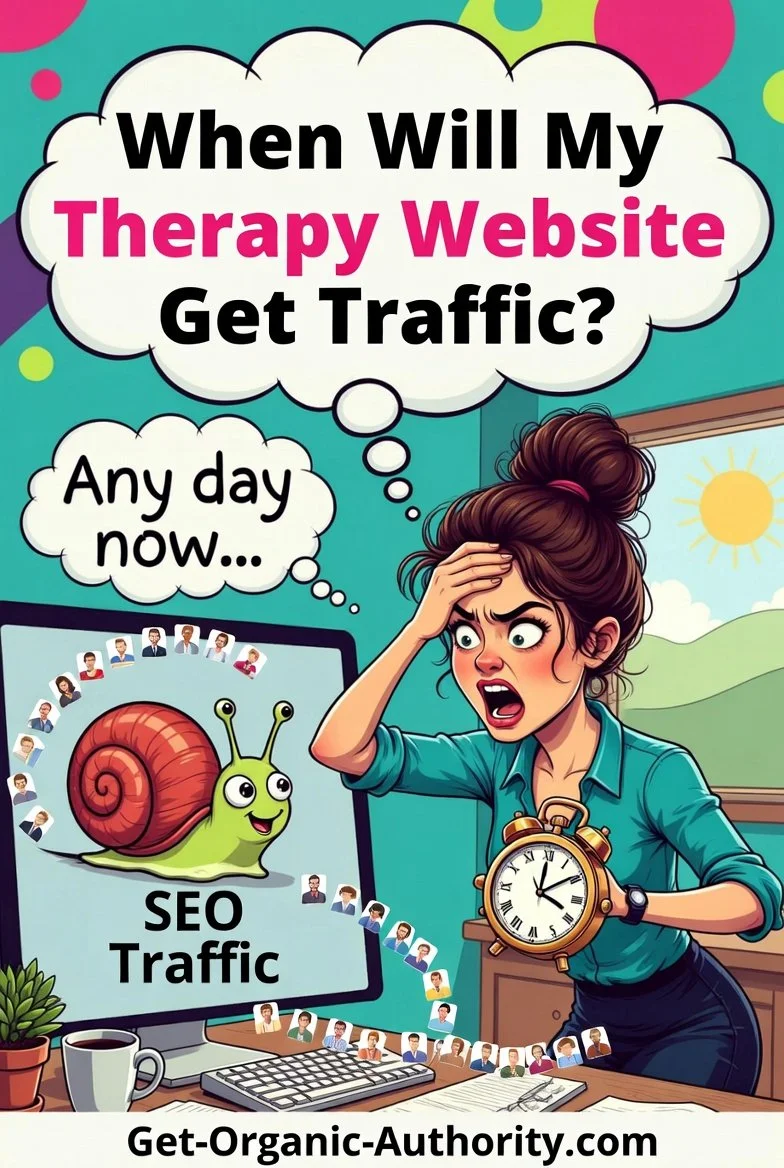
When Will My Therapy Website Get Traffic?
Why Your SEO Guy’s Monthly Report Still Hasn’t Brought You Clients
The Therapist SEO Waiting Room
Every therapist with a new or neglected website eventually enters the same little emotional chamber. The site is live. The colors are soothing. The headshot looks warm but competent. The contact form works, allegedly. A few blog posts exist, somewhere, doing their tiny digital breathing exercises. Then the therapist opens analytics and asks the question that has ruined many lunches:
When will my therapy website get traffic?
Then comes the second question, usually whispered with less optimism and more caffeine: why did I pay the SEO guy if my phone still sounds like a monastery?
It is a fair question. Therapists are patient people by trade, but patience gets thinner when invoices arrive faster than intake calls. A private practice website can sit online for months with almost no organic traffic, no Google visibility, no therapy inquiries, and no meaningful movement beyond a monthly report full of screenshots that look scientific enough to frighten a small accountant. Impressions went up. A keyword moved from position 84 to position 61. A chart is green. Wonderful. Somewhere, a graph had a good week. The practice still needs clients.
The uncomfortable truth is that traffic usually arrives after Google has enough evidence to understand what the site is about, who it serves, where it belongs, and why it deserves to show up over directories, group practices, national platforms, and the suspiciously cheerful competitor across town who somehow ranks for everything. That evidence rarely comes from one homepage, one About page, and a general Services page that says you help people feel heard, heal, and reconnect with their authentic selves. That language may be human. It may be clinically lovely. It may also give Google the search clarity of a fog machine in a basement.
This is why therapist SEO has to be treated differently from generic small business SEO. A therapist is not selling roofing, cupcakes, or emergency drain repair, though all three have their own tiny tragedies. Therapy search is emotional. People search when they feel anxious, ashamed, betrayed, numb, overwhelmed, alone, or terrified that something is wrong with them. They may type "why do I panic before work," "why do I shut down during conflict," "trauma therapist near me," "EMDR therapist for anxiety," or "couples therapy after betrayal." Your website has to meet those searches with recognition, structure, local relevance, and a path toward help.
That is where many therapy websites fail. They speak beautifully to humans already on the page, but they fail to create enough pages, articles, links, and service clarity to get those humans there in the first place. It is like building a calm, sunlit office in the middle of the woods and forgetting the road. Very peaceful. Not especially profitable.
Organic Authority is Built Slowly. Patience, Grasshopper!
Prioritize Information That Answers a Question
Google’s own guidance says its ranking systems are designed to prioritize helpful, reliable information created to benefit people, rather than content made mainly to manipulate rankings. That matters for therapists because the goal is not to trick Google with keyword confetti. The goal is to build a site that is deeply useful to real people and structurally clear enough for search engines to understand. Helpful content, in the therapy world, means answering real client questions with compassion and specificity while connecting those answers to the services the practice actually provides.
Local SEO matters too. Google says local results are mainly shaped by relevance, distance, and prominence. Translation for therapists: Google wants to understand what you do, where you do it, and how much trust exists around your practice. Your Google Business Profile, local service pages, reviews where ethically appropriate, therapist bio, service descriptions, and internal links all feed that picture. If your website vaguely says you support adults through life transitions, while your competitor has specific pages for anxiety therapy in your city, trauma therapy in your city, EMDR therapy online in your state, and couples counseling after infidelity, Google has an easier job with the competitor. It rewards clarity because search engines, unlike humans, have limited interest in vibes.
A therapy practice that wants traffic should stop asking only, "How long does SEO take?" and start asking, "What have we built that can earn traffic?" That is the difference between waiting and building. At Get Organic Authority, the whole strategy is built around content ecosystems, not random blog posts. A therapist can start with The Organic SEO Authority Blueprint to build one strong pillar that maps the first real authority lane. A practice ready to build month by month can use The Foundation to create ongoing long-form articles, topic clusters, internal links, and search intent coverage that compounds instead of just decorating the blog page.
This is also why a website can get traffic and still fail. Traffic is not the trophy. Inquiries are closer. Better-fit inquiries are the point. A therapy website can attract thousands of visitors through generic mental health topics and still produce no calls if those readers have no reason to choose that therapist, no local connection, no service page to land on, and no clear next step. Random traffic is just strangers walking into the waiting room, taking a mint, and leaving. Charming little robbery. Poor marketing.
The better goal is client-generating organic authority. That means your website helps Google understand your specialties, helps potential clients recognize their own pain, and helps the right people feel safe enough to reach out. For a deeper version of this problem, the article Why Is My Therapy Website Not Getting Clients? already breaks down how warmth without structure leaves private practice websites invisible. This article goes one step further and answers the traffic question therapists keep asking while their SEO dashboard performs interpretive dance.
Why the Traffic Is Missing, What the Random SEO Master Missed, and How to Build the System Correctly
The random SEO guy is a fascinating modern character. He often has three monitors, a vocabulary full of acronyms, a suspiciously strong opinion about meta descriptions, and the spiritual energy of someone who once ranked a plumber in 2018 and has been dining out on the story ever since. To be fair, some SEO people are excellent. Others optimize title tags, send reports, buy questionable backlinks, publish bland AI sludge, and then act shocked when a therapy practice fails to become the Mayo Clinic of Google by Thursday.
Therapist SEO fails when activity gets confused with architecture. A report is activity. A keyword list is activity. A blog post is activity. Architecture is different. Architecture means each page has a role. Each service page targets a high-intent search. Each blog answers a real client question. Each internal link moves the reader toward a relevant service. Each local signal strengthens relevance. Each trust element reduces hesitation. Each cluster tells Google, over and over, that this therapist has depth in a specific area.
That is exactly why SEO content ecosystems for high-trust businesses matter. High-trust services like therapy, medicine, law, and private practice growth depend on credibility. Nobody chooses a trauma therapist because a keyword appeared fourteen times like a raccoon trapped in a wall. They choose because the content feels specific, credible, local, human, and safe. Google also needs that specificity arranged in a way it can understand.
Mistake 1: The Website Has One Mushy Services Page
The most common private practice SEO mistake is the one giant Services page. Anxiety, trauma, depression, EMDR, couples counseling, grief, addiction, self-esteem, life transitions, and online therapy all get folded into one polite page. To the therapist, this feels clean. To Google, it looks thin. To a potential client, it may feel too general to answer the question burning through their life at 1:17 a.m.
A therapist who wants more organic traffic needs individual therapy service pages. Anxiety therapy deserves a page. Trauma therapy deserves a page. EMDR therapy deserves a page. Couples counseling deserves a page. Online therapy by state may deserve a page. Private-pay therapy, grief counseling, addiction therapy, and therapy for high-functioning anxiety can each become strong pages if those services match the practice. The old Get Organic Authority article Service Pages for Small Businesses explains this beautifully for local service brands, and therapists need the same principle with more emotional intelligence and fewer contractor metaphors, although a little drywall energy never hurt anyone.
A strong therapy service page should explain what the issue feels like, who the page is for, common patterns, how therapy can help, the therapist’s approach, location or telehealth availability, related blog posts, FAQs, and a clear consultation CTA. This lets the page target terms like anxiety therapist in [city], EMDR therapist near me, online trauma therapy in [state], couples counseling after betrayal, or depression therapist for adults. It also gives a scared reader something more useful than a pretty paragraph about healing journeys, which, at this point, should be legally required to retire for a year.
Mistake 2: The Blog Is a Junk Drawer With Feelings
Many therapy blogs begin with good intentions and become a junk drawer. One post about self-care. One post about mindfulness. A holiday coping guide. A boundaries article. A nervous little post about New Year goals. Then silence, because running a practice, seeing clients, billing insurance, answering emails, and being a human organism took priority. Reasonable. Also terrible for organic authority.
Google learns depth through repeated, connected coverage. That is where topic clusters matter. The article How to Build a Topic Cluster for a Service Business Website is one of the strongest internal links to use here because it explains the underlying SEO architecture. For therapists, a topic cluster starts with a core service page, then builds supporting articles around the questions clients ask before they book.
For example, an anxiety therapy cluster might include a service page for anxiety therapy in Orlando, then supporting posts like why do I feel anxious all the time, why anxiety feels worse at night, high-functioning anxiety signs, therapy for overthinking, panic attacks before work, and how to know if anxiety therapy is working. Each article links back to the anxiety therapy page and to related articles. That repeated structure creates topical authority. It tells Google the site has depth around anxiety therapy rather than one lonely post standing in the wind like a brochure stapled to a telephone pole.
A trauma therapy cluster might include articles on signs of unresolved trauma, why people shut down during conflict, emotional numbness after trauma, EMDR therapy for trauma, childhood trauma in adult relationships, and how trauma affects the nervous system. That is where a link to the Get Organic Authority article on SEO for trauma therapists fits naturally. Trauma clients rarely search in clean clinical categories. They search from symptoms, confusion, and fear. The content has to meet them there without exploiting the pain.
Mistake 3: The Content Uses Therapist Language Instead of Client Search Language
Therapists often write from the language of training. Clients search from the language of distress. That gap can swallow an entire website.
A therapist may write: I help clients explore relational patterns and reconnect with embodied self-awareness. A client may search: why do I panic when someone pulls away. The therapist may write about emotional avoidance. The client may search: why do I shut down when my partner is upset. The therapist may write about trauma responses. The client may search: why do I freeze when people yell. Both languages matter. Only one usually appears in Google at midnight from a person clutching a phone like it owes them safety.
This is where The Invisible Searcher becomes a powerful internal link. People often search unclearly when the topic feels private, embarrassing, painful, or hard to name. A therapy website should include both the professional language and the client’s searching language. That means content can sound clinically grounded while still targeting long-tail keywords like therapy for emotional numbness, therapist for people pleasing, why do I feel detached from my life, therapy for betrayal trauma, and online therapist for anxiety in Florida.
Long-tail keywords are not little SEO tricks. They are emotional doorways. They help the person who has no perfect label for the problem find a page that says, in effect, this thing has a name and help exists. That is real strategy. It is also more dignified than publishing another 600-word post called Benefits of Therapy, a title so tired it should receive its own disability accommodations.
Mistake 4: The SEO Work Chases Traffic Instead of Search Intent
Traffic sounds exciting because numbers make business owners feel like something is happening. But therapist SEO has to care about search intent. A person searching what is anxiety wants information. A person searching anxiety therapist near me wants options. A person searching EMDR therapist for panic attacks in [city] may be much closer to booking. A person searching therapist that takes private pay near me may be ready to choose.
The internal article Search Intent for Service Businesses should be woven into this section because it gives the bigger framework. Informational posts build awareness. Service pages capture buyer intent. Comparison pages help people choose. Local pages support city relevance. FAQ pages reduce hesitation. A content ecosystem needs all of them, because a therapy client may move through several searches before reaching out.
This is why a therapist can have impressions but no calls. The site may rank for low-intent topics that educate people but never connect them to services. Or the blog may answer questions and then end abruptly, like a therapist saying, ‘Good insight,’ and walking into the ocean. Every informational article needs a next step. Link to the relevant service page. Link to a consultation page. Link to related content. Guide the person without shoving them. Clarity is not pressure. In mental health marketing, clarity often feels like relief.
Mistake 5: Internal Links Are Treated Like Decorative String Lights
Internal links are one of the simplest ways to make a therapy website stronger, and one of the easiest things for cheap SEO to neglect. A blog post should never sit alone. It should point to a service page, another relevant article, and a conversion path. This helps Google understand page relationships. It also helps a reader move from recognition to action.
The article How to Internally Link Blog Posts to Service Pages Without Making a Mess is tailor-made for this section. A post about why do I shut down during conflict should link to trauma therapy, couples counseling, anxiety therapy, and perhaps an article about nervous system responses. A post about high-functioning anxiety should link to anxiety therapy, online therapy in the state, panic attack content, and a consult page. A post about betrayal trauma should link to trauma therapy, couples therapy, EMDR therapy if relevant, and a clear consultation CTA.
Internal linking turns a website into a map. Without it, every page becomes an island. Some islands are beautiful. Most do not produce private-pay therapy inquiries unless they also have bridges, signage, and a way to book a call. Civilization, despite its many errors, got that part right.
Mistake 6: The Site Ignores Trust Signals
Therapy is a high-trust decision. A potential client may be deciding who gets access to trauma history, relational pain, panic symptoms, grief, shame, addiction, or the sentence they have never said out loud. The website has to make trust visible.
Pew Research Center found in a 2026 survey that three-quarters of Americans say it is highly important that health information sources have medical training, and similar shares value transparency and ease of understanding. Therapy content lives close to that world. A therapist’s website should make credentials, licensure, specialties, modalities, experience, ethical clarity, privacy expectations, telehealth availability, and next steps easy to understand. Trust should never require a scavenger hunt.
This is where older pieces like The Trust Gap and The Back-Pocket Search fit beautifully. Many people still Google a therapist after receiving a referral. They want reassurance. They want to know the therapist is real, credible, specific, and aligned with their needs. If the website feels vague, thin, outdated, or generic, the referral can leak out through the floorboards. Nothing says modern marketing like losing a warm lead to a competitor with clearer pages and better photos.
Mistake 7: Local SEO Gets Treated Like a Side Quest
Local SEO for therapists matters even when telehealth exists. People still search by city, state, neighborhood, and near me because licensure, trust, convenience, insurance, and location cues matter. A therapist in Florida can offer online therapy statewide, but someone may still search online anxiety therapist in Florida or trauma therapist Fort Lauderdale. Google needs those signals.
Google says local ranking depends mainly on relevance, distance, and prominence. For a therapy practice, relevance means the profile and website clearly match the service being searched. Distance means Google considers the searcher’s location or inferred location. Prominence means the practice appears known and trusted through reviews, links, mentions, and broader web signals. This is not wizardry. It is evidence. Google is basically asking, ‘Who are you, where are you, what do you do, and does the rest of the internet agree?’ Suspicious, but fair.
This section should link to Local SEO for Service Businesses and How to Get More Local Leads From Google Without Paying for Every Click. The therapy version includes Google Business Profile optimization, accurate categories, listed services, consistent name-address-phone information where applicable, service area clarity, ethical review strategy, city references on service pages, state-based telehealth pages, and content that ties specialties to location.
BrightLocal’s 2026 Local Consumer Review Survey found that 97 percent of consumers read reviews for local businesses and that consumers increasingly expect high star ratings, fresh reviews, and active responses. Therapists have to handle reviews ethically and carefully because confidentiality matters. Still, reputation signals matter. So do third-party profiles, local mentions, professional directories, and a website that makes the practice look alive rather than preserved in amber from 2019.
Mistake 8: The Practice Depends Too Much on Directories
Directories can help. Psychology Today, TherapyDen, GoodTherapy, Zocdoc, insurance directories, and referral platforms can create visibility. The problem is ownership. A directory ranks, captures the search, controls the comparison, and places the therapist next to dozens of others using the same soft adjectives. Compassionate. Integrative. Trauma-informed. Client-centered. Warm. Safe. Supportive. At some point the entire directory starts to sound like one giant weighted blanket.
The article SEO for Therapists: Get Private-Pay Clients Without Relying on Directories is the obvious internal link here. Borrowed visibility is useful, but owned visibility compounds. Your own website should rank for the services, symptoms, modalities, locations, and client questions that matter most to your practice. Directories can support the ecosystem. They should not be the ecosystem.
A strong therapist website lets the practice control the message. It lets the therapist explain their approach in detail, build service pages around better-fit clients, answer nuanced questions, and move readers toward consultation. That owned system becomes especially important for private-pay therapists who need to attract clients looking for specialty care, not just the next available provider in a directory lineup.
Mistake 9: Cheap SEO Creates Motion Without Momentum
Cheap SEO loves motion. Monthly reports. Metadata edits. A few backlinks from websites that sound like they were named during a keyboard accident. Blog posts that say nothing with great confidence. Technical audits. Keyword rankings. Another spreadsheet. Another login. Another quiet month.
Some technical SEO work matters. Fast pages matter. Indexing matters. Clean titles matter. Mobile experience matters. But technical cleanup alone cannot replace authority. A therapist who wants more traffic needs a publishing system that creates useful, specific content around the actual services and searches that bring in clients. Compressing images on a thin website is like putting racing tires on a shopping cart. It may roll better. Nobody is winning the Grand Prix.
Get Organic Authority’s dogfooding angle belongs here. The article We're Publishing One SEO Article Every Day shows the brand using its own content ecosystem to prove the strategy in public. That matters because the company is not merely telling therapists to publish structured authority content. It is building that exact system on its own site. The Authority Flywheel also fits here because organic authority compounds through consistent content, internal links, topic depth, and trust signals.
The random SEO master usually sells the illusion of movement. A real ecosystem creates momentum. The difference shows up over time. More pages indexed. More long-tail keywords ranking. Better internal pathways. Stronger service pages. More relevant traffic. More consultation-ready readers. Less dependence on ads. Less panic when referrals slow down. Fewer reports that require a translator and a sedative.
What a Real Therapy SEO Timeline Looks Like
So, when will a therapy website get traffic? The honest answer depends on the site’s age, authority, competition, location, technical health, existing content, Google Business Profile strength, reviews, service page depth, backlink profile, and publishing consistency. That answer is less satisfying than ‘three months,’ but more honest, and honesty has to make an occasional appearance in marketing before the species collapses entirely.
A newer or thin therapy website may need several months just to build enough structure for Google to understand the practice. The first month often goes into mapping the content ecosystem, clarifying service pages, identifying high-intent keywords, and publishing a strong pillar page. Months two through six should build supporting clusters, internal links, local signals, and conversion paths. Over time, long-tail rankings often appear first because specific searches are easier to earn than broad competitive terms. A page targeting online EMDR therapist for anxiety in Florida has a better early chance than a vague attempt to rank for therapy.
The right metrics are not just sessions and impressions. Track which pages are getting indexed. Which long-tail keywords are moving. Which service pages receive internal links. Which blog posts send readers to consultation pages. Which cities or specialties begin to gain visibility. Which inquiries mention Google. Which content attracts better-fit clients. SEO is not one magic moment. It is a system slowly becoming harder to ignore.
This is why The Organic SEO Authority Blueprint works as a smart first step for a therapist who needs the map before the monthly machine. It builds one long-form pillar around a core service, niche, or audience and gives the website a stronger authority frame. The Foundation is the next move for practices ready to build clusters month after month with 10 long-form SEO articles, internal linking, and search intent coverage. The point is not content for content’s sake. The point is organized visibility that compounds.
The Better Question
The therapist asking when their site will get traffic is really asking something deeper: when will this start working? That question deserves a clear answer. It starts working when the website becomes useful enough for clients, clear enough for Google, and trustworthy enough for someone to take the next step.
A therapy website gets traffic when it stops behaving like an online brochure and starts behaving like an authority system. It needs service pages that target high-intent searches. It needs content clusters built around client pain, not random blog inspiration. It needs internal links that guide readers toward services. It needs local SEO signals that help Google place the practice geographically. It needs trust signals that make the therapist feel credible before the first call. It needs human writing because therapy decisions are human decisions, and people can smell generic content the way they smell burnt popcorn in an office microwave.
This is exactly the lane Get Organic Authority is built for. The company helps high-trust businesses, especially therapists, lawyers, doctors, and private practices, turn expertise into content ecosystems. Random blog posts make a website look busy. A connected ecosystem makes it easier to find, easier to trust, and harder to ignore.
Stop Paying for Reports That Need a Priest
Your therapy website does not need another vague SEO report telling you that impressions are spiritually maturing. It needs a system. It needs pages that match the services you want more of. It needs long-tail content that speaks to the searches clients actually make before they are ready to call. It needs internal links that connect pain to service. It needs local SEO signals that show where you practice and who you help. It needs trust-building content that makes a future client feel safe enough to reach out.
If your website has been sitting there looking calm, expensive, and unemployed, start with The Organic SEO Authority Blueprint. It gives your therapy practice one serious pillar article built around your niche, audience, and organic SEO opportunity. If you are ready to build the full engine, choose The Foundation, where Get Organic Authority creates 10 long-form SEO articles each month, built into strategic topic clusters with internal links, long-tail keywords, and content designed to rank, build trust, and bring the right people closer to the first call.
Get Organic Authority exists for therapists and high-trust professionals who are tired of being excellent in the room and invisible online. Your practice already has the expertise. Now your website needs the architecture to prove it.
