I Need Help Getting More Clients: Local SEO for Doctors, Lawyers, and Therapists
The Real Reason Good Professionals Stay Invisible
A doctor can change someone’s life, a lawyer can protect someone’s future, and a therapist can help someone crawl out of the private wreckage they barely know how to name. Then all three can open their laptops, search their own service in their own city, and find themselves buried under directory pages, hospital systems, national chains, lead brokers, and competitors with websites that look like they were written by a committee trapped inside a beige conference room.
This is the strange little tragedy of modern local SEO for high-trust professionals. The best provider in the room often becomes invisible online because Google has no sentimental attachment to talent. Google is not sitting there saying, “That attorney really cares” or “That therapist is fantastic with trauma clients.” Search engines need signals. Clear service pages. Location relevance. Helpful content. Internal links. Reviews. A Google Business Profile that actually explains the practice. Content depth around the topics people search before they call. Without those signals, a brilliant practice can look generic. And generic is where good businesses go to quietly lose clients.
Most doctors, lawyers, therapists, and private practices make the same accidental mistake. They treat the website like a digital brochure instead of a search system. The homepage says “compassionate care,” “client-centered service,” “aggressive representation,” or “personalized solutions.” Everyone says that. The internet is basically a landfill of personalized solutions wearing a blazer. The service pages are thin. The blog has a few lonely posts from three years ago. The Google Business Profile has hours, a phone number, and the emotional energy of a waiting room clipboard. The website may look professional, but Google sees a blur.
Local SEO is how a high-trust business becomes visible when the person nearby has intent. Someone searches “anxiety therapist near me,” “workers comp lawyer in Richmond,” “dermatologist accepting new patients,” “couples counseling in Boca Raton,” or “estate planning attorney near me.” Those searches are not casual browsing. They carry urgency, risk, embarrassment, money, fear, pain, or all of the above, because apparently being human includes needing both help and Wi-Fi.
Google’s own local ranking guidance says local results are mainly shaped by relevance, distance, and prominence. That matters because many professional websites focus on design while starving relevance and prominence. Distance is mostly geography. Relevance comes from how clearly the business matches the search. Prominence comes from what Google can understand about the business across the web, including reputation, links, articles, directories, and reviews. A practice cannot control every part of that equation, but it can give Google a much clearer map.
The stakes are high because top search visibility captures attention quickly. Backlinko’s analysis of millions of Google results reported that the number one organic result has an average click-through rate of 27.6 percent, and that position one is far more likely to earn the click than lower spots. Exact click numbers vary by industry, device, ads, maps, and AI features, but the pattern stays painfully obvious. People click what they see first. Revolutionary behavior from a species that also pushes doors marked pull.
The trust layer matters just as much. BrightLocal’s Local Consumer Review Survey 2025 found that only 4 percent of consumers say they never read online business reviews. People may feel more selective, more skeptical, and more willing to compare sources, but they still look for proof. For doctors, lawyers, therapists, and private practices, that proof has to live across the whole search journey: Google Business Profile, reviews, service pages, provider bios, legal or clinical explanations, local content, and the website’s overall authority.
Frustrated? You are Not Alone…
This is why Get Organic Authority exists. The point is not to spray blog posts into the void and call it “content marketing,” which is how civilization gets another article titled “Five Tips for Success” with the soul of a paper towel. The smarter move is to build an organic authority system: service pages that match buyer intent, pillar content that anchors expertise, supporting blogs that answer real questions, and internal links that turn the website into a connected ecosystem. For practices that need a monthly engine, The Foundation builds long-form SEO articles into topic clusters around core services. For brands that need the first strategic authority asset, The Organic SEO Authority Blueprint creates a pillar article that maps the first organic opportunity and gives the site a stronger frame.
That distinction matters. Random content adds noise. Ecosystem content adds structure. A random blog post says, “We published something.” A content ecosystem says, “Here is how this business helps this audience, in this location, with this problem, at every stage of the decision.”
Doctors miss local SEO when they explain their credentials but fail to build pages around the treatments, conditions, and local searches patients use. Lawyers miss local SEO when they write vague practice area pages but fail to answer the urgent questions people ask before contacting a firm. Therapists miss local SEO when their sites feel warm but fail to target the language clients use when they feel anxious, ashamed, confused, or quietly desperate for help. Private practices miss local SEO when they rely on referrals and directories while competitors build a search footprint around every meaningful client concern.
The problem is rarely lack of expertise. The problem is translation. Your real-world authority has to become digital authority. Your services have to become searchable. Your niche has to become visible. Your trust has to become legible before the first call.
That is the heart of this article. Most professionals are not losing clients because they are bad at what they do. They are losing clients because their websites fail to show Google and the searcher why they are the right choice. That blur is fixable. It takes a better system than cheap SEO, outsourced blog sludge, or AI content farms wearing a fake mustache and calling themselves strategy.
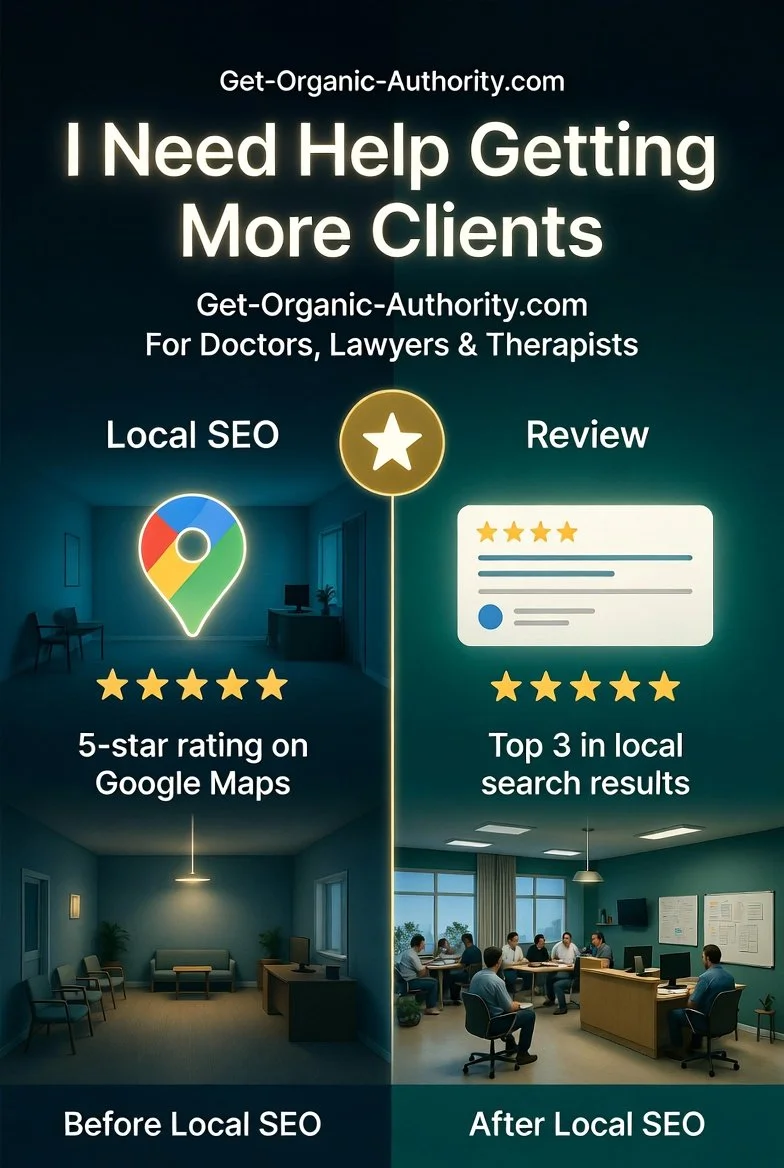
How to Escape Generic SEO Blur and Build Local Authority
Generic SEO usually fails high-trust businesses because it treats a therapist, a surgeon, a criminal defense attorney, and a med spa like they all need the same keyword checklist. Add a title tag. Mention the city. Publish a blog. Stuff in a few keywords. Maybe add “near me” somewhere awkward, because nothing builds client trust like prose assembled from refrigerator magnets.
High-trust local SEO works differently. A person searching for legal, medical, or therapeutic help is not simply shopping. They are evaluating risk. Can I trust this person with my body, my family, my freedom, my marriage, my pain, my money, my reputation, or my future? Search visibility opens the door. Trust gets the person to walk through it.
Google’s helpful content guidance says its systems are designed to prioritize reliable, useful content created for people rather than content created mainly to manipulate rankings. That principle matters for professional services because these are credibility-sensitive industries. A thin page can technically exist. A keyword-stuffed article can technically target a phrase. A cheap AI blog can technically fill the calendar. Technical existence, sadly, is also true of gas station sushi. The bar should be higher.
1. Start with the searches that actually lead to clients
The first move is search intent. Every keyword belongs to a stage of the client journey. Some searches are informational. Some are problem-aware. Some are comparison searches. Some are local and ready to act. A strong SEO strategy maps the page to the person behind the search.
For a law firm, “what happens after a workplace injury” is early-stage. “workers comp lawyer near me” is high-intent. “workers comp settlement timeline in Virginia” may sit in the middle, with the person researching before making a call. For a doctor, “why does my knee hurt going upstairs” is problem-aware. “orthopedic doctor near me” is local commercial intent. For a therapist, “why do I shut down during conflict” may be emotional and early-stage. “trauma therapist in Fort Lauderdale” is closer to action.
That is why service businesses need both education and conversion pages. A strong resource like Search Intent for Service Businesses explains the logic behind matching the page to the searcher. A deeper local plan can connect that intent to Local SEO for Service Businesses, where nearby searches, Google Business Profile, reviews, local pages, and service content work together.
The mistake is treating every search like a sales pitch. A person asking “how long does grief last” may need language, safety, and trust before they need a booking button. A person searching “DUI lawyer open now” needs immediate clarity. A patient searching “same day dermatologist appointment” wants friction removed. Content has to meet the moment.
2. Give every major service its own real page
Many professional websites lose because they bury valuable services inside one generic “Services” page. This feels tidy to the business owner and useless to Google. A doctor who offers acne treatment, eczema care, skin cancer screenings, cosmetic dermatology, and hair loss treatment needs more than a paragraph labeled “Dermatology Services.” A therapist who offers trauma therapy, EMDR, anxiety therapy, couples counseling, and grief counseling needs pages for the work people actually search. A law firm needs practice area pages that explain the legal problem, process, evidence, deadlines, local considerations, and next step.
This is where Service Pages for Small Businesses becomes essential. Service pages are the pages that turn search intent into leads. They should explain what you do, who it helps, symptoms or scenarios connected to the service, what the process looks like, why the business is credible, which locations are served, and what the reader should do next.
A strong service page for a therapist might include who trauma therapy helps, common signs of unresolved trauma, what sessions may involve, approaches used, privacy and fit, local availability, and a clear consultation path. A law firm service page might explain the case type, common mistakes, documents needed, timelines, possible outcomes, attorney experience, and consultation steps. A medical service page might explain the condition or treatment, symptoms, evaluation, provider expertise, insurance or appointment details, and location.
The page should sound human. It should answer real questions. It should build confidence. It should avoid turning into a keyword casserole.
3. Build topic clusters instead of random blog posts
A topic cluster is a group of related pages organized around a core service, problem, or niche. It is how a website proves depth. One article rarely changes a site’s authority. A connected cluster can. The pillar page handles the broad topic. Supporting articles answer specific questions. Service pages capture commercial intent. Internal links connect everything.
For example, a therapist SEO cluster around trauma therapy could include a trauma therapy service page, a pillar on trauma therapy in a specific city, and supporting articles on emotional numbness, shutdown responses, relationship triggers, childhood trauma, EMDR questions, shame, and when to seek help. A medical practice cluster around knee pain could include a knee pain treatment page, provider bios, location pages, and supporting content about swelling, stairs, sports injuries, arthritis, rehab timelines, and evaluation. A law firm cluster around workers’ compensation could include a main practice area page, city page, and supporting articles about denied claims, settlement timelines, wage loss, medical evidence, hearings, insurance adjusters, and mistakes after injury. The structure mirrors the strategy in How to Build a Topic Cluster for a Service Business Website.
This is topical authority in plain English: your site repeatedly demonstrates that it understands the subject from multiple angles. Google gets more context. Readers get more help. Service pages get stronger support. The business stops looking like one generic provider and starts looking like a specialized authority.
Cheap SEO often skips this because clusters require thought. Blog mills prefer titles that can be written for anyone: “The Importance of Mental Health,” “Why You Need a Lawyer,” “Benefits of Seeing a Doctor.” Those pieces are content-shaped fog. They contain words, which is adorable, but they rarely build a path to revenue.
4. Use internal links as strategy, not confetti
Internal links tell readers and search engines how your website fits together. Google’s link guidance says links help Google find pages and that descriptive anchor text helps both users and Google understand the linked page. Translation: the clickable words matter. “Click here” is a tiny surrender flag.
Good internal linking sends a supporting article to the relevant service page, sends service pages to helpful guides, connects related articles, and pushes readers toward the next best step. This is exactly the principle behind How to Internally Link Blog Posts to Service Pages Without Making a Mess.
A therapist article about panic attacks should link to the anxiety therapy service page. A law firm article about denied benefits should link to the workers compensation service page. A doctor article about knee pain should link to the knee pain treatment page or orthopedic evaluation page. A local SEO article should link to the main local SEO or services page. The link should feel like the next logical sentence, not a pop-up wearing pants.
The best internal links follow intent. Educational content can link to deeper guides. Problem-aware content can link to service pages. Comparison content can link to proof, process, and consultation pages. Bottom-of-funnel service content can make booking painfully clear. This is how traffic becomes movement.
5. Make local relevance impossible to miss
Local SEO depends on clarity. Google Business Profile, service pages, location pages, review profiles, local mentions, and website content all help explain where the business operates and what it offers. Google’s Business Profile guidance says local ranking is based mainly on relevance, distance, and prominence. A practice cannot move closer to every searcher. It can become more relevant and more prominent.
That means the Google Business Profile should be complete. Categories, services, hours, photos, description, appointment links, phone number, website URL, review responses, and location information all matter. The website should reinforce the same facts. A lawyer serving Richmond should have content that makes that local relevance clear. A therapist seeing clients in Boca Raton should have local therapy pages. A doctor in Fort Lauderdale should connect services, providers, and location pages in a clean structure.
Local relevance also comes from specificity. “Personal injury lawyer” is broad. “car accident lawyer in Richmond for rear-end collisions and insurance disputes” gives Google and the reader more to work with. “Therapist” is broad. “trauma therapist for adults in Fort Lauderdale” creates a clearer match. “Doctor” is broad. “same-day dermatology appointment in Boca Raton” has intent, place, and service built into the phrase.
6. Treat reviews and reputation as part of the search journey
Reviews are not separate from SEO. They influence clicks, confidence, comparison, and local prominence. BrightLocal’s 2025 survey shows consumers still rely heavily on reviews, with only a small minority saying they never read them. The more sensitive the service, the more people look for reassurance. A patient wants to know the practice feels competent and humane. A legal client wants to know the firm is responsive and serious. A therapy client wants signs of safety, warmth, and fit.
The strategy should be ethical and steady. Ask for reviews appropriately. Avoid incentives where rules prohibit them. Respond professionally. Protect privacy. Watch themes in reviews because those themes often reveal what people value: responsiveness, clear communication, comfort, expertise, outcomes, scheduling, compassion, and follow-through.
Those trust signals should inform the website. A service page can speak to the fears reviews reveal. A provider bio can answer the concerns people mention. A FAQ can clarify repeated objections. The content ecosystem becomes stronger when it listens to the market instead of shouting keywords into a canyon.
7. Understand why AI content farms and cheap SEO fail here
AI can assist with research, outlines, drafts, and workflows. Google’s guidance on AI-generated content focuses on rewarding helpful, reliable, people-first content rather than rewarding or punishing content purely because AI was involved. The problem is shallow automation. A high-trust business cannot afford content that sounds plausible while saying nothing. Doctors, lawyers, therapists, and private practices need content with judgment, empathy, specificity, compliance awareness, and real search strategy.
Cheap content often fails because it removes the very things high-trust buyers need. It removes voice. It removes nuance. It removes local detail. It removes the service pathway. It removes examples. It removes the quiet human understanding that makes a reader feel, “This person gets my situation.” What remains is a smooth paragraph blob that could belong to anyone. And if it could belong to anyone, it builds authority for no one.
Get Organic Authority uses dogfooding: the same content ecosystem strategy it recommends is being built and proven on its own website. The blog already connects ideas like local leads from Google, law firm consultations from search traffic, doctors getting more patients from Google, and therapy websites that are not getting clients. That is the model: publish useful authority assets, connect them with internal links, support service pages, and let the site become easier to understand with each new piece.
8. Build the conversion path before celebrating traffic
Traffic alone is a vanity metric wearing a party hat. A website can get visitors and still fail to bring clients if the path to action is weak. Every high-value page should make the next step clear. Call. Book. Request consultation. Start with a strategy. Download a resource. Read the next guide. Review the service. The CTA should match where the searcher is in the decision process.
Doctors need appointment paths. Lawyers need consultation paths. Therapists need fit and safety paths. Private practices need clarity around who they help, how the process starts, and what a new client can expect. SEO brings people into the room. Conversion-focused content helps them decide to stay.
This is why content ecosystems beat random blogs. A system can bring an early-stage reader into a helpful article, guide them to a service page, support them with related resources, show them proof, and offer a sensible next step. A random blog post usually answers one question and leaves the reader wandering through the site like a lost tourist in a hospital basement.
Build the Authority System Your Practice Should Have Had Already
If you are a doctor, lawyer, therapist, private practice owner, or professional service firm thinking, “I need help getting more clients,” the answer is probably bigger than one blog post and smarter than another generic SEO package. You need a website that makes your expertise visible, specific, local, trustworthy, and connected.
You need service pages that match buyer intent. You need pillar pages that anchor your authority. You need supporting articles that answer real questions. You need internal links that guide people toward action. You need local SEO signals that help Google understand where you serve and why you deserve to show up. You need content that sounds like a real expert talking to a real person, because apparently that is now a competitive advantage. Humanity, back on the scoreboard.
If you want a smarter starting point, begin with The Organic SEO Authority Blueprint. It gives your website a strategic pillar article and a clear authority frame. If you want the monthly engine, move into The Foundation, where long-form SEO articles are built into topic clusters around your core services. If you are ready to stop blending into the local search fog, visit Get Organic Authority and start building an organic authority system that helps better clients find you, trust you, and take the next step.
Your expertise already matters in the room. The work now is making it matter on Google before the room ever exists.
