Should I Run Ads? The Mistake Most Therapists Make Before They Bleed Away Money
Should I Run Ads?
The therapist version of this question usually sounds calm on the outside and panicked underneath. A private practice owner looks at the schedule, notices a few open slots, hears another therapist say they are “running Google Ads,” and suddenly the brain lights a small budgetary candle and whispers: maybe I should pay for visibility.
That instinct makes sense. Empty clinical hours feel expensive. A therapist with four open weekly slots is not just missing “traffic.” They may be missing thousands of dollars in monthly revenue, clinical momentum, referral confidence, and emotional breathing room. Humans, being the elegant stress machines they are, tend to respond to uncertainty by throwing money at whatever promises speed. Paid ads promise speed. That is the hook.
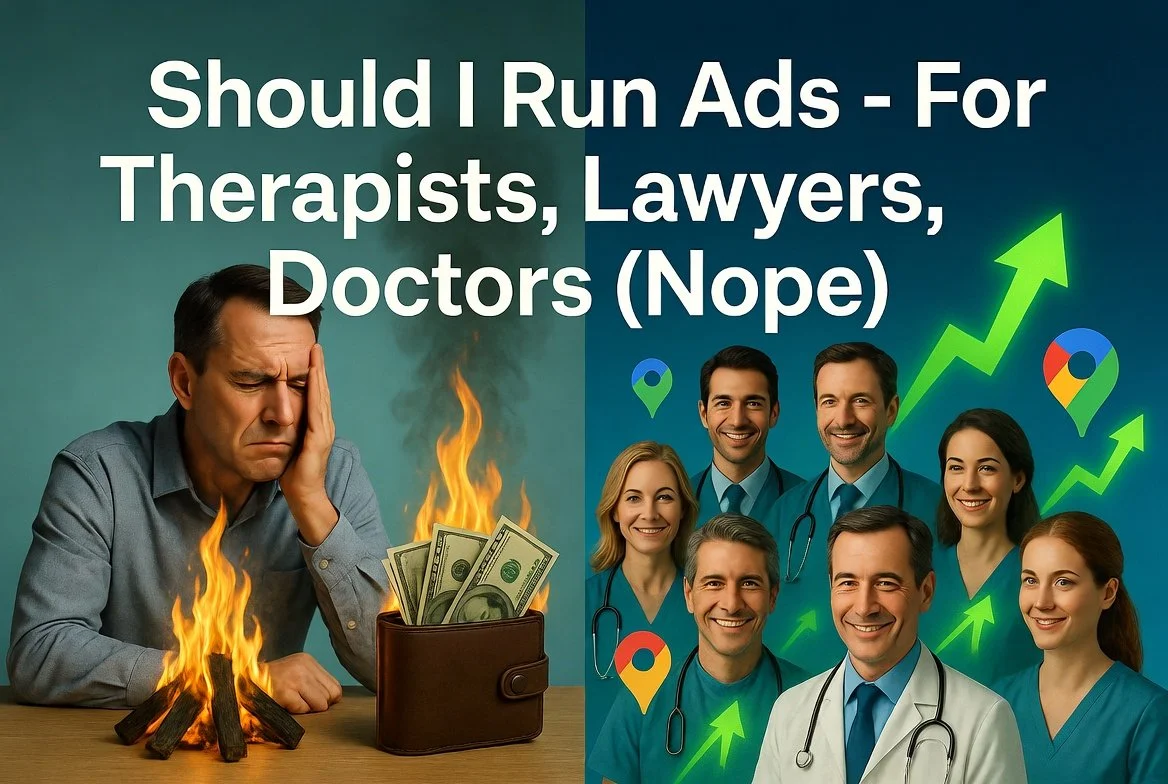
The problem is that speed without structure is how therapists bleed away money. Google Ads can absolutely help a therapy practice, medical practice, law firm, or other professional service business. But ads are not a substitute for a weak website, unclear service pages, thin content, poor search intent matching, weak local SEO, vague positioning, or a brand that sounds like every other practice hiding behind “safe space” and “compassionate care.” Those phrases have been through enough. Let them rest.
Here is the brutal little truth: ads magnify what already exists. If your website is clear, specific, credible, and conversion-focused, paid traffic can help you test and scale. If your website is thin, confusing, generic, or disconnected from what people actually search for, ads simply deliver more strangers to a place that fails to earn their trust. Congratulations. You bought a bounce. Civilization marches on, mostly sideways.
The numbers make this less theoretical. WordStream’s 2025 Google Ads benchmarks reported an average Google Ads search cost per click of $5.26 across industries, with Attorneys & Legal Services at $8.58, Dentists & Dental Services at $7.85, Physicians & Surgeons at $5.00, and Personal Services at $5.81. The average cost per lead across industries was $70.11, while Attorneys & Legal Services reached $131.63 and Physicians & Surgeons landed at $56.83. Those are averages, not guarantees. Local competition, specialty, geography, landing page quality, and follow-up process can make the real cost better or uglier. Usually both, depending on the week and whatever nonsense the algorithm had for breakfast.
For therapists, the danger is not only cost per click. It is cost per qualified client. A $6 click can become a $180 intake if the page converts well. Or it can become a $600 shrug if the visitor lands on a homepage with three vague paragraphs, a stock photo of pebbles, and a contact form that feels like filing taxes in a fog bank. Paid ads do not fix that. They reveal it.
Why Therapists Reach for Ads First
Therapists usually consider ads for one of five reasons. They are opening a new private practice. They want more private-pay clients. They hired another clinician and need to fill the caseload. Referrals slowed down. Or they are tired of directory dependency, where Psychology Today, Zocdoc, Healthgrades, FindLaw, Avvo, or some other platform owns the first touch and rents attention back to them like a tiny digital landlord.
Each reason is valid. The mistake is treating ads as the first move instead of the amplifier. A therapist who has no strong service pages, no topic clusters, no local content, no internal links, no real long-tail keyword strategy, and no trust-building content is trying to buy demand without building authority. That is the marketing equivalent of installing a bigger faucet before checking if the sink exists.
This is where Get Organic Authority comes in as the smarter starting point for high-trust businesses. The goal is not to shame ads into a corner. The goal is to build the organic authority system ads should eventually support: service pages, pillar pages, supporting blogs, internal links, local relevance, trust signals, and human content that helps people feel safer before they ever call. If you need the first strategic asset, The Organic SEO Authority Blueprint builds a long-form pillar around your core service or niche. If you need the full monthly system, The Foundation builds 10 long-form SEO articles each month into connected topic clusters. Tiny detail: connected. Random content is just clutter wearing keywords.
The Core Problem Is Not “No Ads.” It Is No System.
Most therapists ask, “Should I run ads?” A better question is, “What will happen after someone clicks?” That question separates strategy from expensive wishing.
A searcher who clicks an ad for “trauma therapist near me” has a very different mind than someone casually reading “what is trauma?” The ad click is warmer, more urgent, and less patient. They want to know if you help people like them, in their location, with their issue, in a way that feels credible and safe. If the landing page forces them to decode your specialties, guess your fees, search for availability, or scroll through a generic life story, they leave. They may even like you. They still leave. The internet has trained people to abandon confusion instantly, which is rude but efficient.
That is why the foundation has to come before the faucet. A therapy practice needs pages that match buyer intent. A trauma therapy service page should speak to trauma symptoms, first-session concerns, treatment fit, modalities, location, and next steps. A couples therapy page should answer conflict, betrayal, communication breakdown, pricing, session structure, and emotional safety. A private-pay therapy page should explain value, fees, insurance alternatives, and who private-pay care fits. Then blog content should support those pages with specific questions. That is how organic SEO and paid traffic start working together instead of arm-wrestling in the budget meeting.
Ads Are a Faucet. SEO Is the Plumbing.
Paid ads are not evil. They are just brutally literal. You pay for visibility. The visibility appears. The budget stops. The visibility fades. This is why the Get Organic Authority homepage frames paid ads as temporary traffic while long-form SEO content builds compounding authority. That is not anti-ad drama. That is simply how the channels behave.
Organic SEO works differently because every strong page becomes a possible future entry point. A service page can rank for high-intent local searches. A pillar article can rank for broad strategic questions. Supporting blog posts can rank for long-tail searches, objections, comparisons, and emotional questions people feel too embarrassed to ask clearly. Internal links move those readers toward service pages. Over time, the site becomes less dependent on paying for every visit.
This matters even more because clicks from Google are more competitive than they look from the outside. SparkToro’s 2024 zero-click search study found that for every 1,000 Google searches in the United States, only 360 clicks went to the open web. In the European Union, the number was 374. Translation: when you earn a click, do not waste it. The visitor should not land in a digital hallway with no signs, no confidence, and one lonely button labeled “Contact.”
A therapist’s website should behave more like a guided clinical intake path than a brochure. The user starts with a symptom, fear, referral, or question. The site helps them name the issue. It gives them a relevant page. It links to deeper context. It explains the process. It makes the next step feel clear. This is not manipulation. This is user experience with shoes on.
The Mistake Most Therapists Make
The big mistake is running ads before the website can answer the searcher’s real objection. The real objection is rarely “do therapists exist?” The searcher already knows therapists exist. The deeper questions are: Can I trust this person? Do they understand my exact problem? Will this be awkward? Is this worth the money? Will they judge me? Do they work with people like me? What happens in the first session? Can I afford this? Is there a better option? Will I regret reaching out?
That is why therapist marketing needs trust-building content. A person searching for therapy is often in a vulnerable state. They may be ashamed, overwhelmed, numb, skeptical, or quietly desperate. A paid ad can get their attention for three seconds. A strong content ecosystem can meet the question under the keyword. That is the difference between traffic and trust.
This is also why the Get Organic Authority ecosystem already includes articles like Why Is My Therapy Website Not Getting Clients?, The Back-Pocket Search, and The Trust Gap. Those pieces connect to the same central idea: people do not simply find a therapist and call. They verify. They compare. They feel out the language. They look for signs of safety. They may get a referral and still Google you in the car like a tiny private investigator with anxiety and a phone at 7% battery.
Reviews and reputation belong in this same trust path. BrightLocal’s local SEO statistics report that 97% of consumers read reviews for local businesses, 71% use Google to read local business reviews, and 67% often or always look at reviews after a local business search. That does not mean reviews replace SEO. It means SEO, reviews, service pages, content, and brand trust work together. A person may click an ad, read reviews, scan your website, leave, search your name later, read a blog, and then call. Attribution tools will pretend this journey is neat. Adorable.
Build the Page Before You Buy the Click
Before a therapist runs ads, the landing page needs to earn the click. This is the basic checklist.
The page should name the service clearly in the headline. It should say who the service helps. It should explain the problems people bring. It should mention location or telehealth availability. It should explain the therapeutic approach without turning into graduate school soup. It should answer fees or at least reduce pricing anxiety. It should include next steps. It should include proof where ethically appropriate. It should internally link to related services and supporting articles. It should sound like a human being, ideally one who has met another human being before.
A trauma therapy page might link to articles about emotional numbness, trauma responses in relationships, EMDR questions, first-session expectations, and choosing a trauma therapist. A couples therapy page might link to articles about conflict cycles, affair recovery, resentment, communication, and discernment counseling. A private-pay page might link to a guide on therapy investment, insurance tradeoffs, and finding the right fit. Those supporting articles then link back to the service page. This is the basic nervous system of a content ecosystem.
Google’s own link best practices say anchor text should be descriptive, concise, and relevant, helping people and Google understand the linked page. That is why how to internally link blog posts to service pages is not a cute side topic. It is revenue architecture. A blog post that ranks but fails to send people toward the right service page is like a therapist who does a beautiful intake and forgets to schedule the second session.
Random Blog Posts Will Not Save You Either
Here is where many therapists swing from one mistake to another. They stop ads, hire a cheap SEO agency or blog mill, and receive four monthly posts with titles like “The Benefits of Therapy,” “Why Mental Health Matters,” and “How to Practice Self-Care.” These posts are not evil. They are just tired. They target vague keywords, say nothing specific, link nowhere useful, and sound like a wellness pamphlet got trapped in a toaster.
Get Organic Authority builds content ecosystems, not random blog posts. That means every article has a job. Some articles support service pages. Some build topical authority around a core specialty. Some answer comparison questions. Some reduce objections. Some support local SEO. Some strengthen referral verification. Some create a path from problem-aware search to booking-ready page.
A therapist SEO ecosystem around trauma therapy might include a trauma therapy service page, EMDR therapy page, childhood trauma article, emotional numbness article, first-session guide, cost guide, trauma and relationships article, panic attacks after trauma article, comparison of EMDR and talk therapy, and a local guide for trauma therapy in the practice’s city. That is not “blogging.” That is a map. Tiny miracle: maps work better than confetti.
This is exactly the logic behind how to build a topic cluster for a service business website. A topic cluster gives Google repeated, connected evidence that your site understands a subject deeply. One article says, “We know this topic.” A cluster says, “We live here. We pay taxes here. We can explain the side streets.”
Search Intent Decides the Page
Search intent is the reason many ad campaigns and SEO campaigns fail in matching outfits. A therapist might want to rank for “anxiety therapy,” but people searching that phrase are not all in the same state of mind. Some want symptoms. Some want treatment options. Some want a therapist near them. Some want medication. Some want to know if what they feel is even anxiety. Throwing everyone onto the same vague homepage is a wonderful way to make no one feel seen.
A real strategy separates the searcher’s stage. Informational searches need educational content. Comparison searches need balanced, specific guides. Local high-intent searches need service pages and local pages. Branded searches need confirmation assets like bios, reviews, testimonials, FAQs, and process pages. Referral searches need trust. Ads should usually point to the most relevant high-intent page, while SEO content should cover the questions around that page.
This is why search intent for service businesses belongs inside this article’s ecosystem. The page should match the person behind the keyword. For therapists, that person may be searching through shame, fear, ambivalence, or urgency. For lawyers, they may be searching through deadlines, money, custody fears, injury stress, or legal uncertainty. For doctors, they may be searching through pain, symptoms, diagnosis confusion, or treatment anxiety. Same SEO principle. Different emotional weather.
Why Cheap SEO Usually Fails High-Trust Businesses
Cheap SEO fails therapists, lawyers, doctors, and private practices because it treats every business like a keyword container. High-trust services need more than keywords. They need credibility, specificity, structure, and emotional intelligence. Google’s helpful content guidance says its ranking systems are designed to prioritize helpful, reliable information created for people, and it specifically points creators toward original information, comprehensive description, useful analysis, and E-E-A-T concepts. That is a very different standard than “publish 500 words and sprinkle the keyword like parsley.”
For a therapist, generic content is not just weak for rankings. It is weak for trust. A page that says “we treat anxiety, depression, trauma, and life transitions” with no deeper explanation gives the visitor almost nothing to hold. A stronger page explains how anxiety shows up, who the practice helps, what treatment may involve, what the first session feels like, how scheduling works, and which related concerns may belong on adjacent pages. Then supporting articles deepen the topic.
For a law firm, cheap SEO often creates thin legal summaries with no state specificity, no practice-area depth, no consultation path, and no human understanding of fear. For a doctor, cheap SEO often creates generic condition pages that sound medically cautious yet practically useless. For private practices, cheap SEO often creates content that ranks nowhere and converts no one, which is an impressive two-part failure.
This is why Get Organic Authority positions against generic SEO agencies, cheap blog mills, AI content farms, and shallow keyword-chasing. The work is not “write more words.” The work is building an authority system: pillar pages, service pages, supporting articles, internal links, topical depth, local relevance, and conversion-focused writing. Words are the material. Strategy is the architecture.
The Paid Ads Test That Actually Makes Sense
A therapist can run ads once the foundation is strong enough to make the test useful. The right version sounds like this: “We have a strong trauma therapy page. We have supporting content around trauma symptoms, EMDR, emotional numbness, first-session expectations, and local trauma therapy searches. We have clear calls to action, conversion tracking, review signals, and follow-up process. Now let us run ads to test demand, accelerate visibility, and measure cost per qualified consultation.” That is strategy.
The wrong version sounds like this: “We need clients. Let us run ads to the homepage.” That is less strategy and more tossing breadcrumbs into a ceiling fan.
If ads enter the picture, conversion tracking has to enter first. Google Ads conversion tracking exists because clicks alone are not the point. Track calls. Track form fills. Track booked consultations. Track no-shows. Track first sessions. Track which ad groups produce aligned clients. Track cost per qualified lead, not vanity traffic. A therapy practice does not need 300 random clicks. It needs the right people taking the right next step.
For local practices, Google Business Profile guidance also matters because local rankings are influenced by relevance, distance, and prominence. Ads may show above local results, but searchers still look at the business profile, reviews, location, photos, hours, and website. Paid visibility and local trust are not separate kingdoms. They are parts of the same buyer journey, because apparently humans insist on checking several things before making a vulnerable decision. Reasonable, honestly.
Dogfooding: The Part Where Get Organic Authority Eats Its Own Cooking
A lot of SEO agencies talk about content ecosystems while their own blog looks like it has been abandoned since the Obama administration. Get Organic Authority takes the opposite route. The site is being built publicly through daily long-form SEO articles, internal links, topic clusters, and high-trust positioning for lawyers, doctors, therapists, and private practices. The dogfooding article explains the strategy directly: use the same content system on the company’s own site that clients are being asked to trust.
That matters. It turns the blog into proof instead of a brochure. The ecosystem already connects articles about local leads without paying for every click, doctors getting more patients from Google without depending on ads, law firms turning Google traffic into consultations, service pages that turn searches into leads, and why competitors show up on Google before you do. This article belongs in that same cluster because it addresses one of the most expensive questions a therapist or private practice can ask: should I pay for traffic before I have built trust?
The answer is usually: build the trust system first, then use ads carefully.
The Better Sequence for Therapists
Here is the cleaner sequence before running ads.
Step one: clarify the niche. “Therapy” is too broad. Trauma therapy for adults, couples counseling for betrayal trauma, anxiety therapy for professionals, EMDR for first responders, or private-pay therapy for high-achieving women gives the strategy a spine.
Step two: build service pages that match real buyer intent. The service page should be specific enough to rank and useful enough to convert.
Step three: create a pillar article around the main authority topic. This is where The Organic SEO Authority Blueprint fits beautifully. One pillar article can map the first cluster, target a valuable topic, and anchor future supporting content.
Step four: publish supporting articles around long-tail questions, emotional search intent, objections, and local terms. This is where The Foundation becomes the full engine: 10 long-form SEO articles each month, built into connected topic clusters rather than scattered blog confetti.
Step five: internally link everything with intention. Articles should link to service pages. Service pages should link to relevant resources. Pillars should link to spokes. Related articles should connect when they naturally help the reader. This is how the site becomes easier for users and search engines to understand.
Step six: improve trust signals. Reviews, bios, FAQs, credentials, process clarity, fees, location, ethical testimonials where appropriate, and strong calls to action all matter.
Step seven: run ads to the pages that are already built to convert. Now the ad budget has a fighting chance. Tiny applause from the spreadsheet.
Final Thoughts
So, should therapists run ads? Sometimes. But ads should not be the first rescue boat for a website that cannot explain what the practice does, who it helps, why it can be trusted, and what the next step should be.
The smarter play is to build organic authority first. Build service pages that convert. Build pillar pages that anchor your niche. Build supporting articles that answer real questions. Build internal links that guide readers instead of abandoning them. Build local visibility, trust signals, and content depth. Then, when paid ads enter the strategy, they amplify something real instead of funding confusion.
If you are a therapist, lawyer, doctor, private practice, or high-trust service business tired of renting attention one click at a time, Get Organic Authority builds the content ecosystem your website should have had before the ads started draining the account. Start with The Organic SEO Authority Blueprint if you need one powerful pillar article to map the strategy. Choose The Foundation if you are ready for a monthly authority engine with 10 long-form SEO articles built around your core services, long-tail keywords, topical authority, internal links, and trust-building content.
Stop buying clicks for a website that cannot carry the conversation. Build the authority system. Then let traffic find something worth trusting.
