They Said What? Common SEO Lies Doctors, Lawyers, and Therapists Keep Hearing
The SEO Pitch That Sounds Like a Timeshare Presentation
Some SEO pitches feel less like strategy and more like a man in a shiny blazer trying to sell you beachfront property in Nebraska. The agency promises page-one rankings, explosive traffic, secret backlinks, AI-powered content, thirty blog posts per month, and a dashboard with enough colored arrows to make a casino jealous. Doctors hear it. Lawyers hear it. Therapists hear it. Private practice owners hear it while already juggling calls, charts, cases, notes, staff, compliance, and the quiet daily circus of running a serious professional service business.
The problem is not that SEO is fake. SEO is very real. The problem is that bad SEO is easy to sell because it sounds tidy. Buy keywords. Publish blogs. Add backlinks. Wait for money. Human beings love simple vending-machine promises, which explains both bad SEO packages and gas station sushi. But professional service SEO does not work like a vending machine. It works more like reputation, clinical trust, legal credibility, or medical authority. You build it through depth, consistency, structure, usefulness, and proof.
That is especially true for high-trust businesses. Nobody chooses a trauma therapist, estate planning attorney, orthopedic surgeon, med spa, pediatric dentist, or private-pay practice after skimming one robotic 600-word blog titled “Top 5 Benefits of Services.” They search because something matters. They compare because the stakes feel personal. They look for evidence that you understand the problem before they give you their information, their money, their story, or their body. Tiny details carry weight. Thin content feels thin. Generic advice smells like a wet cardboard box.
Why These Lies Work So Well
The common SEO lies work because business owners are exhausted. A therapist wants more aligned clients. A lawyer wants better consults. A doctor wants the right patients. A practice owner wants the phone to ring without selling a kidney to Google Ads every month. So when an SEO company says, “We can handle everything,” the relief feels real. That relief is exactly where the trap opens.
A shallow SEO agency usually sells activity instead of architecture. Activity sounds productive. Ten blogs. Twenty citations. Fifty backlinks. A ranking report. A technical audit. A login to a dashboard nobody opens because the charts look like a weather map for an alien planet. Architecture is different. Architecture asks harder questions. Which service pages need to convert? Which pillar pages need to establish authority? Which supporting articles answer real buyer questions? Which internal links move readers toward decisions? Which topics prove expertise around a niche? That is where real organic authority begins.
The Paid Search Math Already Looks Expensive
The ecosystem fix
This sits beside local leads without paying for every click, doctors getting more patients without depending on ads, and law firms turning Google traffic into consultations. It turns the paid-search pain into a broader authority argument instead of a lonely rant about ad spend.
The pressure to believe SEO shortcuts gets worse because paid search has become brutally expensive in professional categories. WordStream’s 2025 Google Ads benchmarks found the average cost per click across industries was $5.26, with attorneys and legal services at $8.58, dentists at $7.85, and physicians and surgeons at $5.00. The average cost per lead was $70.11 overall, but attorneys and legal services came in at $131.63 per lead, dentists at $83.93, physicians and surgeons at $56.83, and business services at $103.54. Those numbers are not evil. Paid ads can work. But they make one thing painfully clear: visibility rented by the click gets expensive fast.
That is why the smarter question is bigger than “Should we hire an SEO company?” The better question is: are we building an asset that compounds, or are we buying another month of digital oxygen? If you want a cleaner starting point, Get Organic Authority built The Organic SEO Authority Blueprint for exactly this reason: to map the first real pillar, the supporting articles, the service-page opportunities, and the internal links before money gets poured into motion. For businesses ready to build every month, The Foundation turns that map into a consistent content ecosystem.
Lie #1: “We Guarantee Page-One Rankings”
This is the classic. The old reliable. The SEO equivalent of a fortune cookie wearing a Bluetooth headset. Any agency guaranteeing a specific organic ranking is either oversimplifying search, selling paid placement in disguise, or hoping you never ask how rankings actually work. Google’s own SEO Starter Guide says there are no secrets that automatically rank a site first. Search changes. Competitors publish. Local packs shift. Reviews move. User behavior changes. Algorithms interpret intent differently. The SERP is a living thing, not a hotel room you reserve for the weekend.
A better agency can forecast opportunities. It can identify winnable long-tail keywords. It can improve structure, content depth, internal links, and conversion paths. It can build authority around a topic until your website becomes more deserving of visibility. But a ranking guarantee for “best lawyer near me” or “therapist for anxiety” belongs in the same drawer as miracle hair tonic and crypto advice from a guy named Blade.
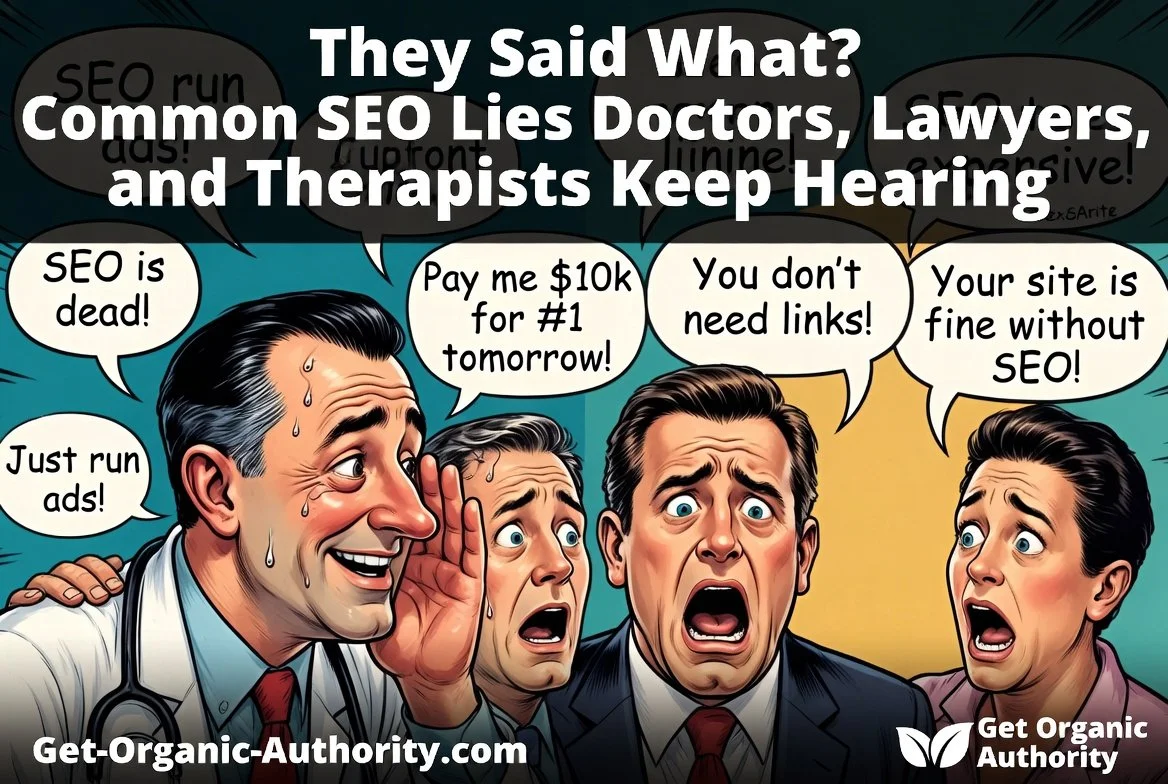
They will say just about anything to get that contract signed!
What a Real Promise Sounds Like
The ecosystem fix
This section links to why your competitors show up on Google before you do and then to The Organic SEO Authority Blueprint as the practical next step.
A real promise sounds less flashy and more useful. We will build the strongest possible page for this search intent. We will connect it to supporting content. We will strengthen your service pages. We will help Google understand the relationship between your expertise, your location, your audience, and your offer. We will measure rankings, traffic, inquiries, and content gaps over time. That is not as sexy as “guaranteed #1,” but neither is flossing, and dentists keep insisting it matters.
Get Organic Authority takes that architecture-first view through content ecosystems, pillar pages, supporting articles, service pages, and strategic internal linking. The goal is not to trick Google for a week. The goal is to make your website a clearer, deeper, more useful answer than the competitor currently standing in your way. The article on why your competitors show up on Google before you do explains the same ugly truth: stronger competitors usually have stronger pages, clearer intent, and better structure. Annoying. Also fixable.
Lie #2: “You Just Need More Blog Posts”
More content can help. More random content can also turn your website into a junk drawer with a contact form. The lie is not that blogging matters. The lie is that volume by itself creates authority. A therapist does not need twenty disconnected posts about “self-care tips.” A law firm does not need a pile of nearly identical blogs about “what to do after an accident.” A doctor does not need generic health content that reads like it was assembled from mayonnaise and search volume.
Google’s helpful content guidance asks whether content provides original information, substantial description, insightful analysis, and value beyond the obvious. It also warns against producing lots of content across many topics merely hoping some of it performs. That matters because cheap SEO often mistakes production for strategy. The agency publishes. The invoice arrives. The website still feels like a filing cabinet fell down the stairs.
The Difference Between a Blog Calendar and a Content Ecosystem
The ecosystem fix
This is the natural handoff to how to build a topic cluster for a service business website, how to internally link blog posts to service pages, and service pages that turn searches into leads. Those three pages explain the machinery behind the claim.
A blog calendar says, “Here are four topics for this month.” A content ecosystem says, “Here is the pillar page that owns the main topic. Here are the supporting articles that answer the before-the-call questions. Here are the service pages that convert. Here are the internal links that move authority and readers through the site. Here is the search intent behind each piece. Here is how the cluster gets stronger over time.” One is scheduling. The other is strategy. Humanity survives another distinction.
For example, a therapist who wants to rank for trauma therapy should not publish one lonely blog and then wander into the woods. The ecosystem might include a trauma therapy service page, a pillar on how trauma therapy works, supporting articles about EMDR, complex trauma, somatic symptoms, dissociation, trauma and relationships, cost questions, and what to expect in the first session. Those articles should link into the core service page and to each other where helpful. That is why Get Organic Authority’s guide on building a topic cluster for a service business website belongs near the center of this conversation. A cluster tells Google, and the human reading, that the business understands the whole problem instead of one keyword-shaped crumb.
Lie #3: “We’ll Handle Your Keywords”
This sounds responsible until you learn that many agencies treat keywords like lottery tickets. They chase volume. They stuff phrases. They celebrate ranking for terms that bring curious readers instead of serious buyers. A therapy practice does not need traffic from people writing college papers on attachment theory. A medical practice does not need visitors looking for anatomy diagrams. A law firm does not need national informational traffic when it needs local consults for a specific practice area.
Search intent matters because the person behind the search is at a different point in the decision. “What is EMDR?” is educational. “EMDR therapist near me” is closer to action. “Cost of trauma therapy in Miami” suggests evaluation. “Best divorce lawyer for custody case” carries urgent buyer intent. One keyword brings a reader. Another brings a potential client. Pretending they are equal is how agencies build traffic graphs that look successful while the phone remains quieter than a museum gift shop on a Tuesday.
Intent Beats Volume in High-Trust SEO
The ecosystem fix
Read this to understand search intent for service businesses and The Back-Pocket Search because both explain how real buyers quietly compare professional service brands before they ever make contact.
High-trust SEO works when content matches the emotional and practical stage of the searcher. Some pages should educate. Some should compare. Some should convert. Some should reassure. Some should answer the awkward questions people search at midnight before they ever call your office. Get Organic Authority’s article on search intent for service businesses is the antidote to keyword-chasing. The goal is not merely to rank. The goal is to rank for searches that match the reader’s actual need and the business’s actual offer.
Lie #4: “Technical SEO Will Fix Everything”
The ecosystem fix
The practical bridge here is service pages that turn searches into leads because technical cleanup means very little when the page itself gives people no reason to call.
Technical SEO matters. A broken site, slow pages, messy indexing, bad redirects, and crawl problems can hurt performance. But technical SEO becomes a lie when it is sold as the whole solution. Many professional service websites are technically fine enough to be found, yet strategically empty enough to be ignored. The lights are on. The rooms are bare. Google can crawl the site and still find very little worth ranking.
A site audit might identify missing titles, duplicate meta descriptions, weak schema, thin pages, and slow load times. Good. Fix those. Then ask the bigger question: what authority does this website actually prove? Does it explain the practice areas deeply? Does it show expertise? Does it answer the real objections? Does it connect related pages? Does it help a person make a decision? Technical SEO prepares the road. Content authority gives people a reason to travel it.
Lie #5: “Backlinks Are All You Need”
The ecosystem fix
This links cleanly to The Trust Gap because backlinks may signal popularity, but trust is built on proof, clarity, and content that feels worthy of the decision.
Backlinks still matter, but “we build links” has become one of the slipperiest phrases in SEO. Some links are legitimate signals of trust. Others are digital confetti fired from websites that exist purely to sell digital confetti. Professional service businesses need reputation, not mysterious backlinks from sites with names like BestInfoGlobalHub247. Very serious. Much authority. Possibly operated from a haunted printer.
Google’s spam policies call out link spam, and its helpful content guidance points repeatedly toward useful, people-first content. The safest long-term link strategy is to deserve links through useful resources, local relevance, strong service pages, expert content, community relationships, and real authority. A backlink may help a strong page. It rarely rescues a hollow one.
Lie #6: “AI Content Is the Same as Expert Content”
The ecosystem fix
Pair this with the dogfooding article to show that Get Organic Authority uses AI-aware workflows without turning the site into a landfill of synthetic sameness.
AI can assist research, outlines, editing, ideation, and workflows. Used well, it is a power tool. Used lazily, it produces beige pudding with headings. The SEO lie is that AI-generated content at scale can replace expertise, experience, original judgment, and a human understanding of the audience. Google’s spam policies specifically warn against generating many pages mainly to manipulate rankings and provide little value, including pages created with generative AI tools without adding value for users.
This matters more for doctors, lawyers, therapists, and high-trust businesses because the content has to carry credibility. A person reading about panic attacks, custody battles, personal injury, addiction treatment, root canals, hormone therapy, or estate planning is not shopping for novelty socks. They are trying to decide whom to trust. Generic content creates the opposite of trust. It creates a faint but unmistakable odor of “nobody here really wrote this.”
Real Authority Has Fingerprints
Strong SEO content should sound like it came from a real practice with a real point of view. It should include examples from the field, clear explanations, practical nuance, relevant internal links, and honest answers. It should know the difference between a diagnosis page and a service page, a legal guide and a consultation page, a medical explainer and a conversion asset. The article on The Trust Gap captures this perfectly. High-trust businesses lose when their website feels thinner than their expertise. The page has to make the reader feel, “These people understand me,” before it asks for the inquiry.
Lie #7: “SEO Is Just Ranking Keywords”
The ecosystem fix
This is where service pages that turn searches into leads and internal linking from blog posts to service pages become conversion infrastructure rather than SEO decoration.
Ranking keywords is one piece of the machine. The machine also needs conversion. A law firm can rank for an informational article and still fail to earn consultations if the service pages are weak. A therapist can attract visitors and still lose private-pay clients if the site never builds enough trust. A doctor can get traffic and still lose patients if the page feels sterile in the wrong way, which is impressive because medical websites have somehow made sterile feel suspicious.
SEO for professional services needs a clear path from search to belief to action. That path often looks like this: a person finds a supporting article, reads a useful answer, clicks into a related service page, scans proof of expertise, checks location and fit, reads reviews, compares options, and then calls or fills out a form. Internal links matter because they create that path. Service pages matter because they convert the path. Pillar articles matter because they anchor the topic. Supporting blogs matter because they answer the doubts along the way.
Lie #8: “Your Monthly Report Means Things Are Working”
A report can be useful. A report can also be a fog machine with bullet points. Impressions went up. Average position moved. Traffic increased by 11%. Lovely. Did better-fit leads increase? Did the right pages get more organic visits? Did consults improve? Did local visibility grow? Did a service page start ranking? Did supporting articles push readers toward the offer? Did anyone with a pulse and a wallet actually contact the business? These questions are rude only to agencies that hate accountability.
For high-trust businesses, SEO reporting should connect rankings to real business movement. That includes organic traffic by page type, keyword intent, local visibility, engagement, assisted conversions, phone calls, form fills, consultation requests, and opportunities to strengthen the ecosystem. A therapy practice needs more than “blog traffic is up.” A law firm needs more than “you rank for a phrase nobody hires from.” A medical practice needs more than a spreadsheet that could induce a coma in a hummingbird.
Lie #9: “Local SEO Is Just Your Google Business Profile”
The ecosystem fix
This section links to local leads without paying for every click, doctors getting more patients from Google, and law firms turning Google traffic into consultations.
Google Business Profile is important. BrightLocal’s local SEO statistics show 72% of consumers use Google to search for local business information, 45% default to Google for local searches, and 97% read reviews for local businesses. BrightLocal also reports that consumers trust Google, Google Maps, business websites, Facebook, and Yelp for local business information. Local SEO clearly matters. But local SEO is not only the profile. Your website still has to support the trust decision.
A complete Google Business Profile can help discovery, but the searcher often moves from the map pack to the website for confirmation. They want to know what you do, who you help, where you serve, what makes you different, what the process looks like, and whether you sound like a grown adult with a plan. Local visibility opens the door. Content convinces people to step through it without checking for hidden trapdoors.
The Website Has to Carry the Trust
This is where service pages, localized content, FAQs, reviews, internal links, and educational articles work together. A dentist in one city, a family lawyer in another, and a trauma therapist in a third all need local relevance. But local relevance has to be wrapped around expertise. That is why articles like how doctors get more patients from Google without depending on ads, how law firms turn Google traffic into consultations, and why a therapy website is not getting clients belong in the same ecosystem. Different industries. Same trust problem. Same need for authority-driven pages that turn searches into action.
Lie #10: “SEO Takes Six Months, So We’ll Talk Then”
SEO does take time. That part is true. The lie is using time as a shield against clarity. A serious strategy should have early signals. Are pages indexed? Are impressions growing for the right terms? Are long-tail queries appearing? Are service pages gaining visibility? Are internal links built correctly? Are supporting articles strengthening the cluster? Are users engaging with the content? Waiting six months with no visible architecture is not patience. It is marketing anesthesia.
A strong SEO plan should show what is being built, why it exists, what it links to, which intent it serves, and how success will be measured. That does not mean every piece ranks instantly. It means the work should make strategic sense from day one. The best SEO feels like building a city map. The worst SEO feels like someone throwing pamphlets out of a helicopter and calling it urban planning.
What Real SEO for Doctors, Lawyers, and Therapists Looks Like
Real SEO starts with the business model. Who is the ideal client or patient? Which services are most valuable? Which cases, treatments, or specialties matter most? Which local markets should the website serve? Which questions does a serious buyer ask before contacting the office? Which pages need to convert? Which content gaps allow weaker competitors to outrank a stronger practice? That is the foundation.
Then the content ecosystem gets built around that foundation. A law firm might need a main practice-area service page, a location page, a pillar article on the legal problem, supporting blogs around timelines, costs, mistakes, evidence, process, and FAQs, plus internal links guiding readers toward consultation. A doctor might need condition pages, treatment pages, insurance or payment explainers, procedure guides, recovery expectations, local pages, and trust-building articles. A therapist might need service pages for anxiety, trauma, couples therapy, EMDR, addiction, or private-pay care, plus articles that answer emotional, practical, and cost-based questions.
The Ecosystem Is the Strategy
The content should function like a web, because that is what it is. Pillar pages establish depth. Supporting articles capture long-tail searches. Service pages convert. Internal links distribute relevance and guide readers. Local pages connect geography. Case examples, clinical nuance, legal insight, medical clarity, and expert explanations build trust. The system gets stronger as each page supports the others.
This is also why Get Organic Authority openly uses dogfooding. The company builds and connects its own content ecosystem to prove the strategy it sells. The piece on publishing one SEO article every day is not just a cute behind-the-scenes note. It is proof of method. The company is using the same organic authority model it recommends to professional service businesses, because apparently practicing what you preach remains legal in some jurisdictions.
The Better Checklist Before Hiring an SEO Company
The ecosystem fix
This checklist naturally points to The Organic SEO Authority Blueprint for diagnosis and The Foundation for execution, because a real SEO plan needs both map and momentum.
Before a doctor, lawyer, therapist, or private practice hires an SEO company, the questions should get sharper. Ask what pages they would build first and why. Ask which service pages are missing. Ask how they choose article topics. Ask how every blog supports a larger cluster. Ask how they use internal links. Ask how they measure lead quality. Ask what makes the content expert-level. Ask how they avoid generic AI content. Ask what they would stop doing if the data showed the strategy was weak.
The wrong SEO company will answer with buzzwords. The right one will answer with architecture. It will talk about search intent, topic clusters, conversion pages, long-tail keywords, local visibility, buyer psychology, trust, and page relationships. It will understand that a therapist, attorney, doctor, or professional service firm cannot win long-term with filler content and decorative dashboards. The stakes are higher. The content has to be better.
Final CTA: Build Authority Instead of Buying Excuses
If your SEO company is selling guarantees, random blogs, cheap AI content, mystery backlinks, and reports that explain motion without explaining progress, it may be time to step away from the magic show. Keep the rabbit. Leave the hat.
Get Organic Authority builds content ecosystems for high-trust professional service businesses: lawyers, doctors, therapists, private practices, medical practices, and service firms where credibility matters before the first call. The work centers on topical authority, search intent, service pages, pillar pages, supporting articles, internal linking, and conversion-focused content that helps real people trust you before they ever meet you.
Start with The Organic SEO Authority Blueprint if you need the strategic map: the pillar, the cluster, the service-page opportunities, and the first real authority asset. Choose The Foundation if you are ready to build the system month after month. Or begin at the Get Organic Authority homepage and see how the ecosystem works in the wild. Your future clients are already searching. The only question is whether they find your expertise or another agency’s better-organized mediocrity.
