Why Therapist SEO Takes a Painfully Long Time to Kick In
The Waiting Room of Google Has Terrible Magazines
Therapist SEO is a lot like sitting in a waiting room where the receptionist keeps saying, “The algorithm will be with you shortly,” and then wanders into another dimension. You publish a thoughtful service page. You write a beautiful blog about anxiety therapy, EMDR, couples counseling, trauma treatment, or private-pay therapy. You check Google. Nothing. You check again. Still nothing. You begin to wonder if your website has been placed inside a digital witness protection program.
This is where many therapists, counselors, psychologists, doctors, lawyers, and private practice owners start to panic. They assume SEO is broken. They assume their content failed. They assume the cheap SEO company that promised “page one in 30 days” may have been telling the truth, which is adorable in the way a raccoon washing cotton candy is adorable. Tragic, wet, and doomed.
The truth is sharper and more useful: therapist SEO takes a painfully long time because trust takes a painfully long time. Google is not simply looking for a page with the phrase “therapist near me” sprinkled into it like parsley on a plate nobody asked for. Google is trying to understand what your website is about, who it serves, how credible it appears, how your pages connect, how people engage with your content, and how your practice fits into a local search market already crowded with directories, big platforms, ad-heavy competitors, and older websites with years of accumulated authority.
Slow SEO Usually Means Google Is Looking for Proof
Google Search Central explains that changes can take time to appear in search results. Some changes may show up in hours. Others may take several months. Google also recommends waiting at least a few weeks before judging whether a change had a beneficial effect. For a therapist staring at an empty analytics dashboard, “several months” feels less like guidance and more like a hostage note written by a spreadsheet. But the delay makes sense when the website is connected to a high-trust service.
People choose therapists during vulnerable moments. They search for trauma therapy, anxiety counseling, couples therapy, depression treatment, grief counseling, addiction support, EMDR therapy, family therapy, or therapy for burnout while carrying real pain. They scan quickly, but the decision carries weight. This is not a pizza coupon. This is “Can I trust this person with the story I barely tell myself?” Google has to treat that world differently than a search for novelty socks. Society has asked enough of socks already.
That is why a strong therapist SEO strategy has to build credibility from several directions at once. The homepage has to explain who you help. The service pages have to match real search intent. The blog content has to answer meaningful questions. The internal links have to guide visitors and search engines toward the most important pages. The whole site has to feel coherent, specific, useful, and trustworthy.
The First Ugly Truth: Most Content Never Gets Traffic
Here is the little goblin statistic hiding under every cheap SEO package: Ahrefs found that 96.55% of pages in its study received zero organic traffic from Google. Zero. Not “a little traffic.” Not “promising early movement.” Zero, the official number of tumbleweeds and abandoned mall fountains.
That number matters because many private practice SEO campaigns are still built around random blog posts. One week, “5 Ways to Manage Stress.” The next week, “What Is Anxiety?” Then “Self-Care Tips.” Then “How Therapy Can Help.” These topics sound nice. They also sound like every therapy website, wellness blog, hospital system, national directory, AI content farm, and dusty mental health portal from 2009 already wrote them while wearing the same beige cardigan.
A content calendar alone is not a strategy. A blog post alone is not an ecosystem. A keyword alone is not authority. A therapy website grows when the content is arranged into a connected system, where each page has a job and each article strengthens the pages that actually convert. That is why The Foundation is built around long-form SEO content, topic clusters, long-tail keywords, and internal linking rather than random posts flung into the internet like emotional confetti.
The Second Ugly Truth: New Pages Rarely Crash the Top 10
Ahrefs studied ranking timelines and found that only 1.74% of newly published pages reached Google’s top 10 within one year. It also found that 72.9% of pages in Google’s top 10 were more than three years old, and the average number one ranking page was five years old. There it is. The internet’s least charming bedtime story.
This does not mean a new therapy practice website has to wait five years to get any results. Local SEO for therapists can create earlier movement through Google Business Profile optimization, service page improvements, long-tail keywords, better internal linking, and content aimed at specific local intent. A therapist in Austin writing a precise page for “trauma therapy for first responders in Austin” is playing a different game than a brand-new generic blog post trying to rank for “anxiety.” One is a rifle shot. The other is a kazoo pointed at the moon.
The larger lesson is that Google rewards aged, proven, connected, useful content. Your first article may not explode. Your first service page may not instantly outrank Psychology Today, Zocdoc, Healthgrades, Yelp, WebMD, and the local competitor who has been publishing since flip phones roamed the earth. But the right content begins sending signals. It gives Google more context. It gives visitors more reasons to stay. It gives future articles something to connect to. It gives your website a skeleton instead of a pile of disconnected bones.
The Real Problem Is Usually Not Time. It Is Thin Strategy.
When therapists say SEO is taking too long, the honest question is: too long compared to what? Compared to paid ads, yes, SEO feels glacial. WordStream’s 2026 benchmarks show the average Google Ads cost per click is $5.42 and the average cost per lead is $66.69. Attorneys and legal services came in at $9.87 per click and $131.63 per lead. Dentists averaged $8.00 per click, while physicians and surgeons averaged $4.76. Paid traffic arrives fast because you are paying the toll booth goblin every time someone clicks. Charming business model, if your hobby is feeding coins into a furnace.
Paid search can absolutely make sense for a therapy practice, especially during launch, hiring, a new specialty push, or a high-value service campaign. But ads create rented visibility. Organic SEO builds owned visibility. The point is not “ads bad, SEO good,” because adults can hold two thoughts without needing a committee. The point is that ads are expensive when they are the whole strategy. SEO is slow when the strategy is shallow.
A private practice usually needs a content ecosystem that explains the practice from multiple angles. That means strong service pages, a homepage built for trust, local SEO signals, conversion-focused copy, supporting blogs, topical authority, and articles that answer the questions people ask before they book. A helpful starting point is The Organic SEO Authority Blueprint, especially for practices that need one strong pillar page to anchor future content instead of another lonely blog post floating in the void like a motivational quote on a dentist’s wall.
Why Therapist SEO Is Slower Than Normal Small Business SEO
Therapy Is a High-Trust Search
Therapist SEO moves slowly because therapy is not a casual purchase. Someone searching for “panic attack therapy near me” or “trauma therapist for childhood abuse” is not browsing for a novelty lamp shaped like a duck. They are often anxious, ashamed, overwhelmed, skeptical, private, and careful. That searcher wants information, tone, credentials, safety, clarity, and a reason to believe the therapist understands the actual problem.
Google’s helpful content guidance emphasizes useful, reliable, people-first content. That matters heavily for mental health SEO, medical practice SEO, lawyer SEO, and other high-trust professional service industries. These searches sit close to life decisions. A low-quality page can mislead someone, waste their time, or push them toward a poor-fit provider. Google has every incentive to reward content that feels specific, helpful, and credible rather than keyword soup ladled from a plastic bucket.
This is where many therapy websites lose. They say “safe space,” “healing journey,” and “compassionate care” so many times the words begin to tap on the glass and beg for release. The site may sound kind, but it gives Google very little substance. Strong search intent for service businesses means understanding the difference between someone looking for a definition, someone comparing therapy approaches, someone choosing between providers, and someone ready to book a consultation. Each search deserves the right page.
Your Service Pages Have to Carry the Weight
Most private practice SEO campaigns fail because the service pages are weak. The blog gets attention because writing posts feels productive. But service pages are where money, trust, and booking intent meet for an awkward little conference. A therapist needs strong pages for anxiety therapy, trauma therapy, couples counseling, EMDR therapy, depression counseling, grief counseling, addiction therapy, family therapy, teen therapy, or whatever the actual clinical services are.
A strong therapy service page answers practical questions. Who is this for? What symptoms or situations does it address? What happens in therapy? What approach does the clinician use? What makes this practice different? Where is the practice located? Can people book online? What should they expect during the first session? This is the difference between a page that ranks and a page that quietly performs digital mime.
The same principle applies to law firms, doctors, dentists, chiropractors, med spas, consultants, and other professional service firms. A page built around real buyer intent outperforms a vague page built around vibes. If a website needs better conversion pages, the logic behind service pages that turn Google searches into leads matters more than another generic blog called “Why Choose Us?” which is usually answered by the visitor with, “I am trying to, but you have provided the informational density of a napkin.”
Topical Authority Is Not a Buzzword. It Is the Receipts.
Topical authority means your website has enough useful content around a subject that Google can understand your expertise. For therapist SEO, that might mean a content ecosystem around anxiety therapy with pages and articles covering panic attacks, social anxiety, work anxiety, high-functioning anxiety, anxiety and sleep, anxiety therapy approaches, local anxiety counseling, and therapy FAQs. One article says, “I wrote a thing.” A cluster says, “This practice understands this problem from multiple angles.”
A good topic cluster for a service business website does not chase keywords like a raccoon chasing a shiny fork. It organizes search intent. The main service page targets buyer intent. Supporting blogs answer questions. Comparison articles clarify options. Local pages capture nearby searches. Internal links move authority toward the pages that convert. Everything has a role. Amazing how strategy works better when it has one.
For example, a trauma therapist may need a pillar page for trauma therapy, a local service page for trauma therapy in their city, and supporting articles about trauma responses, EMDR vs talk therapy, complex trauma, dissociation, childhood trauma, somatic symptoms, and what to expect in the first trauma therapy session. Each article can serve a reader while supporting the core service page. That is how authority compounds without sounding like a robot swallowed a keyword spreadsheet.
Internal Linking Is the Part Everyone Treats Like Office Furniture
Internal linking is one of the most ignored reasons therapist SEO takes forever. A practice can publish ten good articles and still leave them stranded. Google discovers them, shrugs, and wonders how they fit together. Visitors read one post, then leave because the site offers no obvious next step. The content exists, but it behaves like a group project where nobody exchanged phone numbers.
Helpful internal links guide both humans and search engines. A post about panic attacks should connect to the anxiety therapy service page. A post about grief after divorce should connect to grief counseling and individual therapy. A post about EMDR should connect to trauma therapy. A local article should connect back to the primary local service page. The structure turns isolated content into a map.
This is why internal linking blog posts to service pages matters so much for therapy practices, medical practices, law firms, and local service businesses. Internal links are not decoration. They are the roads. Publishing without them is like building a beautiful clinic in the woods and forgetting the driveway.
The Myth of the Magic Blog Post
A lot of therapists secretly hope one blog post will do the whole job. One perfect article. One glorious Google breakthrough. One post titled “How to Know If You Need Therapy” that floats into the top three and rains private-pay clients like confetti from a financially responsible parade.
That can happen, but building a marketing strategy around miracles is usually a sign that someone has been spending too much time with Facebook ads gurus in sunglasses. SEO works through accumulation. Google sees repeated relevance. Users find multiple useful pages. Internal links create pathways. Service pages mature. The Google Business Profile gains activity. Reviews build trust. Backlinks and mentions may grow. Older content gets refreshed. The site becomes less of a brochure and more of an authority hub.
The article on why a therapy website is not getting clients makes this painfully clear: visibility alone is not enough. A therapist needs the right pages, right message, right proof, right path to contact, and right content depth. Traffic without trust is just people visiting your website to feel mildly confused before leaving forever. A truly modern fairy tale.
Reviews, Reputation, and Local Trust Are Part of the SEO Timeline
BrightLocal’s 2026 Local Consumer Review Survey reported that 97% of consumers lean on reviews to guide purchase decisions. Therapists operate in a complicated space because review ethics, confidentiality, and clinical boundaries require care. Still, reputation matters. Prospective clients look for signals: Google reviews, directory profiles, credentials, specialties, photos, tone, location, insurance or private-pay details, and signs that the practice is active and real.
For therapy SEO, local trust compounds with content trust. A strong service page may bring someone in. A helpful blog may calm their nerves. A clean website may reduce friction. A Google Business Profile may confirm location. Reviews may provide social proof. A direct booking path may make the next step feel manageable. SEO is not one lever. It is a small control panel built by an over-caffeinated engineer.
That is why the best private practice SEO strategy focuses on the whole search journey. The person may start with “therapist near me,” then search “trauma therapist who takes private pay,” then read about EMDR, then compare clinicians, then check reviews, then come back three days later from their phone. The back-pocket search is real. People quietly save options, return later, and choose the provider who feels safest, clearest, and most credible.
Cheap SEO Fails Because It Tries to Skip the Trust-Building Part
Cheap SEO usually fails therapy practices because it tries to imitate authority without building it. It creates thin blogs, swaps city names, inserts keywords into limp paragraphs, and calls it a day. The result is content that says everything and proves nothing. This is how the internet gets articles titled “Best Therapist Therapy Therapy Near Me Helpful Therapy Guide,” and then everyone wonders why civilization is tired.
Google’s helpful content guidance pushes in the opposite direction. Useful content should help people first. For a therapist, that means original explanations, clinical nuance, ethical clarity, human language, specific services, local context, and answers that reduce confusion. The page should sound like it came from a real practice with a real point of view, not from a software tool locked in a broom closet with 700 keywords and a dream.
Get Organic Authority is built around that difference. The goal is not to publish “more blogs.” The goal is to build organic authority the same way a strong professional reputation is built offline: through consistency, specificity, usefulness, and proof. The strategy has to show what the practice knows, who it helps, and why the reader should trust it before the first call.
Why Doctors, Lawyers, and Therapists Share the Same SEO Problem
Therapists are not alone in the slow-SEO swamp. Doctors deal with medical trust. Lawyers deal with legal urgency. Private practices deal with local competition. Dentists, med spas, chiropractors, surgeons, attorneys, and consultants all face the same broad challenge: they sell services where credibility matters before the sale. A person choosing a doctor, lawyer, or therapist is not merely buying access. They are buying judgment. They are buying safety. They are buying the hope that the person on the other side knows what they are doing. Tiny detail, apparently important.
That is why doctors getting more patients from Google without depending on ads and law firms turning Google traffic into consultations follow the same strategic logic as therapist SEO. Ads can create visibility. Content creates confidence. Service pages answer buying questions. Blogs answer pre-buying questions. Internal links connect the dots. Topical authority helps Google understand the niche. Conversion copy turns searchers into leads.
The language changes by industry, but the pattern stays the same. A personal injury lawyer needs authority around car accidents, truck accidents, workplace injuries, and settlements. A surgeon needs authority around procedures, recovery, risks, candidacy, and local patient concerns. A therapist needs authority around conditions, treatment approaches, specialties, and the emotional questions people ask before they can make the call.
Why SEO Feels Like Nothing Is Happening Before Everything Starts Happening
SEO often has a “quiet period” that feels like failure. During that period, Google crawls pages, tests relevance, compares competitors, learns the site structure, sees how content fits together, and slowly gathers enough signals to trust the website more. Meanwhile, the business owner refreshes analytics like a Victorian widow watching the sea.
Early progress may show up in places that feel underwhelming: more impressions, better rankings for long-tail keywords, pages moving from nowhere to page three, a service page gaining visibility in one nearby town, a blog post getting a few clicks, a Google Business Profile showing more discovery searches. These are not champagne moments. They are foundation moments. You do not frame a poured concrete slab and cry tears of joy. You build on it.
The trick is knowing which signs matter. Ranking for “what is anxiety” may feel exciting, but ranking for “anxiety therapist in [city]” or “trauma therapy for adults near [neighborhood]” is often more valuable. Traffic volume is not the whole game. Buyer intent matters. Local intent matters. Practice fit matters. A smaller number of high-trust clicks can outperform a flood of vague traffic that arrives, blinks twice, and returns to TikTok.
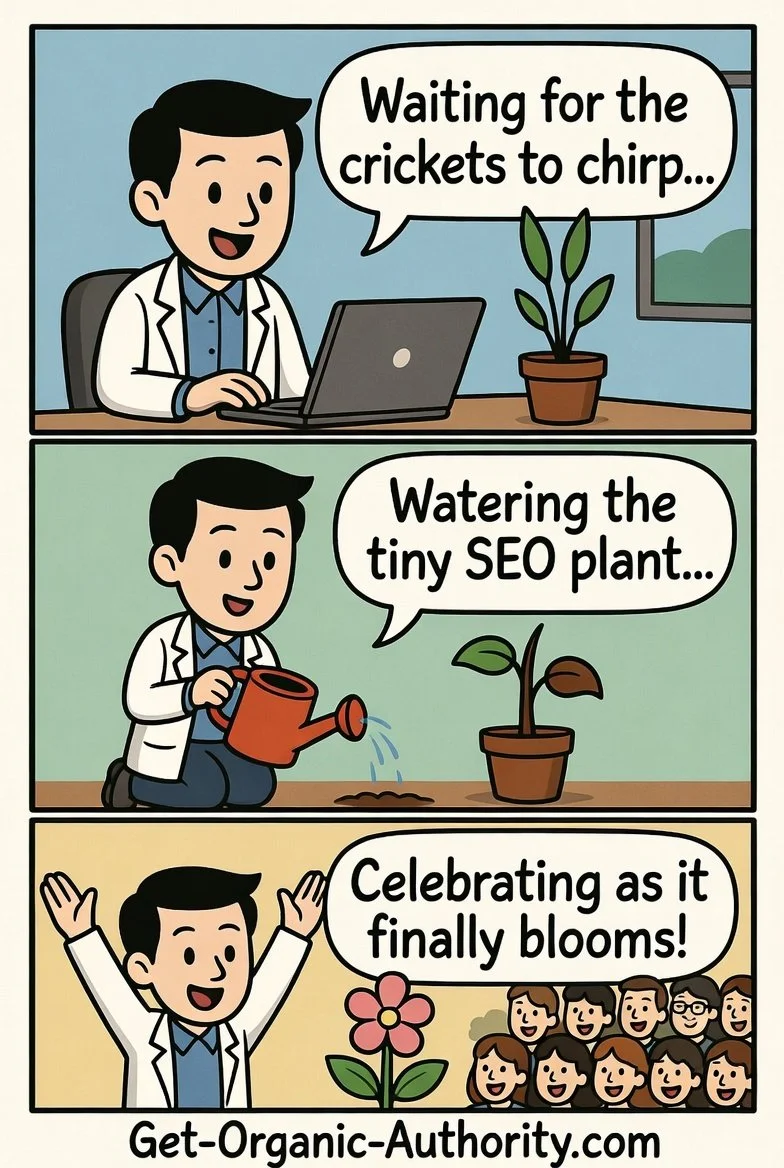
The sweet yield of being patient while the SEO kicks in.
What a Real 6 to 12 Month Therapist SEO Build Looks Like
A realistic therapist SEO timeline has stages. In months one and two, the site usually needs strategy: keyword research, competitor review, service page planning, local SEO cleanup, Google Business Profile optimization, and a content map. This is where the practice stops guessing and starts building around actual search behavior.
In months three and four, the first major pages begin working together. The homepage gets sharper. Service pages become deeper. Pillar content starts anchoring clusters. Supporting articles begin answering long-tail questions. Internal links begin pushing relevance toward the pages that matter. The site starts making more sense to Google and to humans, a rare shared achievement between mammals and machines.
In months five through eight, momentum can start showing up through impressions, keyword movement, more local visibility, and better performance from long-tail terms. The content should be updated, expanded, and connected. The practice may begin seeing better-qualified inquiries because visitors now understand specialties, tone, fit, location, and next steps.
By months nine through twelve, the strongest pages should have enough age, depth, and internal support to compete more seriously. This is also where the content ecosystem becomes easier to expand. Each new article has somewhere to link. Each new service page has supporting content. Each new topic builds on existing trust rather than starting from zero like a baby giraffe in tap shoes.
The Best Therapist SEO Strategy Is Patient, But It Is Never Passive
Waiting is not the strategy. Publishing and praying is not the strategy. “We did SEO once” is not the strategy. A strong therapist SEO campaign is active, measured, and structured. It looks at what people search. It maps the practice around buyer intent. It builds service pages that deserve traffic. It creates articles that answer real questions. It links those articles back to the pages that convert. It improves local trust. It updates content. It studies what is working and adjusts.
This is why The Foundation makes sense for practices that want compounding authority rather than a random monthly blog pile. Ten strategic long-form SEO articles per month can build clusters around core services, support pillar pages, and create a stronger path from search to consultation. The speed comes from consistency. The trust comes from usefulness. The ranking power comes from structure.
For practices that need a smaller first move, The Organic SEO Authority Blueprint gives one long-form pillar asset and a clearer path forward. It is the difference between tossing one article into the void and laying the first steel beam. The void has enough content. It is full. Someone should put up a sign.
So How Long Does Therapist SEO Really Take?
The honest answer: meaningful therapist SEO usually takes three to six months to begin showing useful signals and six to twelve months to show more substantial traction, depending on competition, website age, content quality, location, niche, existing authority, reviews, technical health, and consistency. New practices in competitive cities may need longer. Established practices with decent websites may move faster. Hyper-specific long-tail and local keywords often move before broader keywords.
That answer is less glamorous than “rank tomorrow,” but it has the rare advantage of being connected to reality. Google needs time. People need trust. Content needs structure. Service pages need depth. Internal links need pathways. Your website needs to become the kind of resource a search engine can understand and a prospective client can believe.
The good news is that slow SEO can become a moat. Competitors quit early. Cheap agencies churn out thin posts. Practices panic and abandon strategy right before the compounding starts. Meanwhile, the practice that keeps building the right pages, the right clusters, the right links, and the right trust signals becomes harder to catch. Slow is frustrating. Slow is also where the amateurs wander off to chase the next shiny button.
Build the Website Google Can Trust and Clients Can Feel
If your therapy website feels invisible, the answer is probably not another random blog post, another discount SEO package, or another month of staring at Google Analytics like it owes you rent. The answer is a real content ecosystem built around your services, your niche, your location, your client questions, your authority, and the search intent that leads someone from pain to action.
Get Organic Authority helps therapists, doctors, lawyers, private practices, and high-trust professional service businesses build organic authority through long-form SEO content, service-page strategy, topical authority, internal linking, pillar pages, supporting blogs, and conversion-focused writing. Start with Get Organic Authority if you want the full picture, choose The Blueprint if you need one strong pillar asset to anchor your next move, or use The Foundation if you are ready to build the content system month after month.
Therapist SEO takes time because trust takes time. But once that trust starts showing up in Google, it becomes harder, stronger, and more useful than another rented ad click limping in from the budget machine. Build the authority. Connect the ecosystem. Let your website become what your practice already is in the room: credible, clear, human, and hard to ignore.
