Why Is the Other Guy Getting All the Clients? The SEO Reason Mediocre Competitors Outrank Great Practices
Why Is the Other Guy Getting All the Clients?
Every town has one.
The therapist with a website that looks like it was assembled during a lunch break in 2014. The lawyer whose homepage says “aggressive representation” three times before explaining anything useful. The doctor with a bio photo taken under fluorescent lighting so aggressive it could interrogate a suspect.
And somehow, this person is getting the calls.
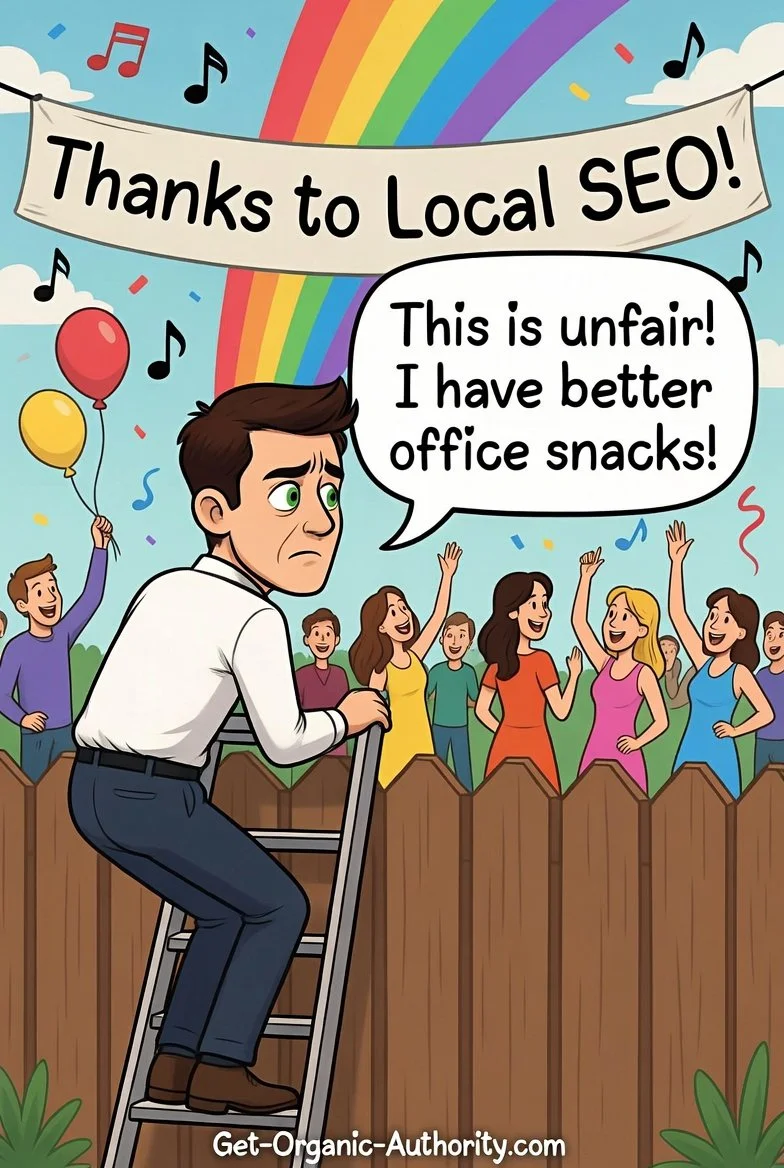
Meanwhile, you are better trained, more thoughtful, more ethical, more experienced, more careful, and possibly less likely to use a stock photo of twelve strangers shaking hands in a conference room. You look at the search results and whisper the most sacred phrase in professional services marketing: “How in the name of all that is decent is that guy ranking above me?”
There is a real answer. It is usually less dramatic than fraud, corruption, or Google having a personal vendetta against your practice. Your competitor may simply be easier to understand online. Google says SEO is partly about helping search engines understand your content and helping users decide whether to visit your site. That sentence sounds calm because Google wrote it. In real life, it means this: if your website makes search engines and anxious humans work too hard, they leave. Charming little disaster.
The brutal truth: better does not automatically rank
Being good at your work matters. Obviously. Please keep being competent. Society is hanging by a thread and needs all the help it can get.
But Google does not rank your silent excellence. It ranks visible evidence. For high-trust professional service businesses, that evidence comes from service pages, local SEO signals, reviews, Google Business Profile details, content depth, topical authority, internal links, backlinks, structured data, clear headings, useful explanations, and a website that proves what you do before the visitor starts chewing through drywall.
That is why so many good therapists, lawyers, doctors, and private practices feel invisible online. The problem is often not a lack of expertise. The problem is that the expertise has never been turned into a clear search system. Get Organic Authority exists for that exact gap: turning real professional knowledge into an organic authority engine built around service pages, pillar content, supporting articles, internal links, and trust-building SEO content.
The hack may be winning because Google has more proof
This is the part that stings. Your competitor may not be a better therapist. They may not be a better attorney. They may not provide better medical care. They may simply have more online proof arranged in a way Google can process.
A stronger competitor website might have dedicated service pages, articles that answer long-tail questions, city-specific content, Google reviews, links from relevant sites, and clean internal paths from blog posts to revenue pages. That structure is why competitors show up on Google before you do. It is rarely magic. It is usually boring execution stacked high enough to look mystical from the ground.
The numbers back up the pain. Backlinko analyzed around 4 million Google search results and found that the number one organic result gets an average click-through rate of 27.6%. Position matters because humans are impatient little raccoons with thumbs. They scan. They click. They trust what appears first, especially when the problem feels urgent, embarrassing, expensive, or medically important.
Searchers are scared, busy, and already judging you
People do not search for therapists, lawyers, and doctors like they search for socks.
They search in moments of pressure. Panic attacks. Divorce. Custody. A denied claim. A frightening diagnosis. A child who needs help. A spouse who finally said, “We need counseling.” A knee that screams every time stairs appear. These searches carry emotional heat. The person wants competence, clarity, reassurance, and proof.
This is why the back-pocket search matters. Even when someone gets a referral, they still Google the name. They check the website. They scan reviews. They compare the competitor down the street. They look for signs that the professional understands their problem and can help without making the process feel like applying for a mortgage in a haunted basement.
BrightLocal reports that 97% of consumers read reviews for local businesses, and its local SEO statistics note that 45% of consumers default to Google for local searches while 15% default to Google Maps. For local SEO for therapists, law firms, doctors, and private practices, that means trust is being formed before the first call. The first impression is already happening. You are just late to your own introduction.
Your website may be pretty and still useless
A beautiful website can still do absolutely nothing. This is a great tragedy for people who paid several thousand dollars for tasteful fonts and a homepage that says “welcome” like it is greeting guests at a bed-and-breakfast for emotionally unavailable entrepreneurs.
Pretty is not a strategy. A modern layout is not a lead system. A homepage with soft gradients and a sentence about compassion is not the same thing as a content ecosystem. Search engines need structure. People need specifics. A high-trust service business needs both.
This is where many private practices discover the ugly little truth behind why their website feels invisible. The site exists. It may look fine. It may even feel polished. But it lacks the pages, content, internal links, service specificity, local signals, and trust proof that turn online attention into real calls.
The “other guy” has clearer service pages
Most lead problems begin on the service page.
A therapist has one page called “Services” and lists anxiety, depression, trauma, couples work, grief, and life transitions in a paragraph. Their competitor has dedicated pages for anxiety therapy in the city, trauma therapy, EMDR therapy, couples counseling, and depression treatment. Guess which site gives Google more to work with?
A law firm says “we handle injury cases.” Its competitor has separate pages for car accidents, truck accidents, workers compensation, denied claims, SSD, slip and fall injuries, and wrongful death. A doctor says “we provide comprehensive care.” The competitor has condition pages, treatment pages, provider bios, insurance information, location pages, and patient education content. One site is a library. The other is a business card wearing cologne.
Strong service pages turn Google searches into leads because they match commercial intent. The person searching “anxiety therapist near me,” “workers compensation lawyer in Richmond,” or “primary care doctor in Boca Raton” is not looking for a vibes-based homepage. They want a page that proves fit fast.
Specificity beats “quality care” every time
“We provide quality care” is the marketing equivalent of saying water is wet, but somehow with less personality.
Specificity wins because it gives searchers something to recognize. A trauma client may search for “why do I shut down during conflict.” A parent may search “therapist for teen anxiety near me.” An injured worker may search “what happens if workers comp denies my claim.” A patient may search “knee pain when walking downstairs.”
Those searches reveal intent. The page has to match the person behind the keyword. That is the entire point of search intent for service businesses: stop writing pages for imaginary generic visitors and start building pages for real people with specific problems, specific urgency, and specific questions.
The competitor may have more entry points
One homepage cannot do the job of an entire website. Humanity keeps trying this anyway, because apparently we enjoy watching homepages collapse under the weight of every service, city, objection, credential, review, FAQ, and call-to-action.
Your competitor may get more clients because they have more doors into the business. Each service page, blog post, FAQ, city page, provider bio, and comparison article gives Google another way to understand the practice and gives a future client another path in.
Ahrefs found that 96.55% of pages in its index get zero organic traffic from Google. That number should haunt every random blog strategy. Publishing content is not enough. Publishing useful, specific, internally connected content that targets real search demand is the difference between building authority and tossing words into the internet swamp.
Random blogging is how websites pretend to work
A lot of businesses have a blog. Fewer have a strategy. The difference is enormous.
Random blogging sounds like this: “Let us post something about mental health awareness month.” “Let us write five hundred words on workplace injuries.” “Let us publish a generic article about healthy living.” “Let us ask AI to write ten blogs about dental care and hope the algorithm feels generous.”
That is not SEO strategy. That is content confetti. It floats for two seconds and then everyone has to vacuum.
A stronger approach builds SEO content ecosystems for high-trust businesses. A pillar page anchors the core topic. Service pages target buyer-intent keywords. Supporting articles answer long-tail questions. Internal links move readers toward the next step. The whole site begins to make sense as one connected authority system.
Topic clusters make the website look serious
A topic cluster is not fancy. It is simply organized proof.
For a therapist, a trauma cluster might include a trauma therapy service page, EMDR page, anxiety page, article on emotional shutdown, article on trauma triggers, article on relationships after trauma, and a local landing page. For a lawyer, a workers compensation cluster might include a practice area page, denied claim article, hearing timeline guide, employer retaliation page, settlement guide, and local workers comp page. For a doctor, a knee pain cluster might include symptoms, treatments, provider bios, location page, insurance information, recovery timeline, and FAQs.
That kind of structure is how you build a topic cluster for a service business website. It helps Google connect the dots, and it helps humans feel like they have landed somewhere that understands the whole problem instead of one lonely keyword wearing a hat.
Internal links are the quiet little roads that make it all work
Internal links are boring until they start making money. Then everyone suddenly respects them. Typical.
Google’s own link best practices explain that anchor text helps people and Google understand the page being linked to. That means “click here” is lazy. “Trauma therapy SEO strategy” or “local SEO for doctors” tells the reader where they are going and tells the crawler what the destination means.
For a high-trust business, internal links should connect educational articles to service pages, service pages to related FAQs, local pages to core services, and pillar articles to supporting content. That is how internal links connect blog posts to service pages without turning the website into a plate of spaghetti someone dropped during a team-building exercise.
The competitor may be winning in Google Maps before the website loads
For local businesses, the fight often starts in Google Maps. This is especially true for therapists, doctors, lawyers, med spas, dentists, contractors, and any business where proximity and trust matter.
Google says local ranking is mainly based on relevance, distance, and prominence. Translation: does your profile match the search, is your business geographically relevant, and does your practice look known and trusted online? That includes Google Business Profile categories, services, reviews, photos, business information, citations, website content, and reputation signals.
A weaker competitor may beat you in the local pack because their Google Business Profile is complete, their reviews mention the right services, their website reinforces the same keywords, and their location signals are cleaner. Your profile may be technically present but emotionally absent, like a chair in a waiting room nobody wants to sit in.
This is why getting more local leads from Google without paying for every click depends on both your Google Business Profile and your website. Maps, reviews, service pages, and content have to tell the same story.
Reviews are not just social proof. They are search behavior fuel
Reviews matter because people use them to shortcut trust. This is not always fair. It is often brutally shallow. Welcome to Earth, the planet where a stranger’s three-sentence review can sway a medical decision.
BrightLocal’s Local Consumer Review Survey found that consumers are highly review-dependent, and its 2026 data also shows that people punish fake-review behavior harshly. For doctors, lawyers, therapists, and private practices, review strategy is not about collecting shiny little stars like a digital raccoon. It is about helping future clients verify safety, fit, competence, and credibility before they contact you.
The competitor getting more clients may simply have fresher reviews, more specific reviews, better review responses, and service language inside the reviews that reinforces what Google and visitors already see on the site.
High-trust industries have a higher burden of proof
A pizza place can survive a vague website. A therapist cannot. A roofer can survive some clunky copy if the emergency is loud enough. A surgeon, attorney, counselor, or medical practice has a higher burden. People need trust before action.
Google’s Search Quality Rater Guidelines use E-E-A-T as a framework for assessing page quality: experience, expertise, authoritativeness, and trust. That matters more in areas where bad information can affect health, money, safety, legal decisions, or major life outcomes. In human language: therapy, legal, and medical websites need to look more trustworthy than a generic service site.
This is the trust problem behind The Trust Gap. Search may bring someone to your site, but weak proof can lose them after Google already did its job. Credentials, bios, reviews, service specificity, helpful content, clear process, FAQs, and ethical language all help close that gap.
Cheap SEO often sells activity instead of authority
Cheap SEO packages love activity. Monthly blog posts. Keyword reports. Meta description tweaks. A spreadsheet with colors. Perhaps even a dashboard, because nothing says “results” like twelve charts explaining why nothing happened.
Google’s helpful content guidance says its systems aim to prioritize helpful, reliable, people-first content rather than content created mainly to manipulate rankings. That should terrify anyone selling generic AI blogs by the pound. Search is moving toward usefulness, clarity, originality, and trust. Thin content written for the algorithm is no longer strategy. It is a little paper hat for a sinking ship.
For therapists, lawyers, doctors, and professional service firms, cheap content often fails because it has no point of view, no lived expertise, no service architecture, no conversion path, no internal linking strategy, and no awareness of what makes high-trust buying behavior different. It checks a box. Then the box catches fire.
Paid ads can make a bad website fail faster
Ads are not evil. Ads can work. Ads can also turn a weak website into an expensive public demonstration of confusion.
WordStream’s 2026 Google Ads benchmarks show that the average Google Ads cost per click across industries is $5.42, with legal, medical, dental, and business service categories often carrying heavier economics than casual consumer niches. That means every confused click costs money. Send paid traffic to a weak page, and the budget bleeds. Send it to a strong authority system, and ads can support an engine instead of carrying the entire wagon uphill while everyone claps politely.
The better question is not “SEO or ads?” The better question is: what happens after the click? If the page fails to match the search, answer the concern, build trust, and move the person toward action, the ad did its job and the website fumbled the handoff.
Zero-click search makes brand authority even more important
Search is getting weirder. It was already weird. Now it is weird with AI summaries, map packs, review snippets, People Also Ask boxes, forums, directories, and answer engines all fighting for attention like raccoons around a restaurant dumpster.
SparkToro’s zero-click research found that many Google searches do not lead to clicks to the open web, and Semrush has tracked the growing role of AI Overviews and zero-click behavior. This does not mean SEO is dead. People have been announcing SEO’s funeral since dial-up, and yet here we are, still optimizing title tags like medieval monks with laptops.
It means visibility is no longer only about one click. It is about being the obvious, trusted, recognized answer across search surfaces. Your service pages, Google Business Profile, reviews, structured content, FAQs, author bios, internal links, and external mentions all help build a footprint that can be seen, understood, and trusted in more places.
Structured data gives search systems cleaner context
Structured data is one of those terms that makes normal people leave the room. Fair enough. But the concept is simple: it gives search engines clearer labels about the content on a page.
Google explains that structured data helps it understand content and facts about entities on the web. For high-trust businesses, schema can help identify local business details, professionals, services, FAQs, reviews, articles, and other page elements. It does not magically make a thin website rank. Nothing does. But it can support clarity when the content itself is strong.
Think of structured data as name tags at a conference. It will not make a boring person interesting, but it may prevent everyone from calling the cardiologist “Gary from catering.”
Titles and headings still matter because humans still scan
A title is not just an SEO field. It is the first little handshake between a searcher and your page.
Google’s title link guidance explains that title links can be influenced by title elements, headings, and other prominent text on the page. For practices, that means every important page needs a clear title that matches the searcher’s problem. “Therapy Services” is vague. “Anxiety Therapy in Fort Lauderdale” is clearer. “Practice Areas” is weak. “Virginia Workers Compensation Lawyer for Denied Claims” has intent.
Specific headings also help readers move through the page. Nobody wants to decode a giant wall of text while deciding who to trust with their marriage, injury claim, panic attacks, dental implant, or chronic pain. Give people signposts. Their nervous systems will thank you. Probably silently, because that is how nervous systems are.
The real fix: build the authority your competitor accidentally faked
The move is not to copy the competitor. Please do not do that. If the other guy’s website is a mess that happens to rank, copying it gives you a mess with fewer excuses.
The move is to build a stronger system than the one beating you.
That means a clear homepage, specific service pages, long-form pillar content, supporting blog articles, local SEO, Google Business Profile optimization, review strategy, internal links, structured data, stronger calls to action, and content that sounds like it came from a real expert instead of a vending machine that dispenses beige paragraphs. The Organic SEO Authority Blueprint is built for the business that needs the first strategic pillar and map. The Foundation is built for the business ready to publish consistent long-form SEO articles around a real topic cluster.
What this looks like for therapists
For therapists, the goal is not to chase every mental health keyword like a caffeinated squirrel. The goal is to build private practice SEO around specialties, locations, client concerns, and modality-specific pages. A trauma therapist may need service pages for trauma therapy, EMDR therapy, anxiety therapy, and complex PTSD work, supported by articles answering the searches clients make before they can clearly ask for help. That is why SEO for trauma therapists works best when symptom language, ethical content, local SEO, and service clarity work together.
A therapist who is excellent in session but vague online may lose to someone less skilled because the weaker clinician has clearer pages, fresher reviews, and more specific answers. The fix is not louder marketing. The fix is better translation: turning clinical expertise into language clients and Google can understand.
What this looks like for lawyers
For lawyers, visibility depends on practice area specificity and conversion clarity. A legal site should not make a potential client hunt through legal fog to understand whether the firm handles their exact problem. The page should match the case type, explain the stakes, answer urgent questions, build trust, and move the visitor toward a consultation. That is how law firms turn Google traffic into consultations.
A law firm with strong practice area pages, local content, attorney bios, proof, FAQs, and articles around case questions can outrank a better attorney who leaves Google guessing. Nobody enjoys that sentence. It remains true.
What this looks like for doctors and medical practices
For doctors, dentists, specialists, and medical practices, the website has to connect symptoms, conditions, treatments, providers, locations, insurance details, and appointment paths. Strong healthcare SEO is not just “write a blog about wellness.” It is patient education tied to service visibility and trust. That is how doctors get more patients from Google without depending on ads.
A patient searching for knee pain, dental implants, hormone therapy, urgent care, or primary care wants reassurance and specifics. A medical website that provides clear treatment pages, provider authority, patient-friendly explanations, and local relevance gives both search engines and patients more reason to choose it.
What this looks like for any local service business
The same framework works for high-trust local service businesses because search behavior is similar. People need a problem solved. They compare options. They look for trust. They move fast when the pain is urgent.
That is why SEO tips for lawyers, doctors, and therapists also apply to service firms, consultants, contractors, med spas, wellness clinics, accountants, and other local experts. The mechanics shift by industry, but the core stays the same: clear pages, useful content, local proof, internal links, reviews, and a path to action.
The competitor gap audit: five uncomfortable questions
Before blaming the algorithm goblin, open the search results and compare your site like a detective with caffeine and mild resentment.
1. Do you have a dedicated page for the service you want to rank for, or is it buried in a vague services list?
2. Does your Google Business Profile clearly list the services, categories, photos, hours, location, and review signals that match the search?
3. Do your reviews mention the services and outcomes people actually search for?
4. Do your articles answer real long-tail questions, or are they generic educational wallpaper?
5. Do your internal links move people from questions to services to contact, or are your pages standing alone like anxious middle-schoolers at a dance?
These questions usually reveal why the other guy is winning. The ranking gap is rarely one thing. It is a pile of small proof points that make their site easier to understand and easier to choose.
The fastest path forward
Start with the pages closest to money. That usually means core service pages, location pages, Google Business Profile, and a strong pillar article that anchors the topic cluster. Then build supporting articles around the questions people ask before they are ready to buy, call, book, or schedule.
For a therapist, that may mean anxiety therapy, trauma therapy, EMDR, couples counseling, and private pay therapy content. For a lawyer, it may mean practice area pages, case questions, local pages, and consultation content. For a doctor, it may mean condition pages, treatment pages, provider bios, insurance information, and patient education articles. For a local service business, it may mean service pages, repair guides, cost articles, emergency pages, and city-specific content.
This is exactly why Get Organic Authority uses its own publishing system in public. The work is visible in the Get Organic Authority blog, where daily publishing, topical authority, internal linking, and long-form SEO content are not abstract promises. They are the method. This is dogfooding without the Silicon Valley self-congratulation confetti.
Final answer: the other guy is getting clients because he is easier to choose
That is the whole miserable little truth.
The other guy may be getting clients because his website is clearer. His Google Business Profile is stronger. His reviews are fresher. His service pages are more specific. His articles answer more searches. His internal links connect better. His content gives Google more context and gives humans more confidence.
That does not mean he is better. It means his online authority is easier to see.
And that can be fixed.
Build the authority your practice already earned
If your therapy practice, law firm, medical practice, or professional service business is tired of watching weaker competitors win online, stop buying random blog posts and hoping Google develops empathy. Build the system. Start with The Organic SEO Authority Blueprint if your site needs a strategic pillar and a map. Choose The Foundation if you are ready for consistent long-form SEO content built into topic clusters around your core services.
Get Organic Authority builds the pages, articles, internal links, and authority signals that help trusted professionals become visible where clients are already searching. The other guy had his turn. Build something harder to ignore.
