Why Is That Other Doctor Ranked Ahead of Me? The Local SEO Autopsy for Doctors Who Want More Patients From Google
The tiny tragedy of being excellent and invisible
There is a special kind of professional irritation that happens when a doctor searches their own specialty on Google and sees another practice sitting above them. The other doctor may have fewer years in practice, a thinner website, a lobby plant that looks emotionally unwell, and a biography that reads like it was assembled from refrigerator magnets. Yet there they are, glowing in the local pack, collecting calls, booking patients, and enjoying the unfair sunlight of visibility.
The immediate thought is usually some version of this: Why is that other doctor ranked ahead of me? Fair question. Also, welcome to the digital coliseum, where Google does not rank bedside manner by telepathy. It ranks signals it can read. Relevance. Distance. Prominence. Reviews. Website structure. Service pages. Condition content. Google Business Profile details. Internal links. Local authority. Patient trust. The whole little machine.
This is where many medical practices get frustrated. They know they provide better care. They know patients like them. They know the competing office may feel like a fluorescent hallway with billing paperwork attached. But Google sees a different picture. Google sees the practice that has clearer pages, fresher reviews, stronger local signals, better condition content, and a website that explains exactly what it does in exactly the language patients use when they search.
That is the rude little secret. Your competitor may rank ahead of you because their online presence is clearer, deeper, and easier to trust at a glance. Better care in the exam room matters. Better signals online get you into the exam room conversation in the first place.
This matters because healthcare decisions are increasingly shaped before the first call. Patients search symptoms, conditions, treatments, insurance questions, reviews, locations, and provider names. They compare quietly. They scan quickly. They look for signs that the practice understands their problem. Pew Research reported in 2026 that healthcare providers remain the most common source of health information for Americans and are viewed as more accurate than many other sources. That trust is powerful, but your website has to show up and communicate clearly enough to receive it.
Ranking also affects who gets considered. Backlinko’s 2025 analysis of 4 million Google search results found that the number one organic result averages a 27.6% click through rate and is 10 times more likely to receive a click than position ten. A few ranking spots can change the entire patient flow. This is annoying because it means the internet has once again turned a meaningful human decision into a leaderboard. Still, the leaderboard exists.
For doctors, specialists, dentists, therapists, chiropractors, med spas, physical therapy clinics, and private practices, this ranking gap usually comes down to one problem: the practice has real authority offline, but limited organic authority online. The expertise exists. The website has failed to translate it into something Google and patients can understand.
That is exactly the work Get Organic Authority is built around. The goal is not to throw random blog posts onto a medical website and pray to the algorithm goblin. The goal is to build a connected content ecosystem that helps patients find you, helps Google understand your authority, and helps your site turn searches into appointments. For practices that need one strong starting point, The Organic SEO Authority Blueprint creates a long form pillar article around a core service, niche, or audience. For practices ready to build month after month, The Foundation creates 10 long form SEO articles each month, built into topic clusters, internal links, long tail keywords, and a human voice that builds trust before the first call.
The better question is not simply, “Why are they above me?” The better question is: “What does Google understand about them that it does not yet understand about my practice?” That question is less satisfying emotionally, but much more useful. Humanity survives another cruel lesson.
Google ranks readable proof, not private greatness
A medical practice can be exceptional and still look vague online. A homepage that says “compassionate care for the whole family” may sound warm. It also gives Google and patients very little to work with. Compassionate care is good. It is also the default promise of every practice that has ever owned a stock photo of a smiling physician with folded arms.
Specificity wins. A patient searching “primary care doctor in Boca Raton accepting new patients” needs a page that clearly matches that search. A patient searching “sports medicine doctor for knee pain near me” needs content that speaks directly to knee pain, sports injuries, treatment options, location, and appointment pathways. A patient searching “dermatologist for acne scars in Fort Lauderdale” needs a page with enough detail to feel relevant and credible.
Google’s own local ranking guidance says local results are mainly based on relevance, distance, and prominence. Relevance means how well your profile and website match what someone is searching. Distance means proximity to the searcher or searched location. Prominence means how well known or trusted your business appears online. In plain human language: Google wants to know what you do, where you do it, and why you deserve to be shown.
This is why a competing doctor can outrank you even with a weaker real world reputation. Their Google Business Profile may list the right categories, services, hours, photos, appointment link, phone number, and review responses. Their website may have pages for each major treatment, condition, specialty, and location. Their provider bios may include credentials, patient friendly explanations, and internal links to services. Their blog may answer specific patient questions. Their reviews may mention the exact services patients search for.
Meanwhile, your practice may have a beautiful website that behaves like a sealed medical chart. It exists. It looks official. It gives away almost nothing.
Get Organic Authority covered this same frustration in Why Your Competitors Show Up on Google Before You Do, where the key point is simple: your competitor may not be better, but their website may be clearer. That idea matters even more in healthcare because patients want confidence fast. A patient does not want to excavate your site like an archaeological dig just to learn you treat plantar fasciitis, anxiety, migraines, hormonal acne, or shoulder pain.
The practice that ranks ahead often has pages doing clear jobs. Service pages target buyer intent. Condition pages answer health concerns. Provider pages build trust. Location pages support local search. Blog articles answer early stage questions. Internal links move people from education to appointment. That is an authority system. It is boring in the way plumbing is boring, until it works and everyone suddenly respects it.
For a deeper breakdown of how this works across healthcare, How Doctors Get More Patients From Google Without Depending on Ads explains why medical SEO needs local visibility and patient trust working together. Ads can create temporary attention. Organic authority creates a stronger long term path from search to appointment.
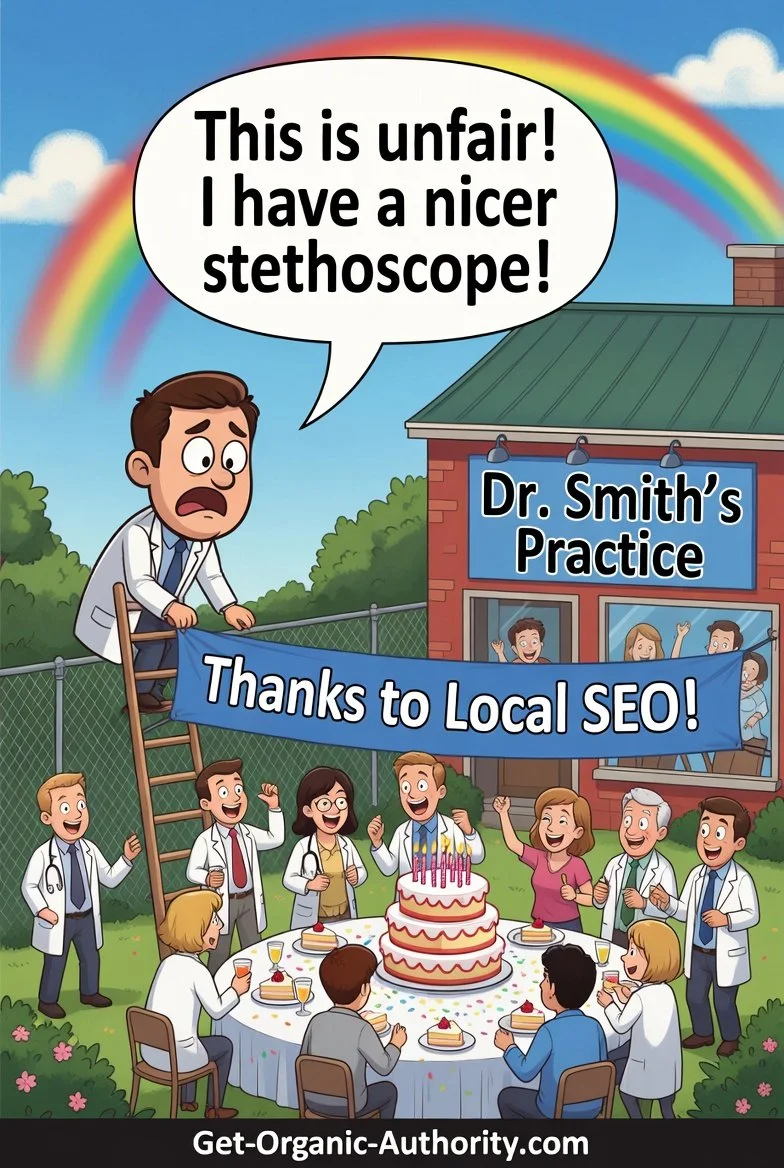
A nicer stethoscope doesn’t translate to ranking higher on Google. Unfortunately.
The competitor may be winning the map before patients even see your website
For doctors and local practices, the battle often starts inside Google Maps and the local pack. That little three listing box can make or break visibility. It sits above many organic results, shows reviews, distance, hours, directions, and call buttons, and lets patients make fast decisions while barely touching your actual website. Delightful. Your entire clinical reputation now competes inside a tiny rectangle.
BrightLocal’s local SEO statistics report that 97% of consumers read reviews for local businesses and 71% use Google to read local business reviews. BrightLocal’s 2026 Local Consumer Review Survey also shows how review recency, star ratings, and platform choice shape local decisions. For doctors, therapists, dentists, chiropractors, med spas, and specialty practices, reviews create a trust shortcut. Patients may not understand every credential, but they understand recent praise, repeated themes, and proof that real people had a good experience.
This means your competitor may be winning before anyone compares treatment philosophy. They may have more recent reviews. Their reviews may mention “knee pain,” “same day appointment,” “listened to me,” “anxiety,” “great dermatologist,” or “helped my child.” Those phrases reinforce relevance. They also reassure patients. Humans love social proof because apparently trusting strangers with usernames is now part of civilization.
A complete Google Business Profile also matters. Google support material notes that customers are 70% more likely to visit and 50% more likely to consider purchasing from businesses with complete profiles. For a medical practice, “purchasing” translates into choosing, calling, booking, or considering you as a credible option. If your profile lacks categories, services, photos, hours, appointment links, insurance notes, or a clear description, your competitor may simply look more complete.
Doctors often focus on the website and forget that the Google Business Profile is often the front door. That profile should support your service pages. Your service pages should support your profile. Your reviews should reinforce your specialties. Your location signals should match across the web. Your content should build depth around the same services and conditions. When all of these pieces agree, Google gets a clearer picture. When they contradict each other, Google shrugs and shows the competitor. Rude, but efficient.
This is why Local SEO for Service Businesses and How to Get More Local Leads From Google Without Paying for Every Click are useful companion pieces for this article. The same local SEO mechanics that help plumbers, lawyers, and therapists also apply to doctors, with higher stakes because healthcare decisions demand more trust.
Your service pages may be too vague to win competitive medical searches
Many doctor websites have one page called “Services.” It lists primary care, physicals, chronic disease management, women’s health, urgent visits, telehealth, and maybe a few specialties. This feels organized to the practice. To Google, it often feels like a crowded elevator where everyone is talking at once.
Each high value service deserves a page with a clear job. A primary care practice may need pages for annual physicals, chronic disease management, diabetes care, hypertension management, preventive care, sick visits, telehealth, women’s health, and same week appointments. An orthopedic practice may need pages for knee pain, shoulder pain, hip pain, sports injuries, joint injections, arthritis treatment, and surgical consultations. A dermatologist may need pages for acne treatment, skin cancer screenings, eczema, psoriasis, cosmetic dermatology, and mole checks.
This is not busywork. It is search intent mapping. A person searching “doctor for diabetes management near me” needs a more specific page than your homepage. A person searching “best dermatologist for acne scars in Miami” needs a page that matches the condition, treatment, location, trust concern, and appointment pathway. One broad services page cannot carry every search like a heroic mule in a lab coat.
Get Organic Authority’s article on Service Pages for Small Businesses explains the same principle outside healthcare: service pages are where Google searches turn into leads. For medical practices, they are where searches turn into appointments. A strong service page should explain who the service helps, symptoms or concerns, what the patient can expect, location served, credentials, related services, FAQs, and a clear call to schedule.
This also connects to Search Intent for Service Businesses. Patient searches exist at different stages. “What causes knee pain when walking upstairs?” is educational. “Orthopedic doctor for knee pain near me” is closer to booking. “Knee injection specialist in [city]” has even stronger commercial intent. A strong SEO system creates pages for each stage, then links them together naturally.
The competitor ranking ahead of you may simply have more pages that match more patient searches. They have more doors into the practice. You have one handsome lobby and a locked side entrance. Google likes doors. Patients like doors. Websites with one door make everyone wander around like confused raccoons.
Random blog posts rarely beat a real content ecosystem
A medical blog can help your practice rank. A random blog usually helps your website look mildly alive while doing very little. There is a difference.
A random blog says, “Here are five tips for healthy living.” Then, six months later, it says, “Happy Heart Month.” Then, after a long silence, it publishes “Why Sleep Matters.” This is content in the technical sense, the same way a vending machine sandwich is technically lunch. It exists. Nobody is thrilled.
A content ecosystem is different. It starts with the services and specialties your practice wants to own. Then it builds supporting articles around the real questions patients search before they book. A knee pain page can link to articles about knee pain while walking upstairs, arthritis vs injury, injections vs physical therapy, when to see an orthopedic doctor, and what to expect at the first visit. A dermatology acne page can link to articles about cystic acne, acne scars, hormonal acne, treatment timelines, and when over the counter products stop helping. A primary care page can link to articles about annual labs, blood pressure concerns, preventive screenings, and choosing a new doctor.
That is not a blog calendar. That is a search architecture. Fancy enough to sound expensive. Practical enough to actually work.
SEO Content Ecosystems for High Trust Businesses explains the bigger idea: a high trust website needs homepage messaging, service pages, pillar pages, supporting blog articles, local content, internal links, reviews, FAQs, and conversion paths working together. The same model works beautifully for doctors because patients often need education and reassurance before they book.
The structure matters because Google’s helpful content guidance says its systems are designed to prioritize helpful, reliable content created to benefit people. In healthcare, helpful content should sound like it came from a practice that understands the patient’s concern, the medical context, and the emotional friction of booking care. It should explain without pretending to diagnose. It should guide without replacing a clinician. It should build confidence without turning every paragraph into a sales pitch with a stethoscope.
This is also where The Invisible Searcher becomes valuable. Many patients search around the problem before they search for the provider. They type symptom based, fear based, and embarrassment based questions. “Why am I dizzy when I stand up?” “Is this mole dangerous?” “Why does my child keep getting stomach pain?” “Why do I feel exhausted all the time?” “Do I need a doctor for panic attacks?” These searches can bring people into your ecosystem before they know what service they need.
Competitors who build content around those questions create more entry points. They also build topical authority. Your practice starts looking like a real resource, not a digital brochure wearing a white coat.
Internal links tell Google which pages matter
Internal linking is one of the least glamorous parts of SEO, which means it is often one of the most neglected. People would rather redesign a homepage hero section twelve times than build a clean internal linking system. This is why the internet has many attractive websites that convert like damp cardboard.
Internal links help visitors move through your site. They also help Google understand relationships between pages. A blog post about knee arthritis should link to the knee pain service page. A primary care article about high blood pressure should link to hypertension management. A dermatology article about suspicious moles should link to skin cancer screenings. A provider bio should link to the services that doctor actually offers. Location pages should link to relevant services. Pillar pages should link to supporting articles.
The words used in links matter. “Click here” tells Google very little. “Dermatologist for acne treatment in Fort Lauderdale” tells Google and patients exactly where the link goes. Descriptive anchor text is not magic. It is basic communication, which somehow still qualifies as innovation on many websites.
Get Organic Authority’s guide to internal linking blog posts to service pages is directly relevant here. The goal is to connect education to action without making the article feel like a carnival barker. A patient reads about a symptom, learns what it may mean, sees when to seek care, and finds a natural link to the service page. Clean. Helpful. Useful. Almost suspiciously sane.
This also strengthens topic clusters. How to Build a Topic Cluster for a Service Business Website explains how pillar pages, supporting articles, and internal links work together to build topical authority. For doctors, topic clusters can be built around specialties, conditions, treatments, locations, and patient populations.
A competitor with internal links has a website with pathways. A practice without internal links has pages sitting alone like awkward interns at orientation. Google can still find them, but it has fewer clues about priority, relationship, and context.
Trust is the ranking factor patients feel before they can name it
Trust is not just a brand concept. It is a patient behavior issue. Healthcare searches are loaded with vulnerability. People are worried about pain, symptoms, cost, diagnosis, insurance, privacy, bad past experiences, and the quiet fear of being dismissed. A medical website that gives thin information creates friction. A medical website that explains clearly creates relief.
This is why provider bios matter. This is why reviews matter. This is why FAQs matter. This is why patient friendly condition pages matter. This is why “we offer comprehensive care” is weaker than a page that explains who the provider helps, what the visit looks like, what symptoms bring people in, and how to schedule.
The Back Pocket Search explains a behavior that doctors, lawyers, and therapists all see: even referred patients Google you before they call. A referral may introduce trust, but the search confirms or weakens it. If the website looks thin, outdated, vague, or generic, the patient may quietly move on. They will never send a formal breakup letter to your contact form. They will simply choose someone else. Very mature of them.
The Trust Gap goes even deeper into this problem. Being found is only the first step. The practice still has to feel credible after the click. That means the website should make the patient feel oriented. What do you treat? Who do you help? What makes this practice different? What happens next? Can I trust you with this problem? The best medical SEO answers those questions before the patient has to hunt for them.
Doctors have another layer of responsibility because healthcare content sits in a trust sensitive category. Google’s helpful content guidance asks creators to provide original, useful, reliable information. In medical content, that means avoiding generic filler, exaggerated claims, vague advice, and AI sludge that sounds like a pamphlet escaped from a hospital waiting room.
The content should be human, careful, clear, and specific. It should use plain language. It should cite credible resources when useful. It should encourage appropriate care. It should build confidence in the practice without pretending a blog post can replace a medical evaluation. Good healthcare SEO respects the patient and the search engine at the same time, which is rare because most marketing departments can barely respect a paragraph.
The competitor gap can be closed, but copying them is the wrong move
When a competing doctor outranks you, the instinct is to copy their keywords, service pages, title tags, and blog topics. That can create a slightly improved imitation. It rarely creates authority.
The smarter move is a competitor SEO autopsy. Search the exact terms you want to win. Look at the top three local competitors. Study the pages ranking. Are they service pages, location pages, directories, Google Business Profiles, or articles? How specific are they? How strong are the reviews? How complete is the Google Business Profile? How many condition pages exist? How many internal links point to the core pages? What questions do they answer? What proof do they show? What trust signals appear above the fold?
Then look for gaps. Maybe the competitor ranks for “primary care doctor near me” but has weak content around diabetes care. Maybe they rank for “dermatologist near me” but have thin acne scar content. Maybe they rank in maps but have poor patient education. Maybe they have reviews but no strong service pages. Maybe they have a big website but bland writing. Every competitor leaves openings because every website has neglected rooms.
This is where The Organic SEO Authority Blueprint fits. One pillar article can map the practice’s authority opportunity around a core service, specialty, or patient problem. It can become the frame for future supporting articles. It gives Google a stronger starting point and gives the practice a clearer content direction.
For practices ready to build consistently, The Foundation is the stronger move. Ten long form SEO articles each month, organized into strategic topic clusters, can build real momentum around services, symptoms, conditions, treatments, and local search. That is how The Authority Flywheel starts turning. Each strong article supports the next. Each internal link strengthens the system. Each service page gains more context. Each month gives Google more reasons to understand what the practice deserves to rank for.
This is also dogfooding in action. Get Organic Authority uses its own system on its own site. The blog is not decoration. It is the demonstration. The ecosystem is the proof. The strategy being sold is the strategy being used. Extremely suspicious behavior in marketing, also known as integrity.
What a doctor SEO strategy should actually include
A strong SEO strategy for doctors should start with the money pages. Those are the service pages, condition pages, provider pages, and location pages most likely to turn searches into appointments. Before publishing fifty blog posts, fix the pages that should convert.
Next, build the local layer. Complete the Google Business Profile. Choose accurate categories. Add services. Keep hours accurate. Add photos. Use appointment links. Encourage ethical review generation. Respond to reviews appropriately. Make sure name, address, and phone information stays consistent across directories. Support the profile with website pages that match the same services and locations.
Then build content clusters around the services patients actually search. A pediatric practice might build clusters around well visits, ADHD evaluations, sick visits, vaccines, asthma, and school physicals. A physical therapy practice might build clusters around back pain, knee pain, shoulder injuries, post surgical rehab, balance problems, and sports injuries. A mental health practice might build clusters around anxiety, trauma, EMDR, couples therapy, depression, and addiction. A medical spa might build clusters around Botox, fillers, laser treatments, acne scars, skin tightening, and consultations.
Each cluster needs a core page, supporting articles, internal links, FAQs, local relevance, and a path to booking. This is the difference between ranking for scattered terms and becoming associated with a topic. Google starts seeing the practice as a deeper resource. Patients start seeing the practice as easier to trust.
Finally, track the metrics that matter. Rankings matter. Organic traffic matters. Google Business Profile actions matter. Appointment requests matter more. Calls matter. Form submissions matter. Private pay inquiries matter. New patient bookings matter. A doctor website with more traffic but fewer appointments has a conversion problem. A website with rankings for irrelevant keywords has a strategy problem. A website with strong pages and no internal links has an architecture problem. A website with good traffic and weak trust signals has a persuasion problem. Marketing gets much easier once the problem receives the correct name.
A cheap SEO vendor may send reports filled with impressions, keyword movement, and charts that look like a cardiology monitor having a mild episode. Reports have their place. But a practice owner needs to know what is being built. Which pages are being strengthened? Which service lines are being supported? Which patient searches are being targeted? Which internal links were added? Which competitor gaps are being closed? Which content assets will compound?
That is the line between generic SEO activity and real organic authority. One produces motion. The other produces a system.
The Solution: Stop letting the other doctor win the obvious searches
The other doctor ranking ahead of you may be excellent. They may also simply have a stronger online authority system. Their Google Business Profile may be clearer. Their reviews may be fresher. Their service pages may be more specific. Their content may answer more patient questions. Their internal links may make more sense. Their website may give Google and patients less work.
That gap is fixable.
Your practice does not need another generic SEO package full of vague “optimization,” sleepy monthly reports, and blog posts that sound like a robot was asked to care about cholesterol. Your practice needs a content ecosystem built around your specialties, your locations, your patient searches, your services, and your authority.
Start with The Organic SEO Authority Blueprint if your practice needs one strong pillar article that maps the opportunity and gives your site a real authority anchor. Choose The Foundation if you are ready to build consistent monthly content clusters that support your service pages, strengthen internal links, target long tail patient searches, and help your practice become harder to ignore.
