Why Your About Page Might Be the Most Underrated SEO Page on Your Website
Your About Page Is Quietly Doing More Than You Think
Most business owners treat the About page like a digital obligation. A headshot. A tiny origin story. A few words about passion, excellence, integrity, compassion, results, and other phrases that have been run through the marketing blender until they taste like wet cardboard. Then they move on to the homepage, service pages, ads, rankings, and lead forms while the About page sits there quietly holding one of the most important jobs on the website.
That job is trust.
For therapists, lawyers, doctors, medical practices, private practices, and professional service firms, trust is not a nice little bonus. Trust is the sale before the sale. Before someone books a therapy consultation, calls a law firm, requests a second opinion, chooses a dentist, schedules with a specialist, or hires a high-stakes advisor, they ask a private question that rarely appears in analytics: “Can I trust these people?”
Your About page can answer that question better than almost any other page on your website. It can support private practice SEO, strengthen branded search, improve conversion after referrals, support local SEO, reinforce E-E-A-T signals, and make the visitor feel like there are actual humans behind the business instead of a tasteful beige rectangle with a contact form.
The Page Everyone Ignores Until the Lead Gets Nervous
Here is the part that gets weird. A person may not land on your About page first. They may come through Google after searching “trauma therapist near me,” “workers comp lawyer in Virginia,” “orthopedic doctor near me,” or “private practice therapist for anxiety.” They may click a blog post, read a service page, look at reviews, and then quietly click About. That click is not random. It is a trust check.
The visitor is trying to figure out who is behind the website, what the practice believes, what the credentials actually mean, how the team talks, who they help, and if the business feels safe enough to contact. That is the same decision zone described in The Trust Gap: the space between being found and being chosen. SEO brings the visitor in. Trust decides what happens next.
This is especially true after referrals. Someone hears your name from a friend, doctor, colleague, pastor, former client, or family member. Then they do what modern humans do with sacred recommendations. They Google you immediately, because apparently even word of mouth now has to pass through a search bar. That behavior is exactly why the back-pocket search matters. Your About page helps turn a warm referral into a real inquiry.
Google Cares About Who Is Responsible for the Website
Search engines do not read your About page and have a tiny emotional breakthrough. Let us remain adults. But Google’s public guidance gives clear clues about why “who is behind this content?” matters. Google’s helpful, reliable, people-first content guidance encourages creators to demonstrate experience, expertise, and usefulness. The Search Quality Rater Guidelines also ask raters to understand who is responsible for a website, who created the content, and what reputation information exists. That matters even more in Your Money or Your Life topics, where bad information can affect health, finances, safety, or major life decisions.
Lawyers, doctors, therapists, and medical practices live right in that high-trust neighborhood. A thin About page makes the website feel underdeveloped. A strong About page helps clarify the entity behind the service, the people behind the advice, and the experience behind the content.
This does not mean your About page alone will shoot you to the top of Google while competitors weep into their dashboards. SEO is never that generous. It means the About page is part of a larger trust ecosystem. When your homepage, service pages, blog articles, provider bios, testimonials, reviews, internal links, citations, and About page all point in the same direction, the website becomes easier for people and search engines to understand.
The Internet Still Wants Proof You Are Real
The Stanford Web Credibility Guidelines are old enough to have lower back pain, but they remain painfully relevant. Stanford’s guidance includes showing that a real organization stands behind the site, highlighting expertise, showing honest and trustworthy people, making contact information easy to find, keeping content useful and current, and avoiding errors. This is the About page’s entire personality if the page is doing its job.
Nielsen Norman Group says users expect About Us sections to be clear, authentic, and transparent, and that users compare company information with third-party reviews before making decisions. NN/g’s research on trustworthiness in web design also points to design quality, upfront disclosure, comprehensive and current content, and connection to the rest of the web as credibility factors.
Translation: the About page should stop mumbling “we care deeply” and start proving why the practice deserves trust.
The About Page Is Not a Biography. It Is a Conversion Page in Disguise.
A good About page does not merely tell visitors when the business started. It moves them closer to action. It should help the right people recognize themselves, understand the practice’s point of view, feel the weight of the credentials, and see the next step clearly.
That is why About page SEO belongs beside service page SEO, local SEO, content strategy, and conversion copywriting. If your About page only says “Founded in 2016, we provide compassionate care and personalized solutions,” congratulations. You have successfully written the world’s smallest sleeping pill.
A Strong About Page Answers Four Questions Fast
Visitors are scanning for four things. Who are you? Who do you help? Why are you credible? What should I do next? Every professional service About page should answer those questions with specificity.
For a therapist, that may mean naming the types of clients served, such as adults with anxiety, trauma survivors, couples, teens, professionals, first responders, or people navigating grief. For a lawyer, it may mean explaining the firm’s practice areas, experience, case philosophy, local roots, and what clients can expect after reaching out. For a doctor or medical practice, it may mean explaining provider credentials, patient philosophy, specialty focus, conditions treated, treatment approach, and how the team communicates with patients.
The point is not to brag. The point is to orient the reader. Confused visitors do not convert. They wander away, usually to a competitor with a clearer website and worse haircut.
The About Page Helps Branded Search
Branded search is what happens when someone searches your name, practice name, provider name, law firm name, clinic name, or “Dr. So-and-so reviews.” These searches are often high-intent because the person already knows you exist. Your About page helps shape what they find and how they feel when they find it.
This is where About page SEO overlaps with reputation SEO. BrightLocal’s Local Consumer Review Survey reported that 97% of consumers read online reviews for local businesses, and its local SEO statistics report that 67% of consumers often or always look at reviews after conducting a local business search. If someone is checking reviews, they are also checking your website for confirmation. Your About page can reinforce the same trust signals your reviews introduce.
For law firms, Clio’s updated article on how clients find lawyers reports that referrals remain a major source of legal clients, while online search also plays an important role. That means a law firm About page should support both paths. It should validate referrals and help organic visitors understand why the firm is qualified to handle their problem.
The About Page Helps Local SEO
Local SEO is not just map pins, city names, and a Google Business Profile that gets updated once and then left to gather digital cobwebs. Local SEO is also about proving that a real, specific business serves a real, specific community.
Google’s Business Profile guidelines emphasize accurate representation of business information. Google’s Local Business structured data documentation explains how structured data can help search systems understand business details such as hours, departments, and other local information. Your About page can support that larger local picture by clearly naming your service area, office location, team, professional background, and community relevance.
For therapists, doctors, lawyers, dentists, med spas, and professional service businesses, the About page can include local trust markers without sounding like a city-name spam sandwich. Mention the communities you serve naturally. Explain why your practice exists in that market. Connect local service pages and specialty pages through clear internal links. The goal is to help readers and Google understand where your authority lives.
The About Page Supports the Content Ecosystem
A website built around organic authority cannot treat the About page like a lonely hallway. It should connect to the rest of the site. A therapist About page might connect naturally to trauma therapy, anxiety therapy, couples therapy, EMDR, online therapy, and articles about what clients search before reaching out. A law firm About page might connect to attorney bios, practice area pages, case-type guides, and consultation explainers. A medical practice About page might connect to provider profiles, treatment pages, condition guides, second-opinion content, and appointment information.
This is the difference between random pages and SEO content ecosystems for high-trust businesses. One page should help another. The About page should reinforce the service pages. Blog posts should support the About page when the reader needs to know the team. Provider bios should connect to relevant specialties. Google’s link best practices recommend descriptive anchor text and explain that internal links help users and Google make sense of a site.
That is also why a strong internal linking strategy matters. Your About page can pass readers into service pages. Service pages can send readers to About when trust needs more context. Supporting articles can send readers toward the provider, practice, or firm when the topic turns personal. The site starts acting like a guided decision path instead of a drawer full of PDFs and panic.
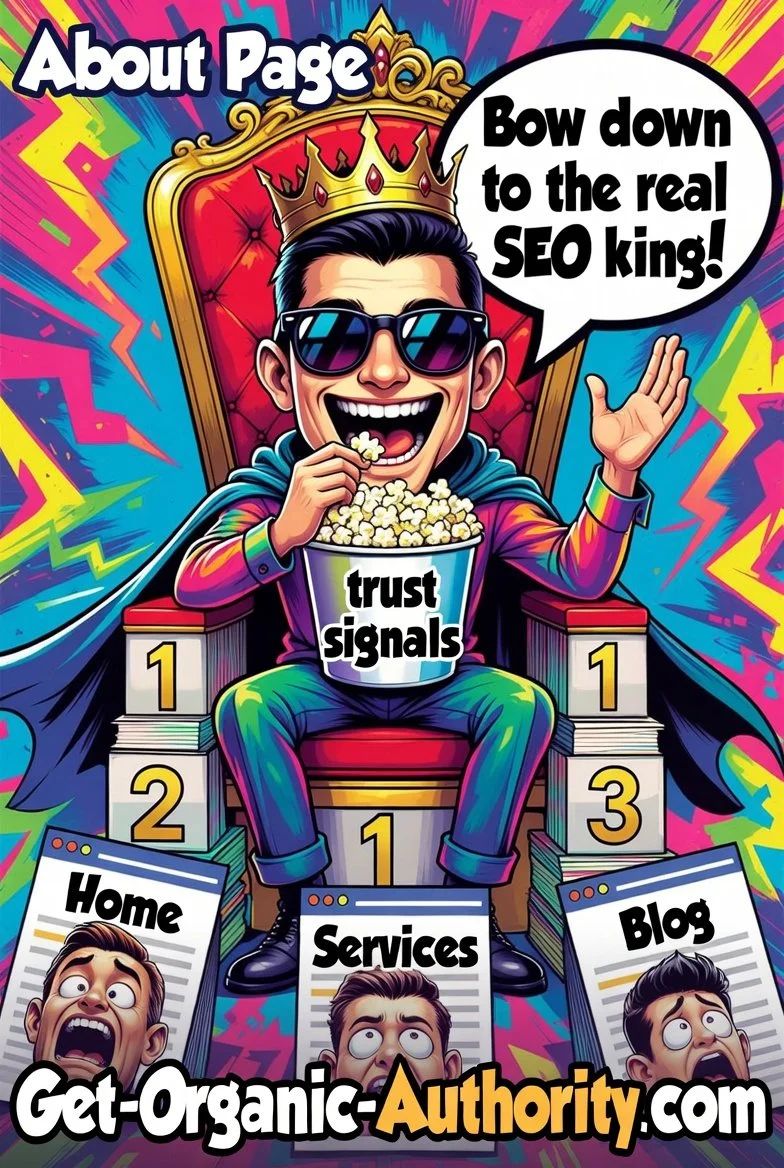
Most About Pages Fail Because They Are Too Polite
Bad About pages are rarely offensive. That is the problem. They are pleasant, empty, and safe in the least useful way. They sound like they were written by a committee trying to avoid ever being remembered.
Here are the usual crimes.
They Lead With “We Are Passionate”
Everyone is passionate now. Dentists are passionate. Lawyers are passionate. Therapists are passionate. HVAC companies are passionate about airflow. Somewhere a copier repair company is passionately committed to toner integrity. The word has been flattened by overuse.
Better About page writing shows the passion through choices, not slogans. Explain the origin of the practice. Explain the problem you kept seeing. Explain what you wanted to do differently. Explain what clients or patients were missing before your business existed. Show the conviction in the story and the standards.
They Hide the Humans
High-trust businesses need human presence. That does not mean turning the About page into a vacation slideshow or sharing every staff member’s favorite soup. It means showing the people behind the work. Real names. Real credentials. Real roles. Real photos when appropriate. Real professional judgment.
Stanford’s credibility guidance specifically points to showing real people and conveying their trustworthiness. For therapy practices, law firms, and medical offices, this is not decorative. A person choosing a professional wants to know who they may speak with, what that person understands, and why they are qualified.
They Talk About Themselves Without Helping the Reader
The About page is about the business, but it is still for the visitor. That distinction matters. A page that says “we were founded by three partners with a shared vision for excellence” may be true, but it does not help the reader much. A stronger page says, “We built this practice for people who feel overwhelmed by legal decisions and need plain-English guidance before they make the next move.”
That sentence still tells the story. It just has the courtesy to include the human being reading it. Revolutionary, apparently.
They Forget Search Intent
A good About page targets more than “about us.” It captures branded search, provider name searches, practice name searches, team searches, “best [service] in [city]” hesitation searches, and trust-based long-tail searches. It should align with search intent for service businesses, because the person clicking About is usually trying to decide, verify, compare, or confirm.
The About page can target phrases like “experienced trauma therapist in Austin,” “family law firm in Richmond,” “board-certified dermatologist in Miami,” “private practice therapist for anxiety,” “medical practice near me,” “law firm with free consultation,” or “doctor who treats chronic pain.” These phrases should appear naturally, not like someone dropped a keyword jar down the stairs.
They Leave Out the Next Step
A visitor who finishes your About page should know what to do next. Book a consultation. View services. Meet the team. Read the first-session guide. Explore the practice areas. Schedule an appointment. Contact the office. Read the trauma therapy page. Review the attorney bios.
Google’s guidance on title links and meta description snippets focuses on helping searchers understand page relevance before they click. The same idea applies after the click. The page should keep giving clarity. If the visitor reaches the bottom and the next step is vague, the page has politely escorted them into a dead end.
What a Strong About Page Should Actually Include
A high-performing About page for a therapist, lawyer, doctor, private practice, or professional service firm should combine SEO structure with human trust. This is where cheap SEO usually falls apart. It can add keywords. It can stuff a city name into the title. It can even create a technically acceptable paragraph about “personalized solutions.” What it usually cannot do is make the visitor feel understood.
That is why Get Organic Authority focuses on authority-building content ecosystems instead of random blog posts. The About page should be part of the larger structure: homepage, service pages, provider bios, topic clusters, supporting articles, internal links, local trust signals, and conversion-focused copy.
Start With a Human Positioning Statement
The top of the About page should quickly tell the reader who you are and why your work matters. Not “we are a full-service professional firm.” That sentence needs a chair and a nap. Try something sharper.
A therapist might write: “We help adults who look functional on the outside but feel anxious, shut down, or exhausted inside.” A law firm might write: “We help injured workers and families make sense of legal decisions when the system feels built to confuse them.” A medical practice might write: “We help patients get clear answers, thoughtful treatment options, and a care plan that makes sense beyond the appointment room.”
That kind of language has search value and conversion value because it connects the service to the person behind the search.
Name the Audience Clearly
The About page should say who the practice helps. Therapists can name client groups, symptoms, life stages, therapy goals, and modalities. Lawyers can name case types, client situations, industries, jurisdictions, or legal problems. Doctors can name conditions, treatment areas, patient concerns, and specialty focus.
Specificity builds trust. It also gives Google more context. A therapist who works with trauma, anxiety, and emotional regulation should say that clearly and connect to deeper pages like SEO for trauma therapists style content or actual service pages. A lawyer who handles workers’ comp, family law, or personal injury should connect the About page to practice area pages. A doctor should connect provider expertise to treatment pages and condition guides.
Show Experience Without Turning It Into a Trophy Shelf
Credentials matter. Awards matter. Years of experience matter. Training matters. Licenses matter. But credentials should be translated into meaning. Instead of listing every certification like a LinkedIn profile with caffeine poisoning, explain what the experience helps clients or patients receive.
For example: “Our attorneys have handled complex workers’ compensation cases involving denied claims, delayed benefits, and pressure from insurance carriers” is stronger than “Our lawyers have extensive experience.” One sentence gives shape. The other gives fog.
Use Story, But Keep It Useful
A founder story can be powerful when it explains why the business exists. It becomes useless when it wanders into a corporate campfire monologue. The reader does not need every plot point. They need the origin of your standards.
A therapy practice might explain that it was built after seeing clients feel unseen in sterile clinical settings. A law firm might explain that it exists to give plain-English guidance to people overwhelmed by legal systems. A doctor might explain a commitment to longer visits, better education, or coordinated care. The story should make the reader think, “These people understand the problem.”
Add Proof That Belongs on an About Page
Proof can include licenses, board certifications, publications, community involvement, years in practice, professional memberships, case experience, patient education, media mentions, speaking, teaching, reviews, or testimonials where appropriate and ethically allowed. The About page is a natural home for reputation signals because visitors arrive there looking for credibility.
This is also where professional services need restraint. A therapist has ethical limits around testimonials. A lawyer has advertising rules. A medical practice has patient privacy obligations. Strong SEO does not bulldoze those boundaries for a few extra clicks. It works inside them like an adult, which remains a niche skill online.
Connect the About Page to Service Pages
The About page should not be a standalone monument to your origin story. It should send visitors toward the pages that help them act. That means linking to core services, practice areas, provider bios, consultation pages, specialty pages, location pages, and relevant guides.
A strong About page can quietly support service pages that turn Google searches into leads. If a visitor reads about your therapy approach, guide them toward trauma therapy, anxiety therapy, couples therapy, or online therapy. If they read about your legal philosophy, guide them toward family law, personal injury, workers’ compensation, or estate planning. If they read about your medical team, guide them toward conditions, treatments, providers, and appointment booking.
Give the Page Real SEO Structure
About page SEO still needs basics. Use one clear H1. Use helpful H2s. Mention the business name, provider names, location, service area, specialties, professional categories, and the problems the business helps solve. Add internal links with descriptive anchor text. Add a title tag that makes sense. Write a meta description that makes someone want to click. Keep the page current. Include contact paths. Make sure the page is reachable from the main navigation.
Backlinko’s Google CTR study found that title tags between 40 and 60 characters had stronger click-through performance, and Ahrefs’ SEO statistics show how much organic click behavior is concentrated on the first page of Google. Those numbers are reminders that every search result and every page title has a job. Your About page may appear for branded searches, provider searches, and trust-related searches. Give it a title worth clicking.
Build an About Page Cluster
The best About page does not try to carry every trust signal alone. It becomes part of a cluster. For high-trust professional service businesses, that cluster might include the main About page, team bios, provider bios, founder story, credentials page, reviews page, “what to expect” page, consultation page, fee page, location page, and service pages.
This is where the About page becomes part of a topic cluster strategy. Not every page in the cluster targets the same keyword. They support the same trust decision.
For Therapists
A therapist About page should balance clinical credibility with emotional safety. It should explain who you help, how you think about therapy, what clients can expect, what modalities or approaches you use, what issues you commonly support, and how a consultation works. It should avoid sounding like a grad school discussion board with a fern in the corner.
Strong therapist SEO keywords can live naturally here: anxiety therapist, trauma therapist, couples therapist, EMDR therapist, online therapy, private pay therapy, therapy for professionals, therapy for adults, therapy consultation, therapist near me, and private practice therapist in your city. The key is to use them as part of clear language, not as a keyword casserole.
For Lawyers
A law firm About page should show judgment, experience, and process. Potential clients want to know what kinds of cases the firm handles, how the attorneys communicate, what the first step looks like, what experience supports the practice, and why the firm understands the client’s situation. Legal SEO needs more than practice area keywords. It needs confidence without chest-pounding.
Use the About page to connect law firm SEO keywords to real decision points: family law attorney, personal injury lawyer, workers’ compensation lawyer, criminal defense attorney, immigration lawyer, consultation, case evaluation, legal process, attorney experience, and local law firm.
For Doctors and Medical Practices
A doctor or medical practice About page should make expertise easy to understand. Patients want to know who is treating them, what the practice specializes in, what conditions are commonly treated, how appointments work, what the care philosophy is, and why the practice is trustworthy. Healthcare SEO lives in a sensitive space because patients may be anxious, confused, or comparing sources.
A good About page can support doctor SEO keywords like board-certified physician, specialist near me, medical practice, patient-centered care, second opinion, condition treatment, appointment, local doctor, healthcare practice, and physician bio. It should also connect to provider profiles, treatment pages, and patient resources so the visitor can keep moving.
For Professional Service Firms
Accountants, consultants, financial professionals, agencies, architects, engineers, and other expert-led service businesses also need About pages that build trust. These pages should clarify the firm’s point of view, industries served, process, expertise, values, and proof. Generic positioning makes a firm look replaceable. Specific positioning gives it a spine.
The About Page Can Help AI Search Too
Search is changing. AI summaries, answer engines, and zero-click behavior have made clarity even more valuable. When systems try to understand who your business is, what it does, where it operates, and why it is credible, your About page becomes an entity signal. It can help connect the dots between brand, people, services, geography, reputation, and expertise.
This does not mean writing for robots. Please do not. The robots already get enough attention and still cannot fold laundry. It means writing clear human content that also gives machines structured context. Names. Roles. Credentials. Services. Locations. Specialties. Practice philosophy. Internal links. External citations. Schema where appropriate.
That is why cheap SEO and AI content farms struggle with high-trust About pages. They can generate words. They cannot extract judgment from the business. They cannot know what clients ask on calls, what patients fear before booking, what referral partners need to see, or what makes the firm truly different. They produce a page that looks complete until a real prospect reads it and feels absolutely nothing.
A Simple About Page Framework That Actually Works
Here is a clean structure for an About page that supports SEO and conversion.
· Opening promise: Say who you help and what kind of problem you help them navigate.
· Human reason for existing: Explain why the practice, firm, or business was created and what gap it solves.
· Who you serve: Name audiences, client types, patient groups, industries, locations, or cases.
· What you do: Connect the About page to core service pages, specialties, practice areas, and appointment paths.
· Why you are credible: Show credentials, experience, training, reputation, values, and proof.
· How you work: Explain process, communication style, care philosophy, consultation expectations, or first steps.
· Where you work: Clarify location, service area, telehealth, virtual services, office areas, or jurisdictions.
· Next step: Guide the visitor toward booking, calling, viewing services, meeting the team, or reading a relevant guide.
Build the Page That Makes the Rest of the Website Work Harder
A better About page will not replace service pages, blog strategy, local SEO, or technical fundamentals. It makes all of them stronger. It gives visitors a reason to believe the service pages. It gives referral searchers a reason to trust the name they heard. It gives Google clearer context about the people and business behind the content. It gives internal links a meaningful trust destination.
If your website has scattered pages, thin service content, weak internal links, and an About page that sounds like a committee wrote it during a power outage, The Organic SEO Authority Blueprint can map the first authority asset and the content path around it. If you need a consistent monthly system, The Foundation builds long-form SEO articles into strategic topic clusters around your core services.
Your About Page Is Too Important to Be a Funeral for Personality
The About page is one of the strangest missed opportunities in professional service SEO. It has the power to support trust, branded search, local SEO, internal linking, conversion, E-E-A-T, provider credibility, and referral validation. Yet many businesses treat it like an afterthought. A few paragraphs. A stock photo. A sentence about commitment. Then everyone wonders why visitors browse the site and quietly leave like they just toured an apartment with carpet in the bathroom.
For high-trust businesses, the About page should feel alive. It should help a therapy client feel safe enough to reach out. It should help a legal client understand why this firm can handle the stakes. It should help a patient trust the medical practice before booking. It should help a local service customer understand why this business is real, credible, specific, and worth choosing.
It should also connect to the rest of the website. To service pages. To local pages. To team bios. To blog guides. To authority content. To consultation pages. To proof. To next steps. A strong About page is not a decorative plaque. It is part of the conversion path.
The smarter move is to treat it like a pillar of trust inside the larger SEO system. Pair it with strong service pages, long-form content, topic clusters, and internal links. Use it to clarify who you are, who you help, why you are credible, and how the visitor can move forward.
Turn Your Website Into a Trust System
If your About page feels generic, your service pages feel thin, your blog feels random, or your website is somehow both full of words and painfully unclear, it is time to stop decorating the brochure and start building authority.
Get Organic Authority helps therapists, lawyers, doctors, private practices, medical practices, and high-trust professional service businesses turn expertise into a connected organic authority system. That means pillar pages, service pages, supporting articles, internal links, topical authority, helpful content, and trust-building copy that actually sounds like a human with standards wrote it.
Start with The Organic SEO Authority Blueprint if you need the first strategic pillar. Choose The Foundation if you are ready to build the monthly content ecosystem around your expertise.
Because the right people are already searching. Your website should make them feel like they finally found the right place, not like they accidentally walked into a beige conference room where trust goes to dissolve.
