The High-Trust Website Content Map: What Lawyers, Doctors, and Therapists Actually Need on Their Site
Your Website Is Not a Digital Business Card. Please Stop Treating It Like One.
A high-trust website is not a pretty online brochure. It is not a digital lobby with a headshot, a vague mission statement, and a contact form sitting in the corner like a nervous intern. For lawyers, doctors, therapists, and private practices, the website has a bigger job. It has to be found by the right people, explain the right services, prove real expertise, reduce fear, support referrals, satisfy Google, and make the next step feel obvious enough that a stressed human can take it without needing a lantern and a search party.
That is a lot to ask from five pages and one blog post from 2022 titled 'The Importance of Wellness.' Yet many professional service websites are built exactly that way. They look decent. They sound professional. They have the expected tabs: Home, About, Services, Blog, Contact. Then the owner wonders why the site feels invisible, why competitors show up first, why referrals quietly vanish after promising to call, and why the SEO company keeps sending reports that look like they were designed by a spreadsheet with unresolved childhood issues.
The problem is usually not one missing keyword. The problem is the map. High-trust businesses need a connected content system. That means homepage clarity, service pages, location signals, practitioner bios, trust proof, FAQs, reviews, pillar pages, supporting articles, internal links, calls to action, and content that matches how real clients search before they reach out. Get Organic Authority calls this an ecosystem because the pages support each other. One page explains. One page converts. One page reassures. One page captures the weird midnight search. One page builds topical authority. One page tells Google where everything belongs. Terribly inconvenient, this whole 'strategy' thing.
The need is especially sharp for high-trust industries because the stakes are personal. A person choosing a therapist may be dealing with trauma, anxiety, addiction, grief, relationship pain, or a quiet internal collapse they can barely name. A person choosing a doctor may be scared about symptoms, treatment options, cost, insurance, outcomes, or whether they will be heard. A person choosing a lawyer may be injured, accused, fired, divorcing, denied benefits, sued, or trying to protect their family. These searches carry fear, urgency, shame, money, health, and reputation. The website has to meet that moment like an expert, not like a flyer taped to a community board.
Google's own Google helpful content guidance says helpful content should be created for people, provide original value, demonstrate expertise, and leave readers feeling they learned enough to achieve their goal. Google also highlights trust as the most important part of E-E-A-T, especially for topics that affect health, finances, safety, and well-being. In other words, your content cannot merely exist. It has to help. Stunning development. The search engine wants useful answers. Civilization may yet recover.
Local search adds another layer. Google local ranking guidance explains that local visibility is mainly shaped by relevance, distance, and prominence. That means your site and Google Business Profile need to clearly show what you do, where you do it, and why your practice is credible. BrightLocal Local Consumer Review Survey 2026 reports that 97% of consumers read reviews for local businesses, while BrightLocal local SEO statistics notes that 54% of consumers visit a business's website after reading positive reviews. That is the back-pocket search in action. A referral, review, or Google result may create the spark, but the website often decides if the person trusts you enough to call.
This is why Get Organic Authority builds content ecosystems instead of random blog piles. A random post can get a click. A content map can build authority. The Blueprint is built for businesses that need one strong pillar article and a clear map for future content. The Foundation is built for businesses ready to build monthly authority through long-form SEO articles, topic clusters, long-tail keywords, and strategic internal links. The difference matters. One is a starting structure. The other is the ongoing machine.
If your website feels thin, confusing, too generic, or strangely quiet despite your real-world expertise, this map shows what needs to be there. Not because every site needs to be huge. Because every high-trust website needs to answer the questions real people and Google are already asking.
The Core Pages Every High-Trust Website Needs
The first layer of the high-trust content map is the core website architecture. This is the part most businesses think they already have. Sometimes they do. More often, they have a homepage doing twelve jobs badly, a services page listing everything like a diner menu, an About page full of biography confetti, and a contact page that feels less inviting than a DMV form. Technically a website. Strategically, a hallway with flickering lights.
Start with the homepage. The homepage should tell a visitor what you do, who you help, where you serve, what problems you solve, and why you are credible. It should also guide visitors toward the next step. A therapist homepage might quickly clarify specialties like trauma therapy, anxiety counseling, EMDR, couples therapy, addiction recovery, or private-pay therapy. A doctor homepage might clarify specialty, conditions treated, locations, appointment types, insurance or self-pay details, and what makes the practice trustworthy. A law firm homepage should quickly point visitors toward practice areas, attorney credibility, local relevance, case types, consultation options, and proof. The homepage is not the place for abstract brand fog. People arrive confused enough already.
Next come service pages. These are the money pages. For lawyers, that means practice area pages like workers' compensation lawyer, personal injury attorney, criminal defense lawyer, divorce attorney, estate planning attorney, SSD lawyer, employment lawyer, or immigration lawyer. For doctors, it means condition, treatment, and specialty pages: orthopedic knee pain treatment, dermatology for acne, pediatric care, hormone therapy, primary care, dental implants, fertility care, med spa services, pain management, or urgent care. For therapists, it means anxiety therapy, trauma therapy, EMDR therapy, couples therapy, grief counseling, addiction counseling, depression therapy, teen therapy, online therapy, and whatever else the practice actually wants to attract.
A strong service page does several things at once. It matches buyer intent. It explains the problem in plain language. It shows who the service is for. It answers practical questions. It names common fears. It includes local relevance. It links to related articles. It includes trust signals. It makes the next step clear. Service Pages for Small Businesses explains this same principle: service pages are where Google searches turn into leads. A blog can educate, but the service page should convert. If your site has one generic Services page with six bullet points, Google is left squinting at it like a waiter trying to read a handwritten order from a raccoon.
Then come bio pages. Attorney bios, provider bios, therapist bios, doctor bios, clinician bios, partner bios, and staff pages all matter because high-trust buyers want to know who they may actually meet. Pew Research Center health information trust qualities found that people place high importance on medical training, transparency, and easy-to-understand information when judging health information sources. That logic applies beyond medicine. People want credentials, but they also want clarity. They want to know your training, niche, style, experience, approach, and fit.
A strong therapist bio should include licensure, specialties, modalities, populations served, tone, philosophy, session expectations, availability, and links to relevant services. A doctor bio should include specialty, board certification where applicable, training, conditions treated, hospital affiliations, patient philosophy, and appointment paths. A lawyer bio should include practice areas, bar admissions, education, court admissions, representative experience where ethical, local roots, and consultation links. The bio should connect into the ecosystem. A trauma therapist bio links to trauma therapy, EMDR, anxiety, and SEO for Trauma Therapists if the site is educational. A workers' compensation attorney bio links to workers' comp, denied claims, hearings, and How Law Firms Turn Google Traffic Into Consultations as a model for how content supports action.
The contact page also needs more thought than most people give it. It should answer what happens next. Will someone call back? Is the consultation free? Is the message confidential? Can the visitor request an appointment? What should they include? Where is the office? What are the hours? Are telehealth, virtual consults, or remote options available? A contact form that says 'Submit' and nothing else has the emotional warmth of a locked filing cabinet. High-trust businesses need softer friction and clearer instructions.
The last core page category is proof. Reviews, testimonials where compliant, case results where ethical, awards, credentials, media mentions, professional memberships, publications, before-and-after examples where appropriate, and community involvement all belong somewhere visible. BrightLocal Local Consumer Review Survey 2026 reports that 97% of consumers read reviews for local businesses. FindLaw 2024 U.S. Consumer Legal Needs Survey found that 82% of respondents who contacted an attorney after learning about them online used online reviews in their decision-making. Your proof cannot live in hiding. If the reader has to excavate trust signals with a tiny brush and a degree in archaeology, the website is failing them.
The Trust Gap explains this clearly: being found is not the same as being chosen. The content map has to close the gap between visibility and confidence. Core pages create that bridge.
The SEO Pages That Build Authority Instead of Digital Clutter
Once the core pages are clear, the next layer is authority content. This is where most websites either become useful or become a haunted attic full of random blog posts. A high-trust website needs pillar pages, supporting articles, local pages, FAQs, and internal links arranged around actual search intent. SEO Content Ecosystems for High-Trust Businesses is the internal anchor here because it explains the main idea: a content ecosystem makes a site easier for Google to understand and easier for people to trust.
A pillar page is the big authority page around a major topic. For a therapist, that might be a pillar page on trauma therapy in your city, anxiety therapy for professionals, EMDR therapy, couples therapy after betrayal, or private-pay therapy. For a doctor, it might be a guide to knee pain treatment, hormone therapy, dental implants, pediatric care, dermatology for acne, fertility options, or chronic pain management. For a lawyer, it might be workers' compensation in Virginia, what to do after a car accident in Florida, SSD claims after injury, divorce and custody basics, or criminal defense after arrest. A pillar page is not a flimsy overview. It is the central hub that proves depth.
Supporting articles orbit that pillar. How to Build a Topic Cluster for a Service Business Website shows how this works. A trauma therapy cluster might include articles on signs of trauma, EMDR vs talk therapy, complex PTSD, trauma symptoms in relationships, what happens in a first trauma therapy session, how trauma affects sleep, and how to find a trauma therapist near me. Each article answers a real search, then links back to the main trauma therapy service page or pillar. Suddenly the site stops looking like a brochure and starts looking like a field of expertise.
The same structure works for lawyers. A workers' compensation cluster might include denied workers' comp claim, workers' comp hearing, lost wages, medical treatment dispute, employer retaliation, settlement timeline, and do I need a lawyer for workers' comp. Each piece feeds the practice area page. A doctor cluster might include symptom guides, treatment comparisons, recovery timelines, cost questions, appointment preparation, and when to seek care. This is not content for content's sake. This is how the site earns topical authority around the business you actually want.
The secret, which should not be a secret but here we are, is search intent. Search Intent for Service Businesses explains that every page should match the person behind the keyword. Someone searching 'what is EMDR' needs education. Someone searching 'EMDR therapist near me' needs a service page. Someone searching 'best EMDR therapist for childhood trauma' needs comparison, trust, specialization, and location. Someone searching 'cost of private-pay therapy' needs pricing context and reassurance. Cramming all those searches onto one page is how websites become soup.
The Invisible Searcher adds another layer. High-trust buyers often search awkward, private, emotional, or indirect questions before they are ready to call. A therapist's future client may search 'why do I shut down when my partner talks to me' before searching for trauma therapy. A patient may search 'should I worry about knee pain going down stairs' before searching for an orthopedic doctor. A legal client may search 'what happens if insurance denies my claim' before searching for a lawyer. Long-tail content captures these earlier searches and builds trust before the decision point.
Local pages matter too, but they need care. A city page should not be a copy-paste disaster with the city name swapped like a cheap disguise. A good local page explains the service, the area served, nearby communities, local relevance, appointment or consultation options, and specific reasons someone in that location should trust the business. How to Get More Local Leads From Google Without Paying for Every Click connects directly here. Local SEO works through Google Business Profile, service pages, city pages, reviews, citations, local relevance, and a website that actually confirms what the listing says.
Internal linking turns the map into a path. How to Internally Link Blog Posts to Service Pages Without Making a Mess should be linked from any article like this because internal links are the roads between helpful content and revenue pages. A blog about anxiety symptoms should link to anxiety therapy. A post about denied claims should link to workers' compensation. A guide about acne treatment should link to dermatology appointments. Anchor text should be clear. 'Learn more' is fine sometimes. 'Schedule trauma therapy in Fort Lauderdale' says more. 'Read our guide to service pages for small businesses' says even more. 'Click here' is language waving a white flag.
Backlinks and outside proof sit on top of the system. Backlink Strategy for Practices That Want to Build Real Organic Authority explains that authority is easier to earn when the site has linkable assets: guides, checklists, research summaries, expert commentary, local resources, and useful explanations. Backlinks are not magic beans. They work best when they point into a site that already has structure. Otherwise, it is like pouring water into a bucket made of screen doors.
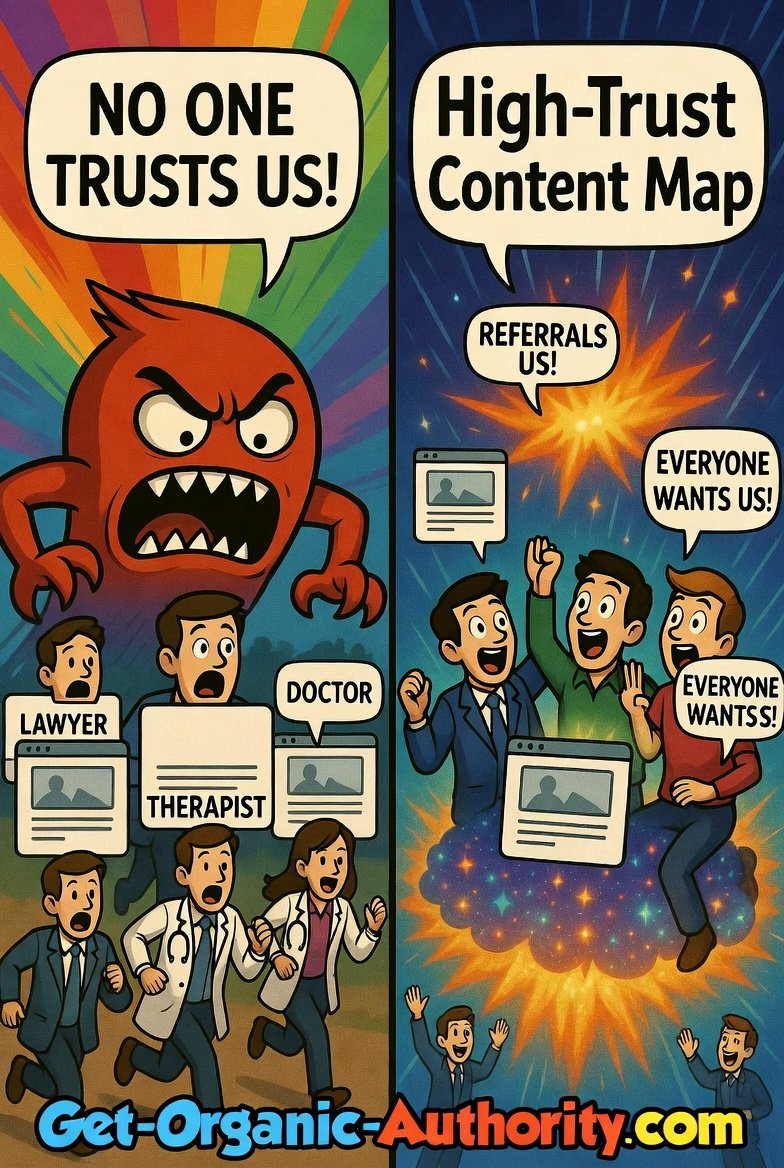
Gaining trust isn’t easy, but the only solution for attracting online leads.
The Trust Content That Makes People Feel Safe Enough to Call
High-trust content is not only about ranking. It is about lowering the emotional cost of reaching out. This matters for all professional services, but especially for therapy, healthcare, and law. The visitor is often scared, skeptical, embarrassed, rushed, or comparing you against three other tabs while also eating lunch over a keyboard like a wounded office animal. The site has to reassure quickly.
Start with FAQs. FAQs are not filler. They are conversion tools. A therapy site can answer: What happens in the first session? How long does therapy take? Do you offer online therapy? What if I feel nervous about starting? What is EMDR? Do you work with trauma, anxiety, addiction, couples, or grief? A doctor site can answer: What symptoms should I watch for? What happens during the appointment? Do you accept insurance? How soon can I be seen? What treatments are available? A law firm site can answer: Do I have a case? What should I bring to a consultation? What are the deadlines? What happens if my claim was denied? What does a lawyer do during the process?
Good FAQs support SEO because they target long-tail questions. They also support trust because they reduce uncertainty. The same page can serve Google and humans without becoming a keyword piñata. Google helpful content guidance specifically asks if readers leave feeling they learned enough to achieve their goal. FAQs help create that feeling.
Next, add process content. Process content explains what happens after someone contacts you. This is criminally underused. A therapist can explain consultation, intake, first session, treatment planning, privacy, payment, and scheduling. A doctor can explain appointment request, forms, evaluation, diagnosis, treatment options, follow-up, and referrals. A lawyer can explain consultation, case review, documents, next steps, communication, fees, and timelines. Process content reduces the fear of the unknown. People are far more likely to call when the next step feels safe and clear.
Add fit content. This is especially powerful for therapists and private practices. Fit content explains who the service is for and who it may not serve best. That does not need to sound exclusionary. It can sound grounded. A trauma therapist might say the practice works well with adults who feel stuck in survival patterns, emotional shutdown, hypervigilance, or relationship triggers. A medical practice might clarify ideal candidates for a treatment and when another type of evaluation may be needed. A law firm might explain the types of cases it handles most often. Fit content saves time and builds trust because people feel less like they are entering a sales funnel and more like they are being oriented by an actual human. Dangerous innovation.
Add comparison content. People compare before they contact. The Back-Pocket Search explains why referrals still Google a professional before calling. A referred patient may search the doctor's name. A referred client may compare two therapists. A referred legal consumer may read reviews and scan bios. Comparison content helps them make sense of options: EMDR vs traditional talk therapy, therapist vs psychologist, primary care vs urgent care, dermatologist vs med spa, workers' comp lawyer vs personal injury lawyer, settlement vs hearing, paid ads vs SEO for therapists, directory listing vs owned website authority. These pieces can be honest, helpful, and conversion-friendly.
Add trust proof in context. A review page is useful, but reviews belong near decisions. A service page should include proof related to that service. A bio should include credentials related to the work. A location page should include local proof. A consultation page should include reassurance. BrightLocal Local Consumer Review Survey 2026 found reviews remain deeply embedded in consumer decision-making, and BrightLocal local SEO statistics reports that 71% of consumers use Google to read local business reviews. FindLaw shows the same pattern in legal services. For high-trust businesses, proof is not vanity. It is oxygen.
Add content that respects compliance. Lawyers need ethical care around case results, guarantees, disclaimers, and attorney advertising rules. Doctors need medical accuracy, scope clarity, and disclaimers that educational content does not replace medical advice. Therapists need privacy, licensure clarity, ethical boundaries, crisis language where appropriate, and careful handling of sensitive topics. This is another reason cheap blog mills are a bad fit for high-trust industries. They write like every business sells patio furniture. A trauma therapy article and a roofing article should not have the same emotional temperature. Astonishing, I know.
This is where Get Organic Authority's positioning matters. The work is not simply writing words. It is translating real expertise into a content system that Google can understand and humans can trust. The article They Said What? Common SEO Lies Doctors, Lawyers, and Therapists Keep Hearing makes the same point by calling out fake shortcuts: guaranteed rankings, random blogs, keyword stuffing, mysterious backlinks, and reports that confuse motion with progress. High-trust website content requires more care because the buyer's decision requires more trust.
The Content Map by Industry
A strong content map changes by industry. The skeleton is similar, but the bones carry different weight. Lawyers need legal urgency and practice-area clarity. Doctors need clinical trust and condition-specific education. Therapists need emotional safety, fit, and niche language. Private practices need all of this with local SEO stitched through the whole thing like thread through a very expensive quilt.
For lawyers, the map should include a homepage, individual practice area pages, attorney bio pages, city pages, case result pages where ethical, testimonials where allowed, FAQs, consultation pages, legal process pages, and blog clusters around major case types. A personal injury firm needs car accident, truck accident, slip and fall, premises liability, wrongful death, and insurance dispute pages. A workers' comp firm needs denied claims, hearings, lost wages, medical treatment, retaliation, settlements, and state-specific guidance. A family law firm needs divorce, custody, support, mediation, property division, and protective orders. How Law Firms Turn Google Traffic Into Consultations is the natural internal support piece because it explains how legal content must move the visitor from search to consultation.
For doctors and medical practices, the map should include specialty pages, condition pages, treatment pages, provider bios, location pages, insurance and payment pages, patient resources, appointment process pages, review signals, FAQs, and educational articles that answer patient questions in plain language. Pew Research Center health information study reports that 73% of Americans get health information at least sometimes from three or more of the sources studied, which means patients are cross-checking information. Your website should be one of the places that feels accurate, clear, and trustworthy. Pew also reports that healthcare providers remain a key source of health information. Your site should make that expertise visible before the appointment.
For therapists, the map should include niche service pages, modality pages, issue pages, therapist bios, online therapy information, fees and insurance guidance, what-to-expect pages, FAQs, crisis resource language, blog clusters around client searches, and trust-building content that sounds human. Why Your Private Practice Website Feels Invisible and When Will My Therapy Website Get Traffic? both support this angle. Therapists often do meaningful work but have websites that under-explain their specialties. A visitor should not have to guess if you work with trauma, anxiety, substance abuse, couples, grief, OCD, ADHD, teens, men, women, first responders, LGBTQ clients, private-pay clients, or online clients. Clear content is kindness. Also SEO. A rare two-for-one that does not involve a coupon.
For any high-trust local service business, the map should include Google Business Profile alignment, local service pages, city pages where appropriate, reviews, citations, consistent name/address/phone details, and content that mentions local context naturally. Google local ranking guidance says relevance, distance, and prominence shape local results. You cannot control every factor, but you can make relevance and prominence easier to see. That starts with content.
The High-Trust Content Checklist
Here is the practical map. A high-trust website should include these pieces, connected through internal links and built around search intent.
Homepage: Say what you do, who you help, where you help them, what makes you credible, and where to go next. No fog. No hero section that says 'Committed to Excellence' like every other website that lost a bet with a stock photo library.
Service pages: Build one strong page for each major service, practice area, specialty, treatment, or therapy focus. Each page should answer the real client question, include local relevance, explain the process, show proof, and offer a clear CTA.
Bio pages: Give each professional a page that proves expertise, builds human connection, links to relevant services, and helps referrals feel confident.
Location pages: Create useful local pages for offices, service areas, or major markets. Make them genuinely local. Google and humans can both smell copy-paste city pages. It is not a pleasant smell.
FAQ pages and sections: Answer the questions people ask before they call. Use these to support long-tail SEO and reduce fear.
Process pages: Explain what happens during intake, consultation, appointment, evaluation, first session, onboarding, or case review.
Proof pages: Include reviews, testimonials, results, credentials, awards, associations, publications, media, or community involvement where appropriate and compliant.
Pillar pages: Build deep authority pages around your biggest topics. Use The Blueprint when you need the first strong pillar and content map.
Supporting blogs: Create articles around long-tail questions, comparison searches, problem-aware searches, and local intent. These should support the pillar and service pages.
Internal links: Connect blog posts to service pages, service pages to blogs, bios to services, location pages to relevant offerings, and pillar pages to supporting content. Use How to Internally Link Blog Posts to Service Pages Without Making a Mess as the operating manual.
Backlink-worthy assets: Create resources worth citing. Guides, checklists, local resource pages, expert explainers, and original frameworks give other sites a reason to link.
Conversion CTAs: Match the next step to the visitor's urgency. Schedule a consultation. Request an appointment. Ask about your case. Start therapy. Book an evaluation. Get help with a denied claim. The CTA should feel like help, not a trapdoor.
This map is the difference between having a website and having a system. It is also the difference between SEO that sounds busy and SEO that compounds. A single article can help. A connected ecosystem gives every new article somewhere useful to live.
Why Random SEO Content Fails High-Trust Businesses
Random SEO content fails because it misunderstands the buyer. A person choosing a lawyer, doctor, or therapist is not shopping for socks. They are making a trust decision. They need clarity, proof, fit, and reassurance. Cheap SEO often gives them keyword mush. The title ranks for something. The article says almost nothing. The page ends with a call to action so generic it could belong to a dentist, plumber, divorce attorney, and haunted escape room. 'Contact us today.' Brave poetry from the content mines.
The bigger failure is that random content rarely connects. A blog post sits alone. A service page sits alone. A bio page sits alone. A local page sits alone. Google sees fragments. Visitors see fragments. The site owner sees a dashboard with impressions and wonders why the phone remains silent. Why Your Competitors Show Up on Google Before You Do explains the annoying truth: competitors often win because their signals are clearer. They may have stronger service pages, better local SEO, more reviews, cleaner internal links, deeper topic clusters, and more relevant long-tail content.
This is also why ads cannot fix a weak site. Paid traffic can send more visitors to a thin website, but it cannot make the website trustworthy. Should I Run Ads? The Therapist Marketing Mistake That Bleeds Money makes this point for therapists, but the same logic applies across high-trust businesses. Buying traffic before fixing trust is like inviting guests to a restaurant while the kitchen is on fire and the menu says 'food items.' Bold. Bad.
Get Organic Authority exists for the opposite approach. The goal is to build the structure first. Clarify the service pages. Build the pillar. Answer the search intent. Link the ecosystem. Dogfood the strategy by publishing its own content system and showing how organic authority compounds. Then each new article has a job. Each page has a place. Each internal link has a reason. This is not magic. It is architecture, consistency, and human writing with a spine.
Build the Map Before You Wonder Why the Website Feels Invisible
If your professional website feels invisible, the question may not be 'Why is Google ignoring me?' The better question is 'Have we given Google and real people enough structure, depth, proof, and clarity to trust this site?' Annoying question. Useful question. The kind of question that walks in without knocking and improves the place.
Lawyers, doctors, therapists, and high-trust professional service firms need a content map because trust needs evidence. Your homepage sets the promise. Your service pages capture commercial intent. Your bio pages humanize expertise. Your location pages support local relevance. Your reviews and proof reduce hesitation. Your pillar pages establish depth. Your supporting blogs capture long-tail searches. Your internal links guide people and Google through the system. Your calls to action turn interest into contact.
That is the high-trust website content map. It is not glamorous in the way fake SEO promises are glamorous. It does not wear sunglasses indoors and promise page one by Friday. It works because it reflects how people actually choose serious professionals. They search. They compare. They verify. They read. They check reviews. They look for fit. They decide if the website feels safe enough to take the next step.
If your site is missing the map, start with The Blueprint. It gives your business one long-form SEO pillar article built around your core service, niche, or audience, plus the structure for future supporting content. If you are ready to build monthly authority, The Foundation is the stronger move. It creates 10 long-form SEO articles each month, built into strategic topic clusters, internally linked, search-intent driven, and written to help real people trust you before the first call.
Your website should not be a placeholder. It should be a client acquisition system, a trust engine, a local authority asset, and a map that makes your expertise impossible to miss. Get Organic Authority builds that map. The internet, tragically, will not organize itself.
The Solution:
Ready to turn your website into something more useful than a pretty waiting room? Start with The Blueprint if you need the first pillar and content map. Choose The Foundation if you are ready to build the full authority system month after month. Get Organic Authority helps lawyers, doctors, therapists, private practices, and high-trust businesses turn expertise into organic visibility, trust, and better client inquiries.
