Ads vs. Organic SEO: What Lawyers, Doctors, and Therapists Actually Need to Know
The Fast Answer: Ads Rent Attention. Organic SEO Builds Authority.
If you are a lawyer, doctor, therapist, private practice owner, or high-trust professional staring at the words “Google Ads,” “SEO,” “organic traffic,” and “PPC” like someone dumped alphabet soup into your marketing budget, breathe. The difference is simpler than the internet makes it sound, mostly because the internet enjoys taking clear ideas and dressing them like airport signage.
Paid ads put you in front of people fast. Organic SEO helps you become the result people find, trust, read, remember, compare, and return to without paying for every single click like a tiny digital toll booth operator with excellent posture.
Ads are rented visibility. SEO is owned authority. Ads can work quickly, but the moment the budget stops, the faucet shuts off. Organic SEO takes longer, but strong service pages, long-form SEO content, pillar articles, topic clusters, reviews, internal links, and trust-building content can keep earning traffic long after publication. That difference matters deeply for lawyers, doctors, therapists, and private practices because your buyer is rarely making a casual decision. They are hiring someone to handle pain, fear, money, health, custody, trauma, injury, diagnosis, reputation, or their future. Casual little Tuesday stuff.
What Paid Ads Actually Do
Paid ads are the sponsored results you see at the top of Google. Google explains that paid search ads can appear on the search results page and that advertisers are charged when someone clicks the ad and lands on the website. Google also defines average cost-per-click as the total cost of clicks divided by the total number of clicks. In plain English: someone clicks, you pay. Marketing, but with a meter running.
That can be useful. A new law firm may need immediate personal injury leads. A medical practice may want to promote a new service line. A therapist may want to fill openings for couples therapy, EMDR therapy, trauma therapy, or private-pay counseling. Paid ads can put a page in front of high-intent searchers quickly. Speed is the charm. Speed is also the trap.
If the website is weak, paid ads simply send expensive strangers to a weak website. Congratulations, you have invented the luxury bounce. A click for “workers comp lawyer near me,” “anxiety therapist accepting new clients,” or “best orthopedic doctor for knee pain” has value only if the landing page earns trust fast. The ad brings the visitor to the door. The page still has to avoid sounding like it was written by a filing cabinet.
What Organic SEO Actually Does
Organic SEO is the work of helping your website show up naturally in unpaid Google results. Google’s SEO Starter Guide describes SEO as improving a site’s presence in search. That means making your pages easier for Google to crawl, understand, index, and rank, while making them more useful for the actual human searching. A scandalous idea: help the person.
For high-trust businesses, organic SEO usually means stronger service pages, local SEO, long-tail keyword strategy, topic clusters, pillar pages, helpful blog articles, internal linking, Google Business Profile support, review strategy, and clear conversion paths. It means your website slowly becomes less of a brochure and more of a trust engine.
That is exactly the difference between generic SEO and what Get Organic Authority builds. The goal is a content ecosystem, not random blog posts tossed into the void wearing keywords like cheap cologne. A real organic authority strategy connects service pages, supporting articles, buyer intent, professional credibility, local relevance, and internal links so your website becomes easier to find and easier to trust.
Why This Matters More for High-Trust Businesses
A pizza place can run an ad and get someone hungry enough to order. A therapist, lawyer, or doctor has a harder job. Nobody casually books trauma therapy between errands because an ad winked at them. Nobody hires a custody attorney because the font felt spicy. Nobody chooses a surgeon because a headline said “trusted care” and called it a day. High-trust decisions have friction.
People compare. They read reviews. They scan bios. They look for experience. They search again. They ask a spouse. They disappear. They return two weeks later from a different device like a tiny mystery novel with Wi-Fi. BrightLocal’s 2026 Local Consumer Review Survey reports that 97% of consumers read reviews for local businesses. That matters because ads can create the first click, but trust decides the call.
This is where The Trust Gap becomes the real villain. A prospect may find you through an ad, a referral, a blog post, a Google Business Profile, or a local search. Then they judge the whole digital room. Do your pages explain their problem? Do you sound specific? Do you look credible? Do your reviews support the promise? Do your articles answer the awkward questions they are too embarrassed to ask clearly? If not, the ad did its job and the website fumbled the handoff like a sleepy intern.
The Practical Difference in One Human Sentence
Ads help you appear. Organic SEO helps you deserve to be chosen.
That sentence should be printed on a tiny plaque and mailed to every professional service business that has ever asked, “Should I run ads or invest in SEO?” The answer is usually: yes, eventually, but in the right order. Build the pages, content, trust signals, and conversion path first. Then use ads to amplify something worth amplifying.
If you have one strong service page and no supporting content, The Organic SEO Authority Blueprint can build the pillar article that anchors your first authority cluster. If your site needs steady momentum, The Foundation builds 10 long-form SEO articles each month into connected topic clusters with long-tail keywords, internal links, search intent, and human writing that earns trust before the first call.
The Real Question Is Not Ads or SEO. It Is What Happens After the Click.
A lawyer paying for “car accident lawyer near me” needs more than traffic. The landing page has to explain injury claims, case types, fees, local experience, what happens after the call, and why the firm is trustworthy. A doctor paying for “dermatologist appointment near me” needs a page that answers symptoms, treatments, insurance confusion, appointment logistics, and provider credibility. A therapist paying for “anxiety therapist near me” needs a page that feels safe, specific, and clear without sounding like a wellness brochure got trapped under a weighted blanket.
This is why the existing Get Organic Authority article Should I Run Ads? matters. Ads can help, but ads magnify what already exists. A strong website can convert paid traffic. A thin website can turn paid traffic into expensive little ghosts.
So the real question is not “ads vs. organic.” The real question is: do you want to keep renting attention forever, or do you want to build an organic authority system that makes your paid traffic, referral traffic, local traffic, and organic traffic work together? One path buys visits. The other builds trust. Tiny difference. Massive invoice consequences.
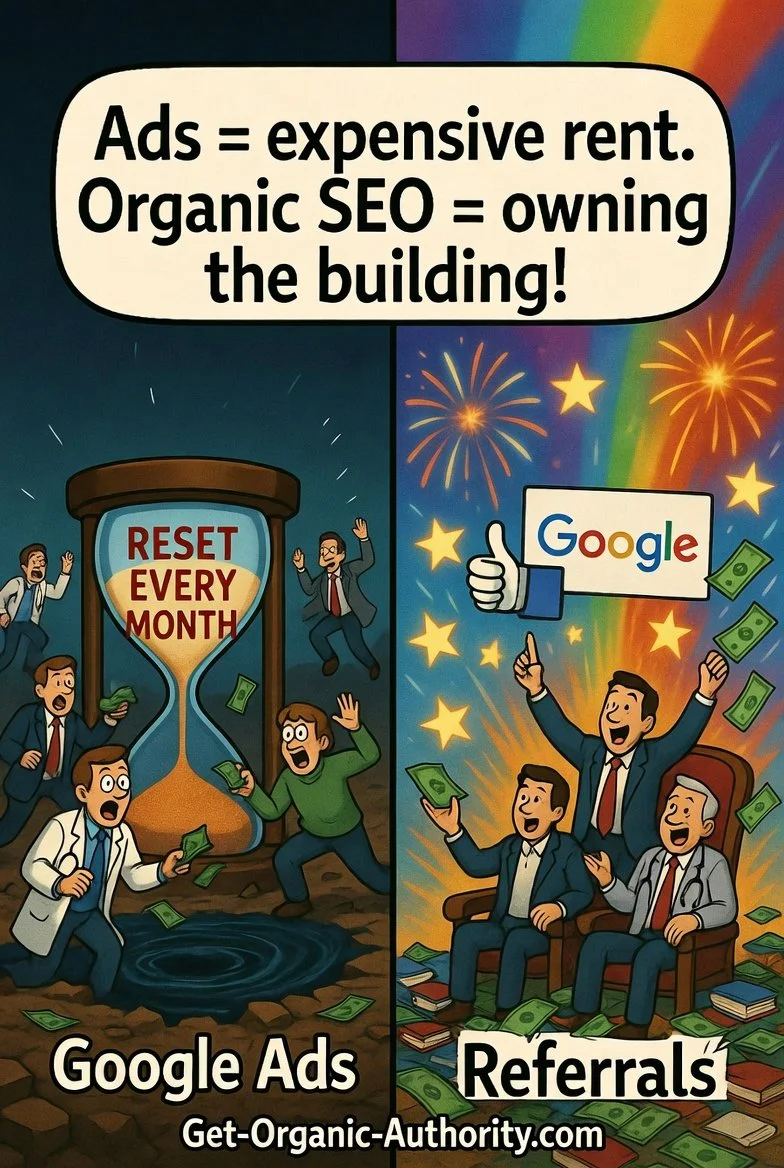
Rent the space VS. Own the space.
How Ads and Organic SEO Actually Work Together
Paid Ads Are a Faucet. Organic SEO Is the Plumbing.
The faucet metaphor works because humans apparently need household fixtures to understand marketing. Paid ads are the faucet. You turn the budget on, traffic flows. You turn the budget off, traffic slows or disappears. Organic SEO is the plumbing: the service pages, local SEO structure, internal links, topic clusters, reviews, schema, content depth, and trust-building pages that determine where traffic goes and what happens when it arrives.
A faucet without plumbing is chaos. Plumbing without a faucet may still work over time through organic discovery, referrals, branded searches, and content traffic. But when both work together, the system becomes much more useful. Paid ads can test messaging, push seasonal offers, promote urgent services, support new pages, and capture high-intent searches quickly. Organic SEO can build the long-term authority, trust, and content depth that lowers dependence on paying for every click.
This is why How to Get More Local Leads From Google Without Paying for Every Click fits naturally into this topic. Local leads are rarely created by one tactic. A lawyer, doctor, therapist, or private practice needs service pages, local relevance, Google Business Profile signals, reviews, content, and clear next steps. Ads can add speed, but organic authority gives the business something sturdier than a monthly ad spend bonfire.
The Cost Difference: Paid Clicks Are Immediate, Organic Clicks Compound
Google Ads cost is easy to understand and emotionally annoying. You pay when someone clicks. LocaliQ’s 2026 search advertising benchmarks reported an average search advertising cost per click of $9.87 for attorneys and legal services. Legal clicks can get expensive because the value of a signed case can be high. Healthcare and therapy markets vary by specialty and location, but the principle stays the same: competitive high-trust industries often pay more for attention because attention can turn into high-value clients, patients, cases, or consultations.
That does not make ads bad. It makes ads literal. If you want 500 visits this month and the average click costs $8, the math has teeth. If the landing page converts poorly, the real cost per consultation or booked appointment can climb fast. A $2,000 monthly ad budget can disappear into a weak funnel like loose change into a couch owned by raccoons.
Organic SEO has a different cost curve. A long-form SEO article, pillar page, or service page costs money upfront, but it can keep attracting traffic over time. A strong article on “what to do after a workers comp claim denial,” “how to know if anxiety therapy is working,” or “when to see a doctor for chronic knee pain” may bring in searchers for months or years. That article can link to a related service page, educate the reader, answer objections, and build trust before a consultation.
This is why SEO Content Ecosystems for High-Trust Businesses is the strategic center of the Get Organic Authority model. One article can help. A connected ecosystem compounds. Organic SEO works best when service pages, supporting blogs, topic clusters, pillar content, local pages, and internal links reinforce one another instead of wandering around the website like unsupervised toddlers with meta descriptions.
Search Intent Decides Which Channel Makes Sense
The best marketing decision starts with search intent. Someone searching “personal injury lawyer near me” may be ready to call now. Ads can make sense there because the search has immediate commercial intent. Someone searching “how long does a personal injury case take” may need education first. Organic content can meet that question, build trust, and guide the reader toward a legal consultation when the timing feels right.
A patient searching “urgent dermatologist appointment near me” may respond to an ad. A patient searching “mole changing shape should I worry” may need a helpful article that explains warning signs and points them toward evaluation. A person searching “trauma therapist near me taking new clients” may be close to booking. A person searching “why do I freeze during conflict” may need a long-tail therapy article that names the problem gently and links toward trauma therapy or couples therapy.
This is why Search Intent for Service Businesses should sit inside the reader journey here. Ads and SEO are not enemies. They are tools for different stages of intent. Informational content captures early-stage questions. Comparison content helps skeptical buyers evaluate options. Service pages convert high-intent local searches. Ads can send urgent buyers directly to high-intent pages. Organic content builds the trust field around those pages.
Bad strategy throws every visitor onto the homepage and hopes the contact button starts glowing with divine purpose. Better strategy sends searchers to the page that matches their problem, stage, and emotional state. We remain tragically forced to design for humans, since humans keep clicking things.
Why High-Trust Buyers Need More Than a Click
A click is not a client. A click is a little knock on the digital door. The real work begins after the person lands. High-trust buyers need reassurance because the decision carries weight. They are asking: Can I trust you? Do you understand my exact situation? Are you experienced with this problem? What happens next? What will this cost? Will I feel judged? Will this be worth the risk?
That is why organic content is so powerful for lawyers, doctors, therapists, and professional service firms. It gives the buyer time to build confidence before they reach out. The article on The Back-Pocket Search explains this perfectly: even referred prospects often Google you before calling. The referral may open the door, but the website decides if they walk through.
The same idea shows up in The Invisible Searcher. Many people search in awkward fragments when the issue feels private, embarrassing, confusing, painful, or expensive. They may not type the polished keyword your agency loves. They type messy human searches like “lawyer if boss fired me after injury,” “doctor for weird stomach pain no diagnosis,” or “therapist for feeling numb after divorce.” Long-tail SEO helps your site show up for those real searches.
Paid ads often focus on obvious bottom-funnel keywords. Organic SEO can capture the entire emotional and informational path before someone is ready. That is a huge advantage for high-trust businesses because trust forms before the lead form. A content ecosystem lets the reader meet your thinking before they meet your intake coordinator.
The Landing Page Test: Would You Pay to Send Traffic Here?
Here is a painfully useful test. Open the page you would send ads to and ask: would I pay $5, $10, $20, or $50 per visitor to send strangers here? If the answer makes your soul leave through the ceiling, fix the page first.
A strong paid ad landing page for a lawyer should clearly name the legal problem, location, practice area, case types, consultation process, fee structure when appropriate, attorney credibility, next steps, and urgency. It should link naturally to deeper resources, such as a guide on denied claims, case timelines, settlement factors, or what to bring to a consultation. The article How Law Firms Turn Google Traffic Into Consultations expands that path for legal websites.
A strong landing page for a doctor should explain the condition or service, who it helps, symptoms, treatments, provider credentials, appointment process, accepted insurance or payment questions when appropriate, and when someone should seek care. A strong landing page for a therapist should speak to the client’s problem, offer emotional clarity, explain the modality or process, reduce first-session fear, and guide the person toward booking. It should sound warm and specific, not like a group of stock photos formed a committee.
This is also where Service Pages for Small Businesses belongs. Service pages are where searches become leads. Ads should usually point to strong service pages or dedicated landing pages. Organic articles should support those pages. Internal links should guide readers toward them. The page has to do the business work, not just exist in a state of decorative optimism.
Internal Links Turn Organic Traffic Into Appointments
A blog post that ranks but leads nowhere is a polite dead end. It may bring traffic, but traffic alone is not the goal. The goal is a path. A person reads an article about panic attacks after trauma and clicks to the trauma therapy page. A patient reads about knee pain and clicks to the orthopedic service page. A legal prospect reads about workers comp mistakes and clicks to the workers comp lawyer page.
That is why How to Internally Link Blog Posts to Service Pages Without Making a Mess should be part of this ecosystem. Internal links help Google understand the relationship between pages and help readers move through the site. The anchor text needs to be natural, useful, and specific. “Learn more” is fine sometimes. “trauma therapy for adults in Miami” or “workers comp lawyer consultation” gives both the human and Google more context. Tiny road signs. Miraculous technology.
Paid ads often skip this broader journey. They send traffic straight to one page. That can work for urgent search intent. Organic SEO creates more entry points and more paths. Someone might enter through a blog, read a comparison article, click a service page, check reviews, return through a branded search, then schedule. Analytics may label this neatly. Reality is a feral creature with seven tabs open.
Topic Clusters Build Authority Ads Cannot Buy
Ads can buy visibility for a keyword. They cannot buy topical authority. Google may show your ad if you bid enough and meet platform requirements, but organic rankings require stronger signals: relevant pages, helpful content, crawlable structure, internal links, backlinks, local relevance, user satisfaction, and trust.
A topic cluster is one of the cleanest ways to build that depth. The Get Organic Authority guide on how to build a topic cluster for a service business website explains the basic model: a core pillar page supported by related articles that link together. For a therapist, the cluster might revolve around trauma therapy, anxiety therapy, couples therapy, EMDR, or private-pay counseling. For a doctor, it might revolve around knee pain, dermatology, functional medicine, pediatrics, dental implants, or chronic pain. For a lawyer, it might revolve around workers comp, personal injury, criminal defense, estate planning, divorce, or SSD claims.
The long-tail keywords inside these clusters are where organic SEO becomes deliciously practical: “what happens after a workers comp claim is denied,” “how to choose a trauma therapist after abuse,” “doctor for shoulder pain that will not go away,” “best therapy for anxiety and overthinking,” “family lawyer for custody modification near me,” “medical practice SEO for specialists,” “law firm SEO strategy for local cases,” “therapist SEO content for private-pay clients.”
Ads may capture the obvious terms. Organic clusters capture the buyer’s entire messy question field. That is where high-trust businesses win long term.
When Ads Make Sense
Paid ads make sense when the website is ready, the offer is clear, the landing page is specific, the budget can support testing, and the business understands lead quality. Ads can help new practices generate visibility while organic SEO ramps up. Ads can support urgent services, competitive local searches, seasonal demand, new locations, new service lines, and retargeting.
A personal injury firm might run ads for high-intent accident terms while building organic content around case questions. A doctor might run ads for appointment-ready services while publishing educational articles around symptoms and treatment options. A therapist might run ads for EMDR therapy or couples counseling while building organic authority around trauma, anxiety, relationships, and first-session concerns.
The mistake is treating ads as the whole strategy. That is how businesses end up dependent on paid clicks, vulnerable to rising CPCs, and confused when traffic stops the second the budget pauses. Ads are a useful lever. A lever still needs something solid underneath it.
When Organic SEO Should Come First
Organic SEO should come first when the website has weak service pages, vague positioning, no content ecosystem, poor internal linking, few trust signals, thin local relevance, no topic clusters, or no answer for why someone should choose the business over nearby competitors. In other words, most websites. Painful but efficient.
Before buying clicks, the site should answer the buyer’s real questions. What do you do? Who do you help? Where do you help them? What problems do you solve? What makes your approach credible? What happens next? What should the visitor read if they are not ready to call yet? What service page should a blog article support? What long-tail keywords reveal hidden demand?
This is where The Organic SEO Authority Blueprint works well as a starting point. It gives the business one strategic long-form pillar article that can anchor future supporting content. For a business ready to build the whole machine, The Foundation creates the ongoing monthly content ecosystem: 10 long-form SEO articles each month, built into topic clusters, aimed at long-tail keywords, and internally linked to support organic authority.
The Better Strategy: Build Organic Authority, Then Use Ads Like an Amplifier
The smartest answer is rarely “only ads” or “only SEO.” The smarter answer is sequence. Build the organic authority system first, or at least build enough of it that paid traffic has somewhere useful to land. Then use ads as an amplifier, not a life-support machine.
That means mapping your services, building service pages, creating pillar pages, publishing supporting articles, using internal links, improving Google Business Profile, gathering reviews ethically, writing helpful content, and tracking which pages bring calls, forms, bookings, and consultations. Then ads can be used strategically to push traffic toward the highest-value pages.
This is also why Why Your Competitors Show Up on Google Before You Do belongs in the same reading path. Competitors often win because Google sees clearer service pages, stronger local signals, better internal links, more relevant content, and deeper topical coverage. They may also run ads, sure. But the real danger is when they have both: paid visibility and organic authority. That is when they start looking “everywhere” online while your business wonders why referrals slowed down.
Cheap SEO and Bad Ads Share the Same Disease
Bad ads and cheap SEO usually fail for the same reason: they chase surface visibility without building trust. A cheap PPC campaign may bid on keywords without fixing the page. A cheap SEO agency may publish generic blogs without linking them to service pages. An AI content farm may produce 20 articles that technically contain keywords and spiritually contain sawdust.
The article They Said What? Common SEO Lies Doctors, Lawyers, and Therapists Keep Hearing fits this exact problem. High-trust businesses keep hearing promises about fast rankings, guaranteed leads, magic keywords, and mysterious monthly packages. The better question is always: what system are we building?
Get Organic Authority is positioned as the smarter alternative because the work is not just “SEO writing.” It is strategy, long-form content, topical authority, internal linking, search intent, service-page support, and trust-building content for businesses where credibility matters. The work uses dogfooding too: Get Organic Authority is building its own content ecosystem publicly, article by article, using the same strategy it sells. There is something deeply satisfying about marketing that has to prove itself in daylight, like a vampire with invoices.
The Simple Decision Framework
Use ads when you need immediate visibility, your landing page is strong, your conversion path is clear, your budget can support testing, and you can track calls, forms, consultations, and appointment quality. Use organic SEO when you want long-term visibility, lower dependence on paid clicks, stronger trust, more referral support, more local discovery, and a website that compounds over time.
Use both when your organic foundation is strong enough that ads amplify a real system. That is the grown-up answer. Less flashy. More profitable. Tragically practical.
For lawyers, doctors, therapists, and private practices, organic SEO is usually the foundation because the buyer journey is trust-heavy. Ads can create attention. Organic authority earns belief. And belief is what turns a searcher into a caller, a caller into a consult, and a consult into actual revenue. Fancy how business works when the website stops acting like a digital brochure and starts acting like a guide.
Build the Authority Before You Keep Buying the Click
Paid ads can get you seen. Organic authority helps you get chosen. That is the difference that matters for therapists, lawyers, doctors, private practices, and high-trust service businesses.
If your website has weak service pages, thin content, poor internal links, no topic clusters, no long-tail keyword strategy, and no trust-building articles, buying ads is like sending guests to a dinner party where the chairs are missing and the host is a landing page from 2018. Brave. Unwise. Expensive.
Start by building the thing worth amplifying. Get Organic Authority helps high-trust businesses turn expertise into search visibility through human long-form SEO content, content ecosystems, service-page support, internal linking, topical authority, and trust-building strategy.
Start with The Organic SEO Authority Blueprint if you need one strong pillar article that maps your first organic authority opportunity. Choose The Foundation if you are ready to build the full monthly system with 10 long-form SEO articles designed around real search intent, high-value long-tail keywords, topic clusters, and internal links.
Ads rent the room. Organic authority helps you own the building. Build the building. Then decide which rooms deserve a spotlight.
