Your Website Got the Click. Now What?
Traffic Is Cute. Trust Pays the Bills.
A website click can feel like victory. Someone found you on Google. The analytics chart moved. A little green arrow may have appeared somewhere, and for one shimmering second, everyone pretended the marketing problem had been solved. Humanity loves a graph. We see one upward line and start behaving like we discovered fire with Wi-Fi.
Then nothing happens.
The phone stays quiet. The intake form remains untouched. The calendar has the emotional temperature of an abandoned dentist office. The visitor came, looked around, and left without calling. For lawyers, doctors, therapists, and other high-trust professional service businesses, this is the part generic SEO agencies love to ignore because it ruins the cute traffic report.
Getting found is not the same as getting chosen.
That sentence should be taped above every website dashboard in America. It explains why a law firm can rank for a local injury keyword and still lose the consultation. It explains why a medical practice can get traffic from condition searches and still watch patients book somewhere else. It explains why a therapist can show up for “anxiety therapist near me” and still lose the private-pay client to a directory profile with better photos and clearer copy. Annoying? Deeply. Fixable? Also yes, which is a rare mercy in marketing.
The Click Is Only the Front Door
A click means someone gave you a chance. That is all. It does not mean they trust you. It does not mean they understand your service. It does not mean they feel safe enough to call. It does not mean they have stopped comparing you against five other tabs, a referral, a directory listing, a competitor with suspiciously perfect reviews, and one practice website that looks like it was built by a yacht club but somehow ranks above you.
For high-trust businesses, the visitor has a second journey after the search result. They scan the page. They judge the headline. They look for specificity. They inspect credentials. They read reviews. They click your About page. They wonder if you handle their exact situation. They ask a silent question: “Do I feel safer moving forward here?”
That silent question is where The Trust Gap lives. The trust gap is the space between visibility and action. It is the difference between a visitor landing on your site and a visitor becoming a lead, patient, consultation, or appointment. Get Organic Authority builds content around that gap because traffic without trust is basically a parade marching into a closed bank.
Google’s own Google SEO Starter Guide frames SEO as helping search engines understand your content and helping users decide whether to visit your site. That second half matters. The human still has to decide. The page still has to earn the read. The website still has to make the next step feel clear, credible, and worth the emotional effort.
Why High-Trust Visitors Behave Differently
A person choosing a lawyer, doctor, or therapist is rarely casually browsing like someone comparing patio umbrellas. These searches carry risk. A legal client may be worried about money, custody, criminal charges, injury, immigration, employment, or a deadline. A patient may be worried about symptoms, pain, diagnosis, cost, recovery, or whether a doctor will actually listen. A therapy client may be carrying shame, panic, trauma, relational collapse, addiction recovery, grief, or the quiet dread that life cannot keep going the same way.
These visitors are not shopping for a novelty mug. They are looking for competence with a pulse.
That changes the job of SEO content. The article, service page, bio, FAQ, and internal link structure all have to do more than attract traffic. They have to lower fear. They have to answer the question behind the keyword. They have to make the business feel real, specific, experienced, and safe enough to contact. This is why SEO content ecosystems for high-trust businesses matter more than random blog posts. A random blog gets attention for one keyword. A connected content ecosystem helps the reader move from problem to trust to action.
The “Website Traffic Not Converting” Problem Usually Has a Trust Problem Underneath
When a business owner says, “My website gets traffic but no leads,” the usual suspects line up immediately. Weak headline. Thin service page. Generic copy. No internal links. No proof. No clear next step. No location signals. No helpful supporting content. No emotional specificity. No real explanation of what happens after the call. In other words, the visitor arrived and the website greeted them with a beige handshake.
This is especially common in private practice SEO, law firm SEO, healthcare SEO, and therapist SEO because so many sites are written to sound professional rather than useful. “We provide compassionate, personalized care” may be technically fine. It is also about as memorable as room-temperature oatmeal wearing a blazer. A visitor with a real problem needs more than polished adjectives.
They need to know if you understand the specific thing they are carrying. The workers comp client wants to know what happens when a claim is denied. The patient wants to know what symptoms mean and what the appointment may involve. The therapy client wants to know if trauma work will feel overwhelming, if the consultation is awkward, if confidentiality applies, and if they will be judged for waiting this long to reach out.
That is where trust-building SEO content does the work. It answers real questions before the first call. It supports service pages. It links readers toward the next helpful step. It builds organic authority around the exact problems people search for before they are ready to become leads.
Build the Path After the Click
If your website is getting some traffic but the leads feel thin, scattered, or weirdly underwhelming, the problem may not be “more SEO.” It may be that the content system has no conversion path after the click. The Organic SEO Authority Blueprint gives you one strong pillar article built around your core service, audience, or niche so your site has a strategic anchor instead of another lonely blog post wearing keyword cologne. If you are ready to build the whole authority engine, The Foundation creates 10 long-form SEO articles each month, organized into topic clusters, internal links, search intent, and trust-building content that compounds over time.
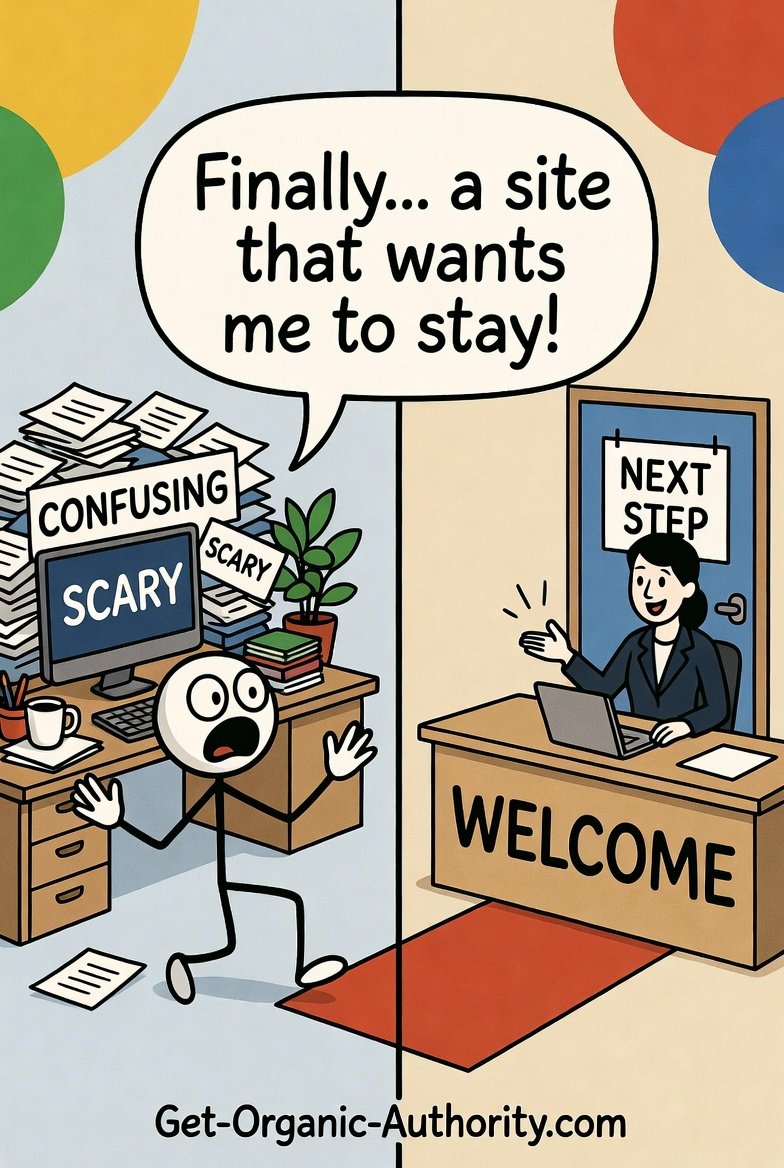
Clicking and staying are two very different paths.
The Trust Content Layer: What Visitors Need After They Land
They Need Specificity, Not Vague Professional Perfume
Most professional service websites smell faintly of template. The law firm fights for justice. The doctor provides patient-centered care. The therapist offers a safe space. The accountant delivers strategic solutions. The consultant partners with clients. Everyone is committed to excellence. Everyone is passionate. Everyone is apparently trapped in the same brochure factory.
Specificity cuts through that fog. It tells the visitor, “This page was built for your actual problem.” For lawyers, that may mean practice area pages and articles that explain case timelines, evidence, fees, insurance tactics, consultation questions, and common mistakes. For doctors, it may mean condition pages, treatment explainers, provider bios, second-opinion content, appointment preparation, and plain-language medical education. For therapists, it may mean articles on panic, trauma, emotional shutdown, couples conflict, private pay, first-session anxiety, and how to choose the right therapeutic fit.
Specific content targets long-tail SEO keywords while building trust. That is the useful two-for-one deal. “What to ask a personal injury lawyer before hiring one” is a keyword. It is also a real fear. “How to choose a trauma therapist when you feel overwhelmed” is a keyword. It is also a human being trying to move without freezing. “When should I see a specialist for chronic knee pain” is a keyword. It is also a patient trying to decide if they are overreacting. Good organic SEO content respects both layers.
They Need Search Intent Matched to the Right Page
Search intent is where many websites quietly injure themselves. Someone searching “what happens during an EMDR consultation” does not need the same page as someone searching “EMDR therapist near me.” Someone searching “do I need a workers comp lawyer after my claim was denied” does not need the same page as someone searching “workers comp attorney consultation Richmond.” Someone searching “orthopedic doctor for knee pain near me” has a different level of readiness than someone searching “why does my knee hurt walking upstairs.”
The page has to match the person behind the keyword. search intent for service businesses explains this in the Get Organic Authority ecosystem, and this supporting article extends that idea into conversion. Informational searches need helpful articles. Local high-intent searches need service pages and location clarity. Comparison searches need honest guide-style content. Referral searches need proof, bio depth, reviews, and confirmation. Decision-stage searches need clear next steps.
When search intent is mismatched, traffic looks healthy and conversions look haunted. A blog post attracts someone ready to book, but the post never links to the service page. A service page attracts someone still researching, but the page pushes too hard before answering their fear. A paid ad sends a visitor to a generic homepage, which is marketing’s version of sending a patient to a hospital and pointing vaguely toward “medicine.”
They Need Internal Links That Act Like a Helpful Hallway
Internal links are not little blue decorations. They are the hallways of the website. They tell Google which pages matter. They tell readers where to go next. They move visitors from curiosity to clarity to action. When they are missing, the visitor gets dropped into one page and expected to magically know the next step, because apparently websites are now escape rooms.
A strong supporting article should naturally guide the reader toward related content and conversion pages. A post about “why my law firm website gets traffic but no consultations” should link to a law firm SEO service page, a consultation-focused article like law firms turn Google traffic into consultations, and a broader piece on The Trust Gap. A medical practice article about “why patients leave your website without booking” should link to healthcare SEO content, provider bios, condition pages, and local SEO articles. A therapist article about “why therapy website visitors do not book” should link to anxiety therapy pages, trauma therapy content, consultation FAQs, and trust-building bio content.
The existing GOA article on internal linking blog posts to service pages already explains the mechanics. This piece adds the persuasion layer. An internal link is not just an SEO signal. It is a trust handoff. It says, “You are reading about the problem here. When you are ready, this page shows how we help.”
They Need Topic Clusters That Prove Depth
One blog post can make a point. A topic cluster makes a case. This matters because high-trust buyers want proof that your expertise is not a costume. A therapist with one page on trauma therapy looks less authoritative than a therapist with a trauma therapy service page, a trauma therapy pillar article, and supporting pieces on triggers, emotional numbness, childhood trauma, EMDR questions, dissociation, shame, attachment, and first-session fears. That cluster helps Google understand the practice’s depth and helps the reader feel recognized from multiple angles.
The same structure works for law firms and doctors. A personal injury firm can build a cluster around car accidents, medical records, settlement timelines, denied claims, insurance adjusters, injuries, damages, and consultation questions. A dermatology practice can build around acne, rashes, skin checks, cosmetic dermatology, mole concerns, treatment options, provider expertise, and appointment preparation. This is not publishing for the sake of publishing. This is building a body of evidence.
The article on how to build a topic cluster for a service business website already sits inside the GOA ecosystem for exactly this reason. A supporting article like this one should feed that structure by showing the business owner why topic clusters improve conversion, not just rankings. Depth reduces doubt. Doubt kills leads. Very elegant. Horribly inconvenient. Still true.
They Need Human Proof, Especially on the About Page
The About page is often treated like a polite storage closet for credentials. That is a mistake. For lawyers, doctors, therapists, and private practices, the About page may be one of the most important trust pages on the website. People want to know who is behind the service. They want evidence of experience. They want voice, warmth, clarity, and enough detail to feel they are contacting an actual person instead of a logo wearing pants.
That is why the GOA piece on about page SEO belongs inside this content path. A strong About page can support branded search, referral validation, local trust, provider credibility, and conversion. It can include real positioning, experience, philosophy, credentials, service focus, location relevance, and the human reason the work matters. For therapists, it can reduce fear. For doctors, it can increase confidence. For lawyers, it can make competence feel tangible instead of theatrical.
Reviews matter too. BrightLocal Local Consumer Review Survey reports that 97% of consumers read reviews for local businesses. That number should make every private practice website sit up straighter. People verify. They compare. They look for signs that other humans survived the experience and perhaps even appreciated it. Reviews help, but reviews alone rarely finish the job. The site still needs content that explains, organizes, reassures, and guides.
They Need Content for the Invisible Searcher
Some of the best leads do not search cleanly. They search emotionally. They search with fragments. They search late at night. They search the embarrassing version of the problem, then rephrase it because even Google feels too intimate. This is why The Invisible Searcher matters so much inside the GOA ecosystem.
A therapist’s future client may search “why do I shut down when my partner is mad,” “why do I feel numb after trauma,” or “how to find a therapist when I feel ashamed.” A legal client may search “can I be fired after injury,” “what happens if insurance says I caused the accident,” or “how to tell if I need a criminal defense lawyer.” A patient may search “is this symptom serious,” “when to see a doctor for stomach pain,” or “how to ask for a second opinion without offending my doctor.”
These searches are messy because people are messy. Shocking development. Long-tail SEO for high-trust businesses works because it meets people at the real level of concern rather than forcing every visitor through clean keyword categories. The content that wins here sounds informed, grounded, specific, and human. It avoids panic. It avoids promises. It gives the visitor language for what they are experiencing and a reasonable next step.
The Ads vs. Organic Lesson: Paid Clicks Still Need Organic Trust
Ads Can Buy Attention. They Cannot Buy Belief.
Paid ads can absolutely work. Anyone who says otherwise is selling a different kind of fantasy. Ads can put a therapist, lawyer, doctor, or private practice in front of the right searcher quickly. The problem starts when the ad sends that visitor into a weak website. Then the business pays for the click, the visitor lands on a vague page, and money evaporates with the quiet dignity of a magician stealing your wallet.
That is why the GOA ecosystem needs supporting content around ads vs organic SEO. The real difference is not simply “ads are fast and organic is slow.” The sharper point is this: ads rent attention, while organic authority builds trust assets that keep working. Ads can amplify a strong website. They cannot rescue a thin one. If the landing page lacks specificity, proof, internal links, service clarity, and helpful content, paid traffic just exposes the weakness faster.
Organic trust content gives ads somewhere credible to land. It gives referral searchers something useful to read. It gives Google more context. It gives visitors more confidence. It gives service pages more support. It turns the website from a digital business card into a working decision system.
Why Cheap Content Fails After the Click
Cheap SEO content usually fails because it treats readers like keyword-shaped furniture. It opens with the definition everyone already knows. It says things like “In today’s digital landscape” with the confidence of a toaster giving legal advice. It stuffs in keywords, repeats the service name, adds a few tips, and calls it strategy. Then everyone wonders why the article ranks poorly, reads worse, and converts like a screen door on a submarine.
For high-trust businesses, weak content is not neutral. It can actively make the business feel less credible. A lawyer who publishes vague legal content looks less useful. A doctor with thin health explainers looks less authoritative. A therapist with generic mental health copy sounds less attuned. In low-stakes industries, bland content may be survivable. In high-trust industries, bland content quietly says, “We may not understand your real concern.”
Google helpful content guidance pushes creators toward content that is useful, reliable, people-first, and more than obvious summary. That lines up perfectly with what high-trust visitors already want. They want depth. They want clarity. They want originality. They want signs of experience. They want the page to answer the question they actually brought, not the sanitized version a keyword tool coughed onto a spreadsheet.
How to Turn Website Traffic Into Better Leads
Start With the Pages Closest to Money
Before building a giant blog calendar, fix the pages closest to action. For lawyers, that means practice area pages. For doctors, that means condition, treatment, provider, and location pages. For therapists, that means service pages around problems, populations, approaches, and locations. These pages should be specific enough to rank and human enough to convert.
A service page should answer who the service is for, what problem it solves, how the process works, what makes the provider credible, what questions people usually have, what the next step looks like, and what related content can help the visitor learn more. The goal is not to smother the reader with information. The goal is to remove uncertainty in the places uncertainty blocks action.
Build Supporting Articles Around Real Hesitation
The best supporting articles are not random topic ideas. They are answers to hesitation. What is the visitor afraid to ask? What might keep them from calling? What confusion delays the appointment? What comparison are they making? What does the referral searcher need to verify? What does the invisible searcher type when nobody is watching?
For lawyers, supporting articles might include “What to Ask a Personal Injury Lawyer Before a Consultation,” “Why Workers Comp Claims Get Denied,” or “How to Know if a Law Firm Handles Cases Like Yours.” For doctors, they might include “When to Get a Second Opinion,” “How to Prepare for Your First Specialist Appointment,” or “What Patients Should Know Before Choosing a Provider.” For therapists, they might include “What to Expect on a Therapy Consultation Call,” “How to Know if a Trauma Therapist Is the Right Fit,” or “Why You Keep Searching for Therapy and Still Have Not Reached Out.”
Those articles target long-tail keywords, support service pages, and reduce hesitation. That is the whole trick. Useful content should make the next step easier.
Make Every Article Lead Somewhere Natural
A supporting article should never end in a cul-de-sac. If someone reads an article about choosing a therapist, the next step may be a therapy specialty page, About page, consultation FAQ, or contact page. If someone reads about law firm consultations, the next step may be a practice area page, attorney bio, case process page, or consultation request. If someone reads about choosing a doctor, the next step may be a provider page, condition page, appointment page, or insurance/FAQ page.
The link should feel natural, not shoved into the paragraph like a coupon in a funeral program. Good internal linking is contextual. It respects the reader’s stage. It gives Google a clearer map. It helps the visitor continue the decision journey without feeling hunted by CTAs.
Measure More Than Traffic
Traffic matters, but it is not the whole scoreboard. High-trust businesses should also pay attention to calls, form submissions, consultation requests, appointment bookings, branded searches, service page visits, internal link clicks, scroll depth, local visibility, review behavior, and which articles assist conversion. This is how SEO stops being a mystery cloud and becomes a business system.
The better question is not “Did this article get traffic?” The better question is “Did this article help the right person move closer to trust?” Some articles attract top-of-funnel visitors. Some support service pages. Some answer referral questions. Some close the confidence gap. Some help Google understand your topical authority. Not every piece has the same job, because this is strategy, not a toddler throwing keywords at a wall.
Build the Website People Trust After They Click
Getting the click is not the finish line. For lawyers, doctors, therapists, and private practices, the click is the beginning of the real decision. The visitor still has to believe you understand the problem. They still have to trust your experience. They still have to find the right page. They still have to feel the next step is clear enough, safe enough, and worth taking.
That is why Get Organic Authority builds organic authority systems instead of random blog posts. The work is not “more content” in the lazy, bloated, content-farm sense. The work is building a connected ecosystem of service pages, pillar articles, supporting blogs, internal links, topic clusters, search intent, long-tail keywords, and trust-building content that makes high-trust businesses easier to find and easier to choose.
If your site needs one strategic anchor, start with The Organic SEO Authority Blueprint. It gives your website a serious pillar article designed to frame your first authority opportunity and support future content. If you are ready to build real momentum, start with The Foundation, where 10 long-form SEO articles each month become the structure behind stronger rankings, better trust, and a website that stops behaving like a decorative brochure with hosting fees.
Traffic is nice. Trust is better. A website that earns both is where the calls start.
