Service Pages Are the Money Pages
Your Services Page Is Probably Doing the Work of Twelve Pages and Needs a Nap
Most professional service websites have a page called Services. It sits politely in the navigation, wearing a clean shirt, pretending everything is fine. Click it and you usually find a list. Family law. Personal injury. EMDR therapy. Anxiety counseling. Primary care. Hormone therapy. Dental implants. Estate planning. Couples therapy. Maybe each item gets one sentence. Maybe there are icons. Maybe one icon is a handshake because the internet ran out of imagination in 2013.
That page may look harmless. For SEO, it is usually starving. For conversion, it is usually vague. For the visitor, it often creates the exact feeling high-trust businesses should avoid: “I think they do what I need, but I am not completely sure.” That little uncertainty is where leads crawl into a vent and disappear forever.
A high-trust website needs a real content map, which is exactly why The High-Trust Website Content Map matters as the parent pillar for this topic. Lawyers, doctors, therapists, and private practices need more than a homepage, an About page, a general Services page, and a contact form that says Submit like it was raised by a parking ticket machine. They need individual service pages built around the way people actually search, compare, doubt, panic, verify, and finally reach out.
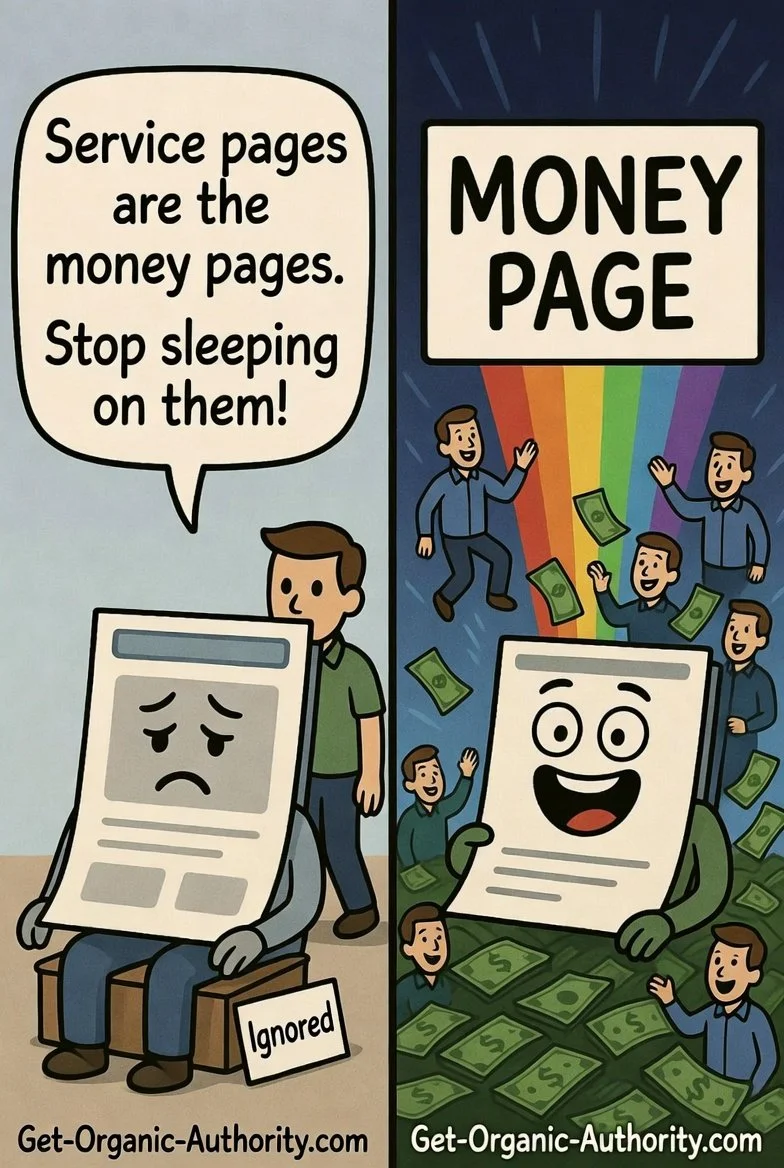
Service pages are the money pages because they sit closest to buyer intent. A blog post may catch the question. A pillar page may build authority. A homepage may orient the visitor. But the service page is where the reader decides, “This person handles my exact problem, in my area, with enough credibility that I can take the next step.” That is not fluff. That is the bridge between visibility and revenue.
Google’s own local ranking guidance says local results are shaped mainly by relevance, distance, and prominence. Relevance means Google has to understand what your business matches. One vague Services page makes that harder. A specific service page for “EMDR therapy in Fort Lauderdale,” “workers comp lawyer in Richmond,” or “knee pain treatment in Boca Raton” gives Google and the searcher a cleaner signal. Revolutionary concept: clarity helps. Alert the village elders.
Google’s helpful content guidance also pushes the same general direction: create useful, reliable, people-first content that demonstrates expertise and leaves readers feeling like they learned enough to move forward. For lawyers, doctors, and therapists, that matters because the searcher is often dealing with something personal. Legal risk. Health fear. Trauma. Pain. Money. Family. Reputation. The page needs to meet that moment with specificity, not polished mist.
The problem is that most service pages are written from the business owner’s perspective. “Here are the things we offer.” Real searchers arrive from a different angle. “Do I need a lawyer for this?” “Is this symptom serious?” “Can therapy help with this thing I barely know how to describe?” “How much does it cost?” “Will this be awkward?” “Will I be judged?” “Can this practice actually help someone like me?”
That is where Search Intent for Service Businesses becomes essential. A service page has to match the stage and seriousness of the search. Someone typing “anxiety therapist near me accepting new clients” needs a different page than someone typing “why do I feel like I cannot breathe before meetings.” The first query is service-ready. The second may need a supporting article that links into the anxiety therapy page. Together, they form a path. Separately, they become random content confetti, which is festive but useless.
This is why Get Organic Authority builds content ecosystems instead of isolated posts. The service page is not a lonely island with a contact button. It is the central conversion page connected to supporting blogs, local pages, FAQ content, bio pages, reviews, and pillar articles. If your website needs that first clear map, The Organic SEO Authority Blueprint can create the starting structure. If you are ready to build the full system over time, The Foundation is designed around monthly long-form articles, topic clusters, long-tail keywords, and strategic internal links. A shocking idea, really: the pages should work together.
What a High-Trust Service Page Actually Needs
A strong service page should feel like a helpful consultation before the consultation. It should not diagnose, promise outcomes, or turn into a legal brief with decorative anxiety. It should explain the problem, clarify who the service is for, answer the questions people are too busy or embarrassed to ask, show why the business is credible, and give a clear next step.
For lawyers, that means practice area pages. A law firm should usually have separate pages for the services and case types it wants to attract: workers’ compensation, personal injury, car accidents, denied claims, criminal defense, DUI, divorce, custody, estate planning, SSD, employment law, immigration, and so on. One “Practice Areas” page with a bullet list is not a strategy. It is a menu taped to a door.
A good legal service page should explain the legal issue in plain language, who needs help, common situations, urgency factors, local or state context, what the firm does, what happens during the consultation, and why the visitor can trust the firm. How Law Firms Turn Google Traffic Into Consultations goes deeper into this path: legal traffic becomes valuable when it moves from search intent to trust to consultation. Ranking alone gets the click. Specificity gets the call.
The legal trust layer is especially important. FindLaw’s 2024 U.S. Consumer Legal Needs Survey found that 82% of respondents who contacted an attorney after learning about them online used online reviews as part of their decision-making, with nearly 40% saying reviews were their primary source of information. So the page should not hide proof in a dusty corner. Reviews, attorney experience, credentials, case familiarity, ethical testimonials, awards, professional memberships, and local relevance all help reduce hesitation.
For doctors and medical practices, service pages usually become treatment, condition, specialty, or appointment pages. A doctor who treats knee pain should not rely on a general Orthopedics page to rank for every knee-related search in the county. A dermatologist should not expect one Dermatology page to carry acne, eczema, psoriasis, skin checks, cosmetic dermatology, and hair loss. That is not optimization. That is stuffing six people into one airplane seat and calling it efficient.
Medical service pages should include symptoms treated, conditions addressed, treatment options, who the service is for, what to expect during an appointment, insurance or payment notes where appropriate, provider credentials, location details, FAQs, and links to supporting condition articles. How Doctors Get More Patients From Google Without Ads explains how healthcare SEO works best when patient trust and search visibility grow together. People are not just choosing a provider. They are trying to decide whom to trust with their body, pain, fear, time, and wallet.
The need for clarity is backed by current trust research. Pew Research Center reported in 2026 that 85% of Americans get health information from healthcare providers at least sometimes, while half say it is at least somewhat difficult to judge whether health information is accurate. That means provider websites have an opportunity. A strong medical page can become a trusted, plain-language resource before the patient books. A weak page says “we offer comprehensive care” and then wanders into the shrubs.
For therapists, service pages need emotional precision. A therapy page is not a technical product description. It has to help someone feel seen without overpromising, pathologizing, or turning pain into a sales funnel with candles. Anxiety therapy, trauma therapy, EMDR therapy, couples therapy, grief counseling, addiction counseling, depression therapy, teen therapy, and online therapy deserve their own pages when those are services the practice genuinely wants to rank for.
A strong therapist service page should name the problem in human language, explain how the therapist helps, clarify approach and modalities, describe what sessions may feel like, include local and telehealth details, answer common fears, and link to supportive articles. Why Is My Therapy Website Not Getting Clients? breaks down why therapy websites often fail when they lack specific service pages, emotional long-tail keywords, and trust-building content. Meanwhile, The Invisible Searcher shows why people often search around their pain before they search for the formal service. The page system has to catch both.
Across every high-trust industry, the service page should answer five basic questions quickly. What is this service? Who is it for? What problem does it solve? Why should I trust you? What happens next? If the page cannot answer those questions, it is not a money page. It is a decorative brochure page with Wi-Fi.
Cha Ching.
The Service Page Blueprint: Structure the Page Like a Calm, Useful Adult
Here is the service page structure Get Organic Authority would usually build for a lawyer, doctor, therapist, or private practice that wants rankings and leads. It does not have to be robotic. In fact, please spare the internet from another page that sounds like it was assembled by a committee of printer manuals. But the bones matter.
Start with a sharp first screen. The visitor should immediately know the service, the location or service area, the type of person helped, and the next step. A good opening might say, “Trauma Therapy in Tampa for Adults Who Feel Stuck in Survival Mode.” That is miles better than “We provide compassionate counseling services.” One names a real person’s problem. The other politely floats away like a napkin in a storm drain.
Next, explain the problem. For a lawyer, this may mean describing what happens after an insurance denial, arrest, injury, custody dispute, denied benefit, or workplace retaliation. For a doctor, it may mean naming symptoms, risks, treatment uncertainty, and when to seek care. For a therapist, it may mean describing how anxiety, trauma, grief, relationship pain, or depression shows up in daily life. This section builds relevance because it mirrors the searcher’s lived experience.
Then explain the service in plain language. Avoid jargon parades. A visitor should understand what you do and how it helps without needing a graduate degree, a legal dictionary, or a spiritually advanced tolerance for nonsense. Use the terms people actually search, but write for the human who has to make the decision.
Add proof. This is where credentials, experience, reviews, testimonials where appropriate, professional licenses, associations, case familiarity, years in practice, board certifications, modalities, trainings, media mentions, and community involvement come in. Proof should feel natural, not like the page is flexing in a mirror at the gym. The point is to make the visitor feel safer choosing you.
Reviews deserve special attention. BrightLocal’s 2026 Local Consumer Review Survey reports that 97% of consumers read reviews for local businesses and that the average consumer uses six different review sites when choosing businesses. BrightLocal also found that ChatGPT and other generative AI tools became the third most popular source of local recommendations in 2026. Translation: people are triangulating trust from everywhere now, because apparently choosing a therapist, doctor, or lawyer requires the research intensity once reserved for buying a used boat.
Then answer FAQs. FAQs are not filler. They are objection-handling, search-intent matching, and trust-building in one neat little section. A law firm might answer questions about cost, timing, consultation details, documents to bring, deadlines, and what happens if the case is complicated. A doctor might answer questions about appointments, recovery, insurance, treatment options, pain, prep, and follow-up. A therapist might answer questions about session length, first-session anxiety, confidentiality, telehealth, private pay, modalities, and fit.
Finally, build internal links like you have a plan, because ideally you do. Google’s link best practices explain that links help Google find pages and that anchor text helps people and Google understand what the linked page is about. That means your anxiety therapy page should link to related content using useful anchor text like “how anxiety shows up in high-functioning adults” or “what to expect in your first therapy session.” A workers’ comp page should link to denied claims, hearings, wage loss, medical treatment disputes, and related blog posts. A knee pain page should link to treatment options, causes, recovery expectations, and provider bios.
This is exactly why How to Internally Link Blog Posts to Service Pages Without Making a Mess exists in the Get Organic Authority ecosystem. Internal links turn content into pathways. Without them, your blog becomes a haunted hotel where every room has a good idea and none of the hallways connect.
Why One Generic Services Page Usually Fails
The single generic Services page fails because it asks one page to rank for too many things, speak to too many people, and convert too many different intents. A person searching for “EMDR therapist for childhood trauma near me” has a different need than someone searching for “couples therapy after infidelity.” A patient searching “dermatologist for acne scars” is not the same as someone searching “annual skin cancer screening near me.” A legal client searching “DUI lawyer after first arrest” is not the same as someone searching “estate planning attorney for young family.”
When every service is crammed into one page, the language becomes broad. Broad language is safe, but safe content rarely wins competitive local searches. Google has fewer specific signals. The visitor has fewer reasons to feel understood. The page has fewer opportunities to rank for long-tail keywords. The CTA becomes generic. The whole thing starts smelling like “we do lots of stuff” energy, which is not exactly a conversion strategy.
This is where Service Pages for Small Businesses becomes the direct companion article. Service pages turn Google searches into leads because they match commercial intent. Blogs can introduce the problem. Pillars can organize the topic. Service pages tell the visitor, “Yes, this is the exact help you were looking for.”
It also connects to SEO Content Ecosystems for High-Trust Businesses. The service page is one node in a larger system. A trauma therapy service page may be supported by articles about trauma symptoms, EMDR, complex PTSD, relationship triggers, nervous system responses, and what to expect in therapy. A doctor’s knee pain page may be supported by articles about causes, imaging, injections, physical therapy, surgery, recovery timelines, and when to book. A law firm’s denied claim page may be supported by articles about appeals, hearings, medical evidence, deadlines, settlements, and employer retaliation.
This is topical authority in practical clothing. Google sees multiple connected pages around a real subject. Visitors see depth. The business has more doors into the site. And the service page becomes the conversion center instead of trying to be a lonely superhero with one cape and eight jobs.
Backlinko’s CTR analysis found that the number one organic Google result has an average click-through rate of 27.6% and is far more likely to get clicked than lower positions. Rankings matter because attention is concentrated. But attention without the right landing page still leaks. A service page earns its keep when it captures the click and moves the visitor toward action.
This also explains why competitors show up before you even when you are better in real life. Why Is That Other Doctor Ranked Ahead of Me? and Why Is the Other Guy Getting All the Clients? both circle the same ugly truth: Google often rewards the practice that is easier to understand online, not the one with the best bedside manner, sharpest legal mind, or deepest clinical skill. Reality remains rude.
How Supporting Articles Feed the Service Page
A service page should convert. Supporting articles should capture related searches and feed the service page. This is where the ecosystem gets fun, assuming your idea of fun includes building a tiny search engine spider highway through your website. Which, frankly, it should. We all need hobbies.
Start with the service. Then build the questions around it. If the service is anxiety therapy, supporting articles might cover “why anxiety gets worse at night,” “high-functioning anxiety symptoms,” “panic attacks before work,” “anxiety therapy vs medication,” “how to choose an anxiety therapist,” and “what happens in the first anxiety therapy session.” Each article should link back to the anxiety therapy page. The page becomes the hub. The articles become the spokes.
If the service is workers’ compensation, supporting articles might cover “what to do if your workers’ comp claim is denied,” “can my employer fire me after an injury,” “workers’ comp hearing timeline,” “what medical evidence helps a claim,” and “do I need a workers’ comp lawyer.” Each article answers a real search and points to the practice area page.
If the service is dental implants, supporting articles might cover “dental implants vs dentures,” “how long dental implants take,” “are dental implants painful,” “dental implant cost factors,” and “who is a good candidate for dental implants.” Each one builds relevance around the main implant service page.
That structure is exactly what How to Get More Local Leads From Google Without Paying for Every Click supports. Local leads often come from a combination of Google Business Profile, service pages, reviews, local content, city relevance, and internal links. No single page does everything. The system does the work.
The right supporting articles also help with the back-pocket search. A referral hears your name. They Google you. They land on your site. They see not only a service page, but a whole library around the issue they care about. That builds confidence. It says, “This practice understands this problem.” It is quieter than a sales pitch and much more persuasive.
That is also the point of The Trust Gap. Being found is not the same as being chosen. The service page closes the gap when it combines clarity, proof, relevance, and next steps. Supporting articles widen the net and deepen trust. Together, they make the website feel like an authority instead of a digital waiting room with one ficus and a loading spinner.
The Service Page Checklist for Lawyers, Doctors, and Therapists
A high-trust service page should include the following pieces. It does not need to feel formulaic. It does need to answer the right questions.
· A clear H1 that names the service and, where useful, the location or audience.
· A first paragraph that confirms the visitor is in the right place.
· Plain-language explanation of the problem the service solves.
· Specific details about who the service is for.
· Local relevance, service area, city, region, or jurisdiction where appropriate.
· Trust signals such as credentials, experience, reviews, memberships, media, awards, or training.
· A section explaining what happens next after the person reaches out.
· FAQs based on real questions and search behavior.
· Internal links to related services, pillar pages, supporting articles, bio pages, and contact pages.
· A CTA that fits the service and emotional temperature of the search.
For therapists, the CTA might be softer: “Schedule a consultation,” “Ask about availability,” or “Find out if trauma therapy is a fit.” For lawyers, it may be more direct: “Request a case review,” “Speak with an attorney,” or “Get help with a denied claim.” For doctors, it may be appointment-focused: “Book an appointment,” “Request a new patient visit,” or “Talk with our team about treatment options.”
The CTA should not sound like it was generated by a vending machine. “Submit” is technically a word, but so is “moist,” and civilization has agreed to use restraint.
The About page also matters here. A strong service page should link naturally to the person behind the service. That is why Why Your About Page Might Be the Most Underrated SEO Page on Your Website belongs in this ecosystem. In high-trust services, people choose people. Credentials matter. Tone matters. Fit matters. If the service page creates interest, the bio or About page often seals confidence.
And yes, this is where bad SEO advice becomes dangerous. They Said What? Common SEO Lies Doctors, Lawyers, and Therapists Keep Hearing exists because too many high-trust businesses get sold shortcuts instead of structure. Stuffing keywords into thin service pages, publishing cheap AI blogs, or buying random links from mystery websites will not build the kind of authority a serious practice needs. The internet already has enough haunted shortcuts.
Build the Pages That Actually Carry the Business
Your service pages should be some of the strongest pages on your website. They should rank for the services people are already searching. They should explain your work clearly. They should help Google understand your relevance. They should help people feel safe enough to take the next step. They should connect to your blogs, pillar pages, About page, reviews, location signals, and contact path.
A single vague Services page can only carry so much. Eventually it collapses under the weight of every keyword, every audience, every offer, every location, and every conversion goal. Then everyone acts surprised when the site gets impressions but no clients. The poor page was asked to be a receptionist, salesperson, therapist, paralegal, doctor, tour guide, and SEO intern at the same time. Cruel, really.
If your website needs a smarter map, start with The Organic SEO Authority Blueprint. It gives your business one strong pillar asset and a clear direction for future supporting content. If you are ready to build the authority system month after month, The Foundation is built for that work: long-form SEO articles, strategic topic clusters, internal links, long-tail keywords, and human writing designed to rank and build trust before the first call.
Your expertise deserves pages that can carry it. Get Organic Authority builds those pages into ecosystems, because random content is what happens when a website gives up and starts collecting loose furniture.
