Your Homepage Has Main Character Syndrome
Why It Cannot Do the Whole SEO Job for Lawyers, Doctors, Therapists, and Private Practices
Your Homepage Is Important. It Is Also Not the Messiah.
Every high-trust business owner has had the same hopeful little thought: “Maybe if we just fix the homepage, everything will work.” Lawyers think it. Doctors think it. Therapists think it while quietly judging the stock photo of a fern and a smiling couple who clearly met eight minutes ago. Private practice owners think it when the website feels polished but the phone stays rude and silent.
The homepage becomes the chosen child. It gets the fancy hero image, the warm headline, the service list, the bio preview, the review carousel, the location blurb, the FAQ teaser, the “as seen in” strip, the contact button, the mission statement, the vague promise, the slightly panicked CTA, and occasionally enough text to qualify as a novella with a scheduling widget. Then everyone stares at it and waits for Google to applaud.
Here is the uncomfortable truth: your homepage matters a lot, but it cannot do the whole SEO job. It cannot rank for every service, every location, every symptom, every legal issue, every treatment, every modality, every client fear, every comparison search, and every “near me” query while also explaining your brand in six seconds. That is not a homepage. That is an overcaffeinated octopus wearing a blazer.
For high-trust businesses, the homepage should orient the visitor. It should make the business feel real, credible, specific, and worth exploring. It should guide people toward the next right page. It should help Google understand the broad shape of the business. But the deeper SEO work usually happens through a connected system of service pages, pillar pages, supporting articles, location content, FAQs, About pages, proof sections, and internal links.
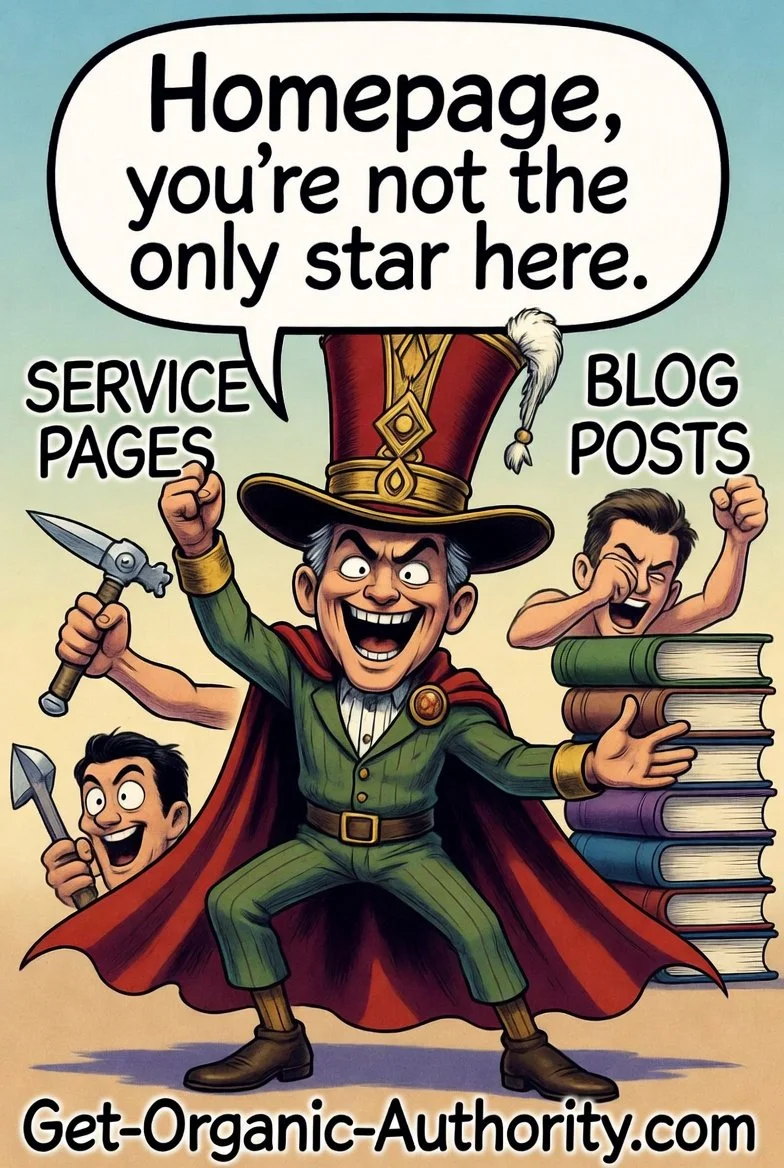
That is why The High-Trust Website Content Map exists. A homepage is one piece of the map, not the whole country. When lawyers, doctors, therapists, and professional service firms try to make the homepage carry everything, they often end up with a page that says a lot and clarifies very little. It becomes a lobby with seventeen doors and zero signage.
The Homepage Job Description Is Simple. Humans Complicated It.
A strong homepage has four jobs. It should tell visitors who you help, what you help with, where you help, and why someone should trust you enough to keep clicking. That is plenty. Humans, naturally, looked at that clear job description and decided to make the homepage responsible for the entire marketing department, client intake process, brand identity, SEO strategy, sales funnel, childhood wounds, and the Wi-Fi password.
Nielsen Norman Group’s homepage design principles say effective homepages are simple, accessible, clear about the organization’s purpose, engaging, and action-oriented. That sounds obvious until you look at most professional service homepages and realize they are trying to be inspirational posters, legal disclaimers, clinical brochures, keyword warehouses, and TED Talks at the same time.
Google’s own SEO Starter Guide frames SEO as helping search engines understand your content and helping users decide if they should visit your site. That is the cleanest description of homepage SEO you could ask for. Help Google understand the business. Help people decide where to go next. That is the assignment. Somehow, many websites turn it into “Welcome to our practice, where we are passionate about comprehensive solutions.” A phrase so vague it could describe a therapist, dentist, accountant, landscaping company, or a cult with excellent branding.
For a therapist, a homepage should quickly communicate the clinical focus, ideal clients, local or telehealth availability, therapy style, and next step. For a lawyer, it should clarify practice areas, jurisdiction, urgency, credibility, and consultation path. For a doctor or medical practice, it should explain specialty, services, locations, insurance or appointment notes where appropriate, provider credibility, and how to book. For a professional service firm, it should make the offer obvious before the visitor begins spiritually aging in the navigation menu.
The homepage is the front desk. It greets people. It points them in the right direction. It creates a first impression. But it should not be forced to perform surgery, litigate a custody case, treat panic attacks, explain every service, and rank for 140 keywords while smiling politely.
Why Homepage-Only SEO Gets Weird Fast
Homepage-only SEO usually starts innocently. Someone wants the homepage to rank for “therapist near me,” “anxiety therapy,” “trauma therapist,” “couples counseling,” “EMDR therapy,” “depression therapy,” and “online therapy.” A law firm wants the homepage to rank for “personal injury lawyer,” “car accident attorney,” “workers comp lawyer,” “wrongful death lawyer,” and “SSD lawyer.” A medical practice wants the homepage to rank for every condition, treatment, location, and specialty known to modern billing software.
Google, being annoying but not entirely foolish, has to decide what page best satisfies a search. A homepage can sometimes rank for branded searches, broad business searches, and some local category searches. But when someone searches for a specific service, a dedicated service page often gives Google and the searcher a cleaner match. That is where Service Pages Are the Money Pages becomes the obvious next read, because service pages are closer to commercial intent than the homepage ever wants to be.
The problem is specificity. A homepage has to stay broad enough to represent the whole business. A service page can go deep. “Anxiety therapy in Tampa for adults with high-functioning anxiety” has room to explain symptoms, session style, fit, FAQs, cost considerations, location, telehealth, and next steps. A homepage can mention anxiety therapy, but it cannot become the anxiety therapy page without neglecting everything else in the house.
The same logic applies to law firm SEO. A homepage can say the firm handles workers’ compensation, personal injury, and Social Security Disability. But a searcher dealing with a denied workers’ comp claim wants a page about denied claims, deadlines, medical evidence, wage loss, hearings, and what happens next. A homepage waving from the porch with “we fight for you” has less useful depth.
Medical SEO has the same issue with even higher stakes. A dermatology homepage can introduce the practice. It cannot carry acne treatment, eczema care, psoriasis, mole checks, cosmetic injectables, hair loss, skin cancer screenings, and pediatric dermatology in detail without turning into a buffet where every tray is labeled “comprehensive care.” Deliciously useless.
Search Intent Does Not Care About Your Pretty Hero Section
Search intent is the reason homepage obsession fails. People do not all arrive with the same question. Some are trying to understand a problem. Some are comparing providers. Some want pricing. Some need urgency. Some want reassurance. Some are ready to book right now. Some are still typing things they would never say out loud because the internet is the world’s strangest confessional booth.
Google explains that ranking systems look at meaning, relevance, quality, usability, and context to deliver helpful results. Its How Search Works ranking overview gives the non-mystical version: search results try to match what the user actually needs. That means one broad homepage often loses to a more specific page that answers the exact query.
This is where The Invisible Searcher idea matters for high-trust brands. People search around fear. They search around shame. They search around risk. A therapist’s future client may search “why do I freeze during conflict” before searching “trauma therapist near me.” A legal client may search “can I be fired for filing workers comp” before searching “workers comp lawyer.” A patient may search “knee pain going down stairs” before searching “orthopedic doctor near me.”
Your homepage should not try to answer all of that. It should send people to the pages that do. That is the difference between a website that feels like a helpful building and a website that feels like a junk drawer with a logo.
When Get Organic Authority builds around organic authority, the homepage becomes the doorway into a larger content system. The homepage introduces the brand. The service pages convert high-intent searches. The pillar pages organize major topics. The supporting articles catch long-tail questions. The internal links move people from curiosity to confidence. Tiny miracle: the website starts acting like a system instead of a brochure that learned to breathe.
The Homepage Should Build Trust Before It Builds Ego
High-trust businesses sell something delicate. A therapist sells safety, fit, and emotional confidence. A lawyer sells judgment, protection, and competence during a stressful moment. A doctor sells clinical trust, clarity, and the belief that the patient will be taken seriously. A professional service firm sells expertise that the buyer may struggle to evaluate until after the money leaves the building.
That means your homepage must build trust fast. Stanford’s Web Credibility Guidelines recommend making information easy to verify, showing that there is a real organization behind the site, highlighting expertise, making contact easy, and avoiding errors. Nielsen Norman Group’s trustworthiness research points to design quality, upfront disclosure, comprehensive current content, and connection to the rest of the web as major credibility factors. Notice the pattern. Trust is not created by a giant smiling headshot and the phrase “client-centered.”
BrightLocal’s 2026 Local Consumer Review Survey found that 85% of consumers are more likely to use a business after reading positive reviews, 77% are deterred by negative reviews, and 54% check the business website after reading positive reviews. That last number matters. Reviews often do not end the decision. They send people to the site for confirmation. The homepage has to survive that inspection.
This is exactly where The Trust Gap becomes painfully relevant. Google can send a person to your site. A referral can send a person to your site. A review can send a person to your site. Then the website either confirms the decision or quietly ruins it while wearing tasteful fonts.
A homepage should show proof without sounding like it is yelling from a billboard. Use credentials, years of experience, relevant services, reviews, case or care familiarity, community presence, professional associations, media mentions, and clear contact information. For therapists, this may include modalities and populations served. For lawyers, it may include practice focus, jurisdiction, consultation process, and representative experience without overpromising outcomes. For doctors, it may include board certifications, treatment focus, insurance details where appropriate, provider bios, and appointment clarity.
A Homepage Without Pathways Is a Lobby With No Doors
The homepage should guide. That means internal links matter. Not decorative “learn more” buttons sprinkled around like parsley. Useful, descriptive pathways that help people move toward the thing they came for.
Google’s link best practices explain that links help Google discover pages and that anchor text helps both users and Google understand what the linked page is about. This is not a small detail. If your homepage only links to a general Services page, a vague About page, and a Contact page, it teaches visitors and search engines that the site is thin. Maybe it is not thin. Maybe it has good pages hiding somewhere. But if nobody can find them, congratulations, you built a library and locked the doors.
A therapist homepage should link to individual services like anxiety therapy, trauma therapy, couples counseling, EMDR therapy, depression therapy, grief counseling, addiction counseling, and online therapy when those services exist. A law firm homepage should link to individual practice areas and case types. A medical practice homepage should link to specialty pages, condition pages, treatment pages, provider bios, locations, and appointment information. A professional service firm should link to the services that match real buying intent.
This is why SEO Content Ecosystems for High-Trust Businesses is such a strong parent idea. The homepage helps distribute authority and attention through the site. It should point toward the pages that deserve to rank and convert. When the homepage hoards all the information, everyone loses. When it routes visitors clearly, the whole site becomes more useful.
Think of the homepage as the airport. Nobody wants to live there. They want the right gate, clear signage, and fewer emotional incidents near the boarding desk. Your service pages, pillar articles, About page, local SEO pages, and supporting blogs are the destinations.
The Cost of Making the Homepage Do Everything
When the homepage tries to do everything, three bad things happen. First, the copy becomes vague. Second, the page becomes long in all the wrong ways. Third, the visitor has to work too hard to find the exact answer. Humans are already out here trying to remember passwords, compare insurance plans, and cook salmon without poisoning themselves. Your website should not add a scavenger hunt.
From an SEO standpoint, vague homepage copy weakens relevance. A homepage that says “we offer compassionate, comprehensive care for individuals and families” may sound pleasant, but it does not clearly map to “trauma therapy in Orlando,” “immigration lawyer for spouse visa,” or “sports medicine doctor for shoulder pain.” Search engines need clearer signals. Searchers need clearer reassurance.
From a conversion standpoint, broad copy increases doubt. The visitor may think, “I think they can help me, but I am not sure.” That sentence is where leads go to die. Your Website Got the Click. Now What? digs into this exact problem. Getting traffic means very little if the content after the click fails to earn belief.
From a paid ads standpoint, this gets expensive fast. WordStream’s 2026 Google Ads Benchmarks show competitive paid search costs in high-value categories, with legal, dental, medical, and business service clicks often costing far more than casual local searches. Sending expensive ad traffic to a vague homepage is like buying front-row concert tickets and then staring at a wall behind the venue.
That is why Ads vs. Organic SEO matters in this ecosystem. Ads can create visibility, but the destination page still has to convert. Organic SEO can build durable visibility, but the website still has to guide. In both cases, homepage clarity helps. Homepage overreach hurts.
What the Homepage Should Actually Say
A strong homepage for a high-trust business should start with a simple first-screen message. Who do you help? What problem do you help with? Where do you serve? What should the visitor do next? This is not the place for mystery. Mystery belongs in novels, weird neighbors, and the drawer where phone chargers go to form nests.
A therapist homepage might open with: “Anxiety and Trauma Therapy in Fort Lauderdale for Adults Who Feel Stuck in Survival Mode.” A law firm might open with: “Virginia Workers’ Compensation Lawyers Helping Injured Workers Fight Denied Claims.” A medical practice might open with: “Orthopedic Care in Boca Raton for Knee, Shoulder, and Sports Injuries.” Notice how each version gives Google and humans something firm to hold.
After the first screen, the homepage should briefly introduce the core services, but each service should lead to a dedicated page. This is where Service Pages Are the Money Pages carries the deeper work. The homepage gives the visitor the menu. The service pages explain the meal. Please spare everyone from a homepage that tries to be the menu, kitchen tour, recipe book, nutrition label, Yelp response, chef memoir, and receipt.
The homepage should include a short proof section. This may include reviews, credentials, outcomes framed ethically, years of experience, professional background, specialties, associations, or community presence. It should include a human About preview that links to a stronger About page, because high-trust buyers want to know the person or team behind the service.
It should include a clear local signal. Google Business Profile guidance allows service businesses to add services and descriptions, and Google’s Business Profile services documentation shows how important service clarity has become across Google’s local ecosystem. Your homepage should reinforce the same service and location clarity your profile uses.
It can also support structured understanding. Google’s LocalBusiness structured data guidance explains how structured data can tell Google about business details like hours, departments, and more. Schema will not magically rescue bad content, because sadly there is still no markup for “please rank me, I am nice.” But it can help support clear business information when the real page content is already useful.
The Homepage Is Not a Content Strategy
A homepage can introduce your authority. It cannot build topical authority by itself. That comes from depth across a cluster of related pages. Google’s helpful content guidance emphasizes content made for people, built from real value, expertise, and a satisfying answer. One homepage rarely creates that depth.
This is where many high-trust businesses get stuck. They have a decent homepage and a thin blog. Or a decent homepage and one long services page. Or a homepage that looks good but has no supporting architecture. Then they wonder why a competitor with less talent gets more calls. The answer is often boring but fixable: the competitor is easier for Google to understand and easier for people to choose.
Ahrefs’ 2026 SEO statistics summarize a brutal search reality: first-page visibility captures the overwhelming majority of clicks, and pages that fail to earn meaningful visibility often sit untouched. Backlinko’s Google CTR study found the number one organic result gets an average 27.6% click-through rate, while only 0.63% of searchers clicked a result from the second page in its dataset. In other words, page two is less a location and more a witness protection program.
To compete, a practice needs more than a nice homepage. It needs a content system that proves relevance from multiple angles. A therapy practice may need pages for anxiety therapy, trauma therapy, EMDR, couples therapy, depression therapy, and supporting articles that answer related questions. A law firm may need pages for each practice area, local pages, FAQs, and articles that explain urgent legal situations. A doctor may need condition pages, treatment pages, provider pages, and patient education content that creates confidence before the appointment.
Why One Blog Post Won’t Save Your Website takes the same idea from the blog side. One homepage will not save the website either. One good page can help. A connected system compounds.
The Homepage and the Dogfooding Problem
Get Organic Authority talks about dogfooding because the strategy is being used on the business itself. The site is not just talking about content ecosystems while hiding behind a two-page brochure and a dream. It is building pillars, supporting articles, internal links, resource-heavy pages, and topical depth in public, which is exactly how organic authority starts to make sense.
That matters because high-trust businesses are tired of SEO agencies selling fog. They get dashboards, keyword lists, and monthly reports that look like someone taught a spreadsheet to sweat. But what they actually need is a site structure that makes sense: homepage, service pages, About page, proof, local SEO pages, pillar content, supporting articles, internal links, and conversion paths.
The Organic SEO Authority Blueprint is built for the business that needs the first strong authority asset and a clear map for what should come next. The Foundation is built for businesses ready to build the monthly content ecosystem through long-form SEO articles, topic clusters, long-tail keywords, and internal linking. The homepage is part of that system, but it is not the system.
That distinction matters. Cheap SEO often treats the homepage like a punching bag for keywords. Generic agencies add a few phrases, tweak a title tag, maybe rearrange headings, and then wait for miracles. AI content farms may generate pages that sound correct but feel like they were written by a polite refrigerator. Real organic authority requires sharper architecture, better questions, stronger service pages, and useful content that earns trust.
The Homepage Audit for People Who Enjoy Mild Pain
Here is a simple homepage audit. Painful, but cheaper than pretending.
Can a visitor understand what you do in five seconds? Can they tell where you serve? Can they tell who you help? Can they find the service they care about without joining a detective agency? Can they see proof that you are credible? Can they understand the next step? Can Google crawl clear links to your most important pages? Can the page support your Google Business Profile categories and services? Does the copy sound like a human with expertise, or like a corporate fog machine?
For therapists, check if your homepage links clearly to your highest-value therapy services. For lawyers, check if each practice area has a page that deserves to rank. For doctors, check if patients can find treatment, condition, provider, and appointment information quickly. For private practices, check if the site explains why someone should choose you beyond “we care.” Caring is good. Caring plus clarity is better. Caring plus clarity plus proof plus a working content ecosystem is where things get interesting.
Also look for what the homepage is hiding. If your About page is thin, the homepage will feel less trustworthy. If your service pages are vague, the homepage will carry too much weight. If your blog posts never point to your services, your content will attract readers and then abandon them in a field. If your local pages barely exist, Google may struggle to connect your expertise to your market.
None of this means your homepage is bad. It means your homepage probably needs coworkers.
A Better Homepage Strategy for High-Trust SEO
The better strategy is simple. Let the homepage introduce the business and guide the visitor. Let service pages match commercial intent. Let pillar pages organize major topics. Let supporting articles answer long-tail questions. Let the About page build human trust. Let reviews and proof reduce hesitation. Let internal links connect the entire journey.
For a therapist, the homepage might point toward anxiety therapy, trauma therapy, EMDR therapy, couples counseling, online therapy, therapist bios, insurance or private-pay details, and articles that help people understand what they are feeling. For a law firm, the homepage might point toward practice areas, consultation pages, attorney bios, FAQs, local pages, and articles that answer urgent legal concerns. For a medical practice, the homepage might point toward conditions treated, services, providers, locations, appointment information, patient resources, and insurance guidance.
The homepage becomes the central orientation page. It sets the tone. It builds immediate trust. It routes people. It supports local SEO. It gives Google a clear snapshot of the business. Then the rest of the ecosystem does what the homepage cannot do alone.
This is how a website becomes easier to find, easier to understand, and easier to choose. The homepage stops trying to be the main character. It becomes the opening scene that makes the rest of the story make sense.
Give Your Homepage a Team
Your homepage deserves attention. It also deserves backup. A lawyer, doctor, therapist, or private practice website cannot grow on one beautiful homepage and positive thoughts. It needs service pages that convert, pillar pages that organize authority, supporting articles that answer real searches, internal links that guide visitors, and trust content that makes the next step feel safe.
If your homepage is trying to do the whole SEO job, Get Organic Authority can help turn the site into a real content ecosystem. Start with The Organic SEO Authority Blueprint if you need the map. Build with The Foundation if you are ready for monthly long-form SEO content, strategic topic clusters, and authority-driven articles that support your highest-value services.
Your homepage can keep the spotlight. It just needs the rest of the cast to show up.
