The Pre-Call Trust Check: What Lawyers, Doctors, and Therapists Must Prove Before People Reach Out
The Pre-Call Trust Check: What People Inspect Before They Contact You
A stranger finds your website. Congratulations. Tiny parade. One balloon. The algorithm briefly looked in your direction.
Now comes the part most lawyers, doctors, therapists, and private practices underestimate: the visitor does not call just because they landed on your website. They inspect. They compare. They squint at your About page. They read reviews like a detective with a latte. They check if your service page actually explains the problem they have, or if it says “we provide compassionate, client-centered care” in the same foggy tone as every other practice within a thirty-mile radius.
This quiet inspection is the pre-call trust check. It happens after the click and before the contact form. It happens when a referral Googles your name from the parking lot. It happens when a patient compares three doctors. It happens when someone searching for a therapist opens five tabs and immediately closes the ones that feel generic, cold, confusing, or suspiciously stock-photo haunted.
This is the missing middle between visibility and revenue. Get Organic Authority exists for exactly this problem: high-trust businesses need more than traffic. They need long-form SEO content, service pages, pillar articles, internal links, reviews, local SEO signals, and human writing that builds trust before the first call. That is why The Foundation is built around monthly content ecosystems instead of random blog posts, and why The Organic SEO Authority Blueprint starts with a strategic pillar that gives Google and real humans something solid to understand.
Traffic Is the Knock. Trust Opens the Door.
Traffic gets someone to the porch. Trust decides if they knock. This matters because lawyers, doctors, therapists, and other high-trust businesses are not selling novelty socks. People are bringing fear, money, pain, shame, uncertainty, health concerns, legal problems, relationship pain, family stress, or professional risk into the search bar. A weak website makes that decision harder. A strong website lowers the emotional friction.
Google says SEO can help search engines understand your content and help users decide whether to visit your site from search. That second part gets ignored because everyone loves rankings more than human behavior, which is adorable in the way a broken vending machine is adorable. The real goal is not merely being found. The goal is being understood, trusted, and chosen.
This article supports The Trust Gap, The Back-Pocket Search, Your Website Got the Click. Now What?, and the larger SEO Content Ecosystems for High-Trust Businesses pillar. The pre-call trust check explains what happens after someone finds you and before they reach out. That tiny gap can swallow a shocking amount of money.
Why High-Trust Buyers Behave Differently
High-trust buyers move differently because the stakes are higher. A person choosing a therapist is not just buying an appointment slot. They are asking, “Can I say the real thing here?” A person choosing a lawyer is asking, “Can this person protect me, explain this mess, and help me avoid making it worse?” A patient choosing a doctor is asking, “Will I be safe, heard, and taken seriously?”
That is why generic SEO content fails so often in professional services. It treats every visitor like a coupon hunter. High-trust buyers are usually not just looking for “near me.” They are looking for evidence. They want clarity, reassurance, specificity, credentials, local relevance, reviews, next steps, and a sense that the person behind the website has actual judgment. Revolutionary concept: people prefer trusting the professional before handing over their problem like a flaming casserole.
BrightLocal’s 2026 Local Consumer Review Survey found that 97% of consumers read online reviews for local businesses, with 41% saying they always read reviews when browsing for businesses. For doctors, Software Advice has reported that 90% of surveyed patients use online reviews to evaluate physicians. Reviews are not a decorative trust garnish. They are part of the decision path.
But reviews alone rarely carry the whole conversation. Reviews may get attention. Your website has to hold it. That is where the content ecosystem matters. Your homepage sets the first impression. Your service pages answer action-intent questions. Your About page humanizes expertise. Your blog posts capture long-tail searches. Your pillar pages organize authority. Your internal links guide the visitor from curiosity to clarity. Your local pages prove relevance. Your FAQs reduce hesitation. Together, they create the trust system. Separately, they are just pages standing around like awkward cousins at a wedding.
The Eight Things People Quietly Check Before They Call
1. They Check If You Actually Handle Their Problem
The first trust check is brutally simple: does this business clearly solve my problem?
A family law prospect wants to know if you handle custody disputes, divorce, support, protective orders, or mediation. A therapy client wants to know if you treat trauma, anxiety, grief, couples issues, OCD, addiction, or emotional dysregulation. A patient wants to know if you treat knee pain, migraines, digestive issues, back pain, skin conditions, fertility concerns, or whatever strange betrayal their body is staging this week.
This is why Service Pages Are the Money Pages belongs inside the ecosystem. Service pages are where high-intent searches turn into action. One vague Services page is not enough for a serious practice. People need specific pages for specific problems, because specificity is trust. “We help with legal issues” sounds like a fortune cookie in a suit. “Workers’ compensation lawyer for denied claims in Virginia” gives the searcher something to hold onto.
Long-tail service keywords matter here: anxiety therapist accepting private pay, divorce lawyer for high-conflict custody, orthopedic doctor for knee pain when walking upstairs, trauma therapist for adults, local SEO services for therapists, medical practice SEO content strategy, law firm service page SEO. These phrases are not glamorous. They are useful. The internet could use more useful and fewer fireworks.
2. They Check If You Sound Like a Real Human
The second trust check is tone. A visitor wants to know if there is a human being behind the website or a committee of beige furniture.
High-trust businesses often accidentally write like they are afraid of being understood. They use safe phrases. Comprehensive care. Personalized solutions. Dedicated advocacy. Client-centered approach. Experienced professionals. Compassionate support. These phrases are not evil. They are simply so overused that they arrive pre-exhausted.
A strong website sounds clear, grounded, and specific. It explains the problem in the language the client or patient actually uses. It respects the seriousness of the issue while still feeling alive. This is where The Invisible Searcher matters. People often search for private, painful, or embarrassing questions in messy language. Your content should meet them there without sounding like a brochure swallowed a thesaurus.
A therapist can write about the person who freezes during conflict and then feels ashamed later. A lawyer can write about the injured worker who is scared to report pain because the boss is already acting weird. A doctor can write about the patient who keeps getting told everything is normal while their symptoms keep interrupting life like an unpaid intern with a trumpet. That is trust-building SEO content. It names the real problem.
3. They Check Your About Page
The About page is where many websites go to gently pass away. It starts with a mission statement, mumbles about values, includes one photo from a decade ago, and exits quietly through the side door.
For high-trust businesses, the About page can be one of the strongest conversion pages on the site. People want to know who they are trusting. They want credentials, experience, philosophy, personality, and proof that the provider understands the people they serve. This is exactly why Why Your About Page Might Be the Most Underrated SEO Page on Your Website fits so naturally into this article.
A lawyer About page should explain legal background, practice focus, courtroom or negotiation experience, client philosophy, and why the attorney handles the cases they handle. A doctor About page should explain medical training, specialties, patient approach, conditions treated, and what patients can expect. A therapist About page should explain clinical style, specialties, populations served, modalities, and what therapy with that person actually feels like.
The pre-call trust check always includes a human scan. If the bio says nothing memorable, the visitor may keep shopping. If the bio helps them feel seen, safe, and oriented, the website starts doing its job. Dignity returns to the pixels.
4. They Check Reviews, Reputation, and Local Proof
People read reviews because they want a second opinion before the first contact. They want social proof. They want signals that other people survived the experience and maybe even appreciated it.
Google Business Profile gives businesses a way to appear on Search and Maps, manage reviews, add photos, share updates, and help people understand what makes the business unique. Google also lets Business Profile owners track views, clicks, and other customer interactions, which means local trust is measurable, not mystical.
This is where Local SEO for Doctors, Lawyers, and Therapists and How to Get More Local Leads From Google Without Paying for Every Click connect to the pre-call trust check. Local SEO is not just maps visibility. It is the full local trust layer: Business Profile, reviews, location relevance, service pages, city signals, photos, hours, phone number, categories, and website content that proves you actually serve the market.
For lawyers, local proof may include practice area pages tied to state law, county-specific explanations, attorney bios, reviews, and consultation details. For doctors, it may include specialty pages, provider profiles, patient education, location pages, and appointment information. For therapists, it may include therapy specialty pages, local private-pay SEO content, niche treatment pages, and language that respects how anxious people actually choose care.
5. They Check If the Website Answers Their Next Question
A prospect rarely has one question. They have a chain of questions. Your website either answers the chain or drops them into a hallway with no signs.
This is where Search Intent for Service Businesses becomes extremely practical. Different visitors arrive with different intent. Some are learning. Some are comparing. Some are local. Some are ready to act. The page has to match the moment. A person searching “how long does therapy take for trauma” needs education. A person searching “trauma therapist near me accepting private pay” needs a clear service page. A person searching “EMDR vs CBT for trauma” needs comparison content.
Lawyers, doctors, and therapists need content that meets each stage. That is why How to Build a Topic Cluster for a Service Business Website matters. A strong topic cluster lets your site answer related questions without forcing one page to do everything. One page cannot be the homepage, service page, FAQ, comparison guide, city page, biography, and emotional support animal. Many have tried. The results remain tragic.
6. They Check If the Website Guides Them Somewhere Useful
Internal links are the tiny hallways of trust. They move people from the page they found to the page they need next.
A blog post about panic attacks should link to an anxiety therapy service page. A guide about what to do after a workplace injury should link to a workers’ comp consultation page. An article about knee pain symptoms should link to the medical service page or appointment page. A piece about ads vs organic SEO should link to a deeper service or strategy page. This is not link decoration. This is user movement.
How to Internally Link Blog Posts to Service Pages Without Making a Mess is a core ecosystem piece because internal links help Google understand relationships between pages and help users move naturally through the site. Google’s SEO Starter Guide also emphasizes links as a way to connect users and search engines to other relevant pages. In other words, links are not confetti. They are structure.
A high-trust site should guide the visitor from question to confidence to action. The path should feel obvious. If someone has to dig for the service page, contact page, location information, or next step, the website is asking a nervous person to play hide-and-seek with revenue. Bold strategy.
7. They Check If Your Content Feels Current and Deep Enough
A thin blog from 2019 can make a website feel abandoned, even if the practice is thriving. People notice stale content. Google notices weak content. Everyone notices the blog page where the last post says “Happy New Year” from an era when we still had patience.
This is why Why One Blog Post Won’t Save Your Website, Long-Form SEO Content for Small Businesses, and The Authority Flywheel all belong in this ecosystem. Authority compounds when a site consistently publishes useful, connected, long-form content that supports core services. One post may help. A system builds weight.
Google’s helpful content guidance says SEO is useful when applied to people-first content rather than search-engine-first content. That is the standard. Useful depth. Clear explanation. Original insight. Human examples. Real answers. The content should leave the reader feeling more informed, not trapped inside a keyword smoothie.
8. They Check If You Feel Like the Obvious Choice
The final trust check is the big one: does this business feel like the obvious choice?
That does not mean the loudest. It means the clearest. The most relevant. The most specific. The most trustworthy. The one that answered the question, explained the service, showed proof, sounded human, made the next step easy, and helped the visitor feel less alone in the decision.
This is why Why Your Competitors Show Up on Google Before You Do and Why Is the Other Guy Getting All the Clients? connect to this article. Mediocre competitors often win online because their websites are easier for Google to understand and easier for people to choose. Annoying? Deeply. Fixable? Also yes.
Organic authority is not only about rankings. It is about becoming legible. To Google. To prospects. To referral partners. To people in a hurry. To people in pain. To people comparing you against the other three tabs open on their screen.
How This Plays Out by Industry
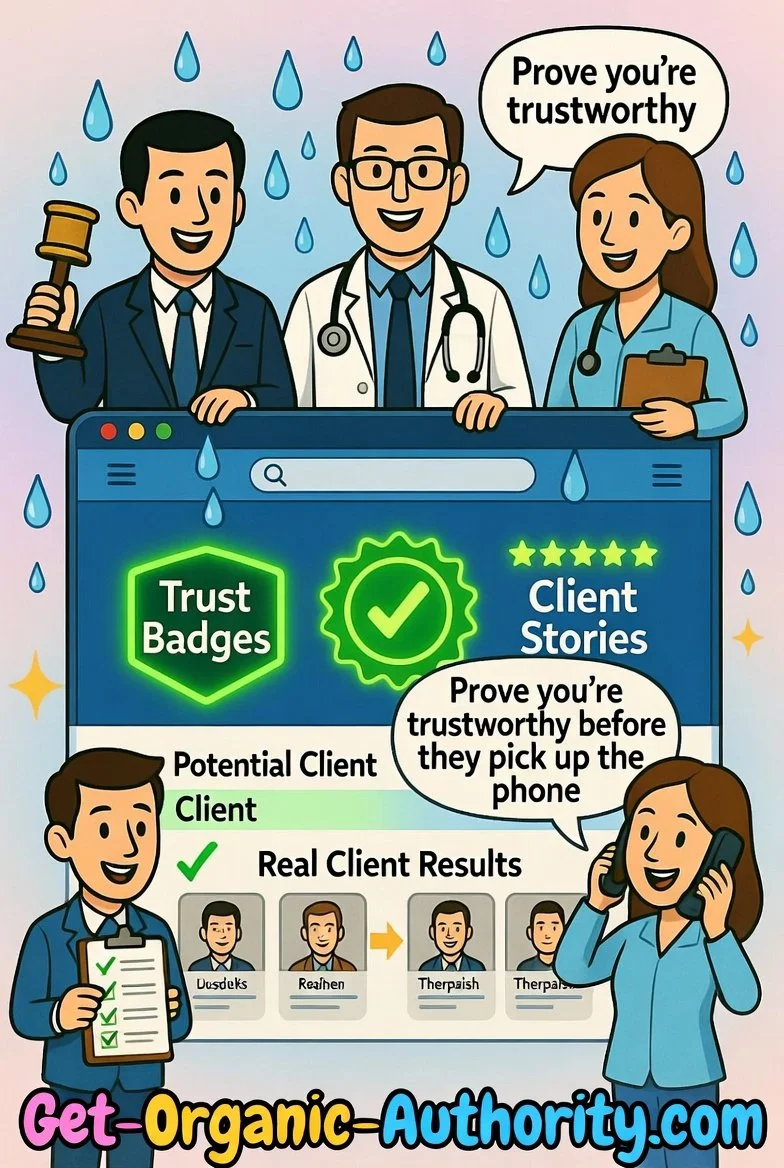
For Lawyers
A legal prospect may land on a blog post after searching “what happens after a workplace injury,” “do I need a lawyer for a denied claim,” “how long does divorce take,” or “can I sue after a car accident.” The pre-call trust check begins immediately.
They look for practice area specificity, attorney experience, local relevance, clear next steps, legal explanations that avoid panic, and proof that the firm handles their kind of case. Strong legal SEO content should move from educational pages to practice area pages to consultation paths. That is the logic behind How Law Firms Turn Google Traffic Into Consultations. Legal content should not just attract traffic. It should escort uncertainty toward action without sounding like a courthouse vending machine.
For Doctors and Medical Practices
A patient may search symptoms first, then treatment options, then reviews, then providers near them. They may compare practices before calling. They may check the doctor bio, insurance notes, appointment process, location, reviews, and condition-specific content.
This connects to How Doctors Get More Patients From Google Without Depending on Ads and Why Is That Other Doctor Ranked Ahead of Me?. Medical SEO has to build both visibility and credibility. A condition page that clearly explains symptoms, treatment options, when to seek care, and what the first visit looks like can reduce hesitation. A vague page that says “we provide quality healthcare solutions” should be escorted gently into retirement.
For Therapists and Private Practices
A therapy client may read your site in a fragile state. They may be embarrassed, anxious, skeptical, or burned out from bad experiences. They may need private-pay therapy but worry about cost. They may want trauma therapy but feel unsure what to say. They may search at midnight with language they would never say out loud.
That is why Why Is My Therapy Website Not Getting Clients?, Why Therapist SEO Takes a Painfully Long Time to Kick In, and the therapist-focused ecosystem pieces matter. Therapy SEO is slow because trust is slow. Google is looking for proof. So are humans. Your site has to show specialties, tone, approach, FAQs, local relevance, and a clear way to reach out when the person is ready.
The Pre-Call Trust Check Is Why Ads Alone Feel So Expensive
Paid ads can put you in front of people quickly. That can be useful. The problem starts when ads send expensive clicks to a website that fails the trust check. Then every click becomes a tiny financial scream.
Ads vs. Organic SEO explains the larger difference. Ads rent visibility. Organic authority builds a system. The pre-call trust check is where both strategies either succeed or embarrass themselves. A strong organic ecosystem makes ad traffic work better because the site has the service pages, proof, answers, internal links, and trust signals needed to convert attention into action.
This is also why a cheap website revamp often fails. A prettier website without a content strategy is just a shinier room with the same missing furniture. The visitor still needs specificity, proof, guidance, and trust. Design matters. Content decides.
How Get Organic Authority Builds for the Trust Check
The Get Organic Authority approach is built around the full decision path. A person finds you through Google, referrals, ads, local search, or a back-pocket search. Then your site has to help them trust you. That requires an ecosystem, not a lonely blog post hoping for a miracle.
The system includes pillar pages that anchor authority, supporting blogs that answer long-tail questions, service pages that convert high-intent searches, internal links that guide readers, About pages that humanize expertise, local SEO content that proves relevance, and CTAs that make the next step clear. This is why the High-Trust Website Content Map is such a useful companion resource. It shows what the whole site needs, not just what one page should say.
For a newer or smaller site, The Organic SEO Authority Blueprint gives the first serious pillar article and strategic map. For a business ready to build consistent authority, The Foundation creates ten long-form SEO articles each month, built into topic clusters, supported by internal links, and written in a human voice that builds trust before the first call.
That is dogfooding in plain English. Get Organic Authority uses its own content ecosystem to prove the system works. The site is not just talking about topic clusters, long-form SEO, internal linking, search intent, service pages, and organic authority. It is building them in public. A rare moment where marketing eats its own cooking and, shockingly, survives.
Build a Website That Passes the Trust Check
If your website gets traffic but people fail to call, the problem may not be visibility. It may be trust. It may be unclear service pages, thin content, weak internal links, stale blogs, vague About pages, missing local proof, or a content ecosystem that looks less like a system and more like a junk drawer with a domain name.
Your future clients, patients, and referrals are already checking. They are reading. Comparing. Clicking. Judging. Wondering. Deciding. The question is whether your website gives them enough reason to trust you before they reach out.
If you want to turn your expertise into a search system that builds visibility, authority, and real confidence before the first call, start with Get Organic Authority. Use The Organic SEO Authority Blueprint if you need the first strategic pillar. Choose The Foundation if you are ready for a monthly content ecosystem that compounds.
Traffic is nice. Trust is what makes the phone ring. Build the thing that earns both.
